
Ask ten security professionals what their job is and most will eventually land on the same three words. Confidentiality, integrity and availability are the objectives behind every firewall rule, backup schedule, access review and incident playbook. The model is old and simple, which is exactly why it is still useful: it gives you a common language for describing what could go wrong with information and what a control is actually for.
This article explains each property precisely, shows the controls that support it, works through the trade-offs between them, and covers how exams such as CISSP, CISM and CRISC test the idea.
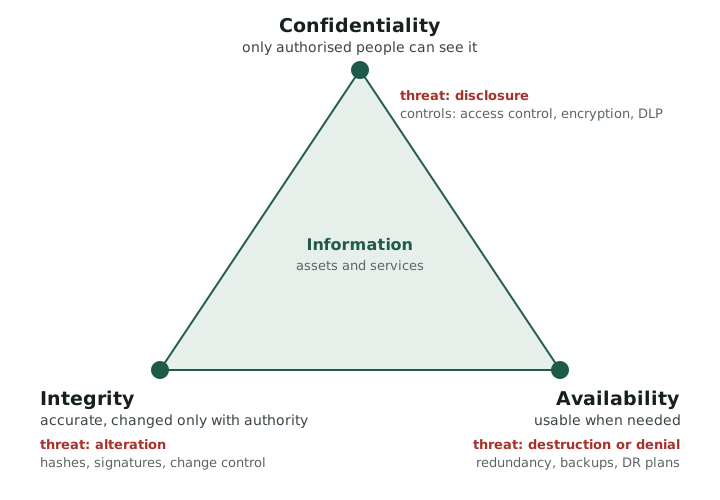
Confidentiality
Confidentiality means information is disclosed only to people, processes and devices that are authorised to see it. NIST's definition also covers personal privacy and proprietary information, which is a useful reminder that confidentiality is not only about secrets: a customer's address is confidential because the customer and the law say so, not because it is valuable to an attacker.
Confidentiality fails through disclosure. That can be deliberate (an attacker exfiltrating a database, an insider copying files to a personal drive) or accidental (a misconfigured storage bucket, an email sent to the wrong distribution list, a laptop left in a taxi).
Controls that protect confidentiality:
- Access control: authentication, authorisation and least privilege decide who can read what. See access control models for how those decisions are made.
- Encryption of data at rest and in transit, with the keys managed separately from the data. See cloud encryption key management.
- Classification and handling rules, so people know which information needs protection and how.
- Data loss prevention, masking and tokenisation, which reduce how much sensitive data is exposed in the first place.
- Physical controls such as clean-desk rules, screen filters and secure disposal.
Integrity
Integrity means information and systems are accurate, complete and changed only in authorised ways. It covers two things people often blur together: data integrity (the record says what it should) and system integrity (the system does what it should, without unauthorised modification).
Integrity fails through alteration: a fraudster changing a beneficiary account number, malware modifying a configuration file, a buggy batch job overwriting good data, or a well-meaning administrator "fixing" a record without a change ticket.
Controls that protect integrity:
- Hashing and checksums to detect that data has changed.
- Digital signatures and message authentication codes, which detect change and also tell you who made the data.
- Input validation and database constraints that stop bad data getting in.
- Change management and segregation of duties, so no single person can make and approve the same change.
- Logging and file integrity monitoring to detect unauthorised changes after the fact.
- Versioning and immutable backups, so you can prove what the data looked like before it changed and restore it.
Many frameworks treat authenticity (the data really comes from who it claims to) and non-repudiation (the sender cannot credibly deny sending it) as part of integrity, or as separate properties alongside the triad. In exam questions, digital signatures are the classic control for all three.
Availability
Availability means authorised users can get timely, reliable access to information and systems when they need them. A perfectly confidential, perfectly accurate system that nobody can reach has failed.
Availability fails through destruction or denial: ransomware encrypting servers, a distributed denial-of-service attack, a failed storage array, a data centre power outage, an expired TLS certificate, or a cloud region going down.
Controls that protect availability:
- Redundancy: clustering, load balancing, RAID, multiple availability zones or regions.
- Backups that are tested, kept offline or immutable, and restorable within the agreed recovery time. See the ransomware readiness checklist.
- Capacity planning and DDoS protection.
- Patching and maintenance windows that keep systems healthy without unplanned outages.
- Business continuity and disaster recovery plans with recovery time and recovery point objectives agreed with the business.
The properties trade off against each other
The triad is useful precisely because the three properties pull in different directions. Strengthening one often weakens another, and the right balance depends on what the business needs.
| Decision | Helps | Can hurt |
|---|---|---|
| Encrypt all backups | Confidentiality | Availability, if the keys are lost or the key service is down during recovery |
| Require hardware-token MFA for every login | Confidentiality, integrity | Availability, when tokens are lost or a remote worker cannot authenticate during an incident |
| Replicate data to three regions | Availability | Confidentiality (more copies to protect) and integrity (replication can spread corruption fast) |
| Lock accounts after three failed attempts | Confidentiality | Availability, because an attacker can lock out legitimate users on purpose |
| Strict change approval for every database fix | Integrity | Availability, if an urgent fix waits for a change board |
There is no universally correct answer. A hospital's patient-monitoring system puts availability and integrity first: a delayed or wrong reading can hurt someone. A payments platform cares intensely about integrity, because an altered amount or beneficiary is direct financial loss. A law firm's case files lean towards confidentiality. Good security design starts by asking which property matters most for this information and this business process, not by applying every control everywhere.
Measuring how much each property matters
To make that judgement repeatable, many organisations rate the impact of losing each property separately. The best-known scheme is the US federal standard FIPS 199, which rates the potential impact of a loss of confidentiality, integrity or availability as low, moderate or high, and then categorises the system by its highest rating.
A simplified example for a retail bank:
| Information or system | Confidentiality | Integrity | Availability |
|---|---|---|---|
| Public marketing website | Low | Moderate | Moderate |
| Customer KYC records | High | High | Moderate |
| Real-time payments platform | High | High | High |
| Internal staff canteen menu | Low | Low | Low |
The same approach sits behind data classification schemes and business impact analysis. Rating the three properties separately stops a common mistake: assuming that "sensitive" data needs only confidentiality controls when its real exposure is to tampering or downtime.
A worked example: a payment instruction
Follow one payment instruction through an online banking system and the triad becomes concrete.
- Confidentiality: the customer's session is protected with TLS, the account number is masked on screen, and only authorised operations staff can view the full record.
- Integrity: the instruction is signed by the banking app, the amount and beneficiary are validated against limits and the customer's registered payees, and the core banking system logs every change with the user who made it.
- Availability: the payments service runs across two data centres, with capacity planned for salary-day peaks and a tested failover.
Now imagine an attacker who takes over a customer's session. They might read the balance (a confidentiality failure), change the beneficiary (integrity), or flood the service so genuine customers cannot pay (availability). Each attack calls for different controls, and the triad tells you which question each control answers.
Beyond the triad
The CIA triad is a starting point, not the whole picture. You will meet several extensions:
- Authenticity and non-repudiation, often added as fourth and fifth properties, especially in cryptography and e-commerce.
- Accountability: the ability to trace actions to a specific identity, which depends on unique accounts and good logging.
- Privacy, which overlaps with confidentiality but adds purpose limitation, consent and individual rights. See India's DPDP Act in plain language.
- Safety and resilience, increasingly important for operational technology and AI systems, where a failure can cause physical harm.
- The Parkerian hexad, an alternative model that adds possession or control, authenticity and utility to the original three.
None of these replace the triad. They are refinements you reach for when the three properties are not precise enough to describe a risk.
How exams test the CIA triad
Certification exams rarely ask you to define the triad. They ask you to map a threat or a control to the property it affects. A few patterns appear again and again:
- Hashing provides integrity, not confidentiality. A hash shows that data changed; it does not hide the data.
- Encryption provides confidentiality. On its own it does not prove who sent the data or that it was not altered in transit; that needs a MAC, an authenticated encryption mode or a signature.
- Digital signatures provide integrity, authenticity and non-repudiation, but not confidentiality.
- DDoS attacks, ransomware and hardware failures are availability problems first, even when ransomware also steals data.
- Backups and RAID support availability. Backups also let you recover from integrity failures.
- The best answer considers the business. In management-level exams (CISM, CRISC and the CISSP's managerial questions) the correct choice is usually the one that protects the property the business needs most, not the strongest technical control.
Frequently asked questions
What are the three parts of the CIA triad?
Confidentiality (only authorised people can see information), integrity (information is accurate and changed only in authorised ways) and availability (authorised people can use information and systems when they need them).
Which part of the CIA triad is most important?
It depends on the information and the business process. Patient monitoring prioritises availability and integrity, payments prioritise integrity, and legal or HR records lean towards confidentiality. Rate each property separately before choosing controls.
Is non-repudiation part of the CIA triad?
Not in the original three, but many frameworks add it, together with authenticity, as an extension. It is usually grouped with integrity because the same controls, such as digital signatures, provide both.
What is the opposite of the CIA triad?
The DAD triad: disclosure (the loss of confidentiality), alteration (the loss of integrity) and destruction or denial (the loss of availability). It is a handy way to think about threats.
Does encryption protect integrity?
Encryption on its own is designed for confidentiality. Integrity needs a hash, a message authentication code, an authenticated encryption mode such as AES-GCM, or a digital signature.
Test yourself
10 CISSP practice questions from Domain 1, Security and Risk Management, each with an explanation of the best answer.
Sources and further reading
- NIST SP 800-12 Rev. 1, An Introduction to Information Security
- FIPS 199, Standards for Security Categorization of Federal Information and Information Systems
- NIST SP 800-53 Rev. 5, Security and Privacy Controls
- NIST CSRC glossary, confidentiality
- NIST CSRC glossary, integrity
- NIST CSRC glossary, availability
Written and reviewed by the DigiTrust Asia editorial team. How we research, review and correct articles.
Test yourself on the fundamentals
Free CISSP lessons and practice questions, with an explanation for every answer.
Create a free account