
Every time someone opens a file, approves a payment or calls an API, a system somewhere answers a simple question: is this subject allowed to do this to that object? An access control model is the logic behind the answer, and, just as important, it defines who is allowed to set the rules.
That second point is what really separates the models. In some, the owner of a file decides. In others, a central authority does, and nobody else can override it. Keep the question "who decides?" in mind and the differences become easy to remember.
The building blocks
All the models share a vocabulary:
- Subject: the active entity requesting access, such as a user, a service account or a process.
- Object: the passive resource being accessed, such as a file, database table, printer or API.
- Operation: what the subject wants to do: read, write, execute, delete, approve.
- Reference monitor: the concept of a component that checks every access against policy, cannot be bypassed and is small enough to verify. Operating system kernels, database engines and API gateways all implement it in some form.
Two principles apply whatever model you use. Least privilege gives each subject only the access its task needs, and need to know narrows that further to the specific information required. Separation of duties then makes sure no single person can complete a sensitive task alone.
Discretionary access control (DAC)
In DAC the owner of an object decides who else can access it. The owner is usually whoever created the object, and they can grant or revoke permissions at their own discretion.
- Where you meet it: file permissions on Windows (NTFS access control lists) and Unix-like systems, shared folders, document sharing in collaboration tools.
- How it is implemented: access control lists attached to objects, or capability lists attached to subjects.
- Strength: flexible and easy for users; people can share what they own without raising a ticket.
- Weakness: security depends on every owner making good decisions. DAC is also vulnerable to malware: a program running with a user's identity inherits that user's ability to read and share their files.
DAC is identity-based. If you hear "the data owner can grant access to whomever they choose", think DAC.
Mandatory access control (MAC)
In MAC the system enforces a central policy that owners cannot override. Every subject has a clearance and every object has a classification label (for example Confidential, Secret, Top Secret), often combined with compartments or categories that implement need to know.
- Where you meet it: military and government systems, and operating system hardening such as SELinux and AppArmor, which confine what processes can do regardless of file permissions.
- How it decides: the system compares the subject's clearance and compartments with the object's label. Access requires both a sufficient level and membership of every compartment on the object.
- Strength: strong, consistent protection of confidentiality, and resistance to users or malware leaking data by mistake.
- Weakness: rigid and expensive to administer. Every object needs a correct label, and changing policy is slow.
MAC is the practical home of the Bell-LaPadula confidentiality model: subjects cannot read objects above their clearance ("no read up") or write information down to a lower classification ("no write down"). The Biba model applies the mirror-image rules to protect integrity.
Role-based access control (RBAC)
In RBAC, permissions are assigned to roles, and users are assigned to roles. Users never receive permissions directly. When someone moves from accounts payable to treasury, you change their role membership and their access follows.
- Where you meet it: almost every enterprise application, Active Directory groups used as roles, cloud platforms' built-in roles, ERP and core banking authorisations.
- Strength: scales well, matches how organisations think about jobs, and makes access reviews manageable ("who has the Payments Approver role?").
- Weakness: role explosion. Organisations end up with thousands of narrowly defined roles, or with a few over-broad ones, and both defeat the purpose.
NIST's RBAC work, which became a US national standard, describes several levels: core RBAC, role hierarchies (a senior role inherits a junior role's permissions), and constraints for separation of duties. Static separation of duties stops one user holding conflicting roles at all (Payment Creator and Payment Approver). Dynamic separation lets a user hold both but not activate them in the same session or transaction.
Rule-based access control
Rule-based access control applies global rules that hold for every subject, regardless of who they are. The rules are written by an administrator and usually describe conditions rather than identities.
- Where you meet it: firewall and router rule sets, time-of-day restrictions ("no logins to the payments system between 23:00 and 06:00"), geo-blocking, email filtering rules.
- Strength: simple to reason about for network and perimeter controls.
- Weakness: coarse. Rules do not easily express "this person, for this record, for this reason".
Watch the acronym. "RBAC" almost always means role-based. Where an exam or document means rule-based, it normally spells it out, sometimes as RuBAC.
Attribute-based access control (ABAC)
ABAC decides access by evaluating attributes against a policy. NIST SP 800-162 describes four kinds of attribute:
- Subject attributes: department, clearance, employment type, training completed.
- Object attributes: classification, owner, data type, region where the data must stay.
- Operation: read, approve, export.
- Environment conditions: time, location, device health, threat level.
A single ABAC policy can express what would take many roles: "relationship managers may view customer records in their own branch, from a managed device, during business hours, unless the record is flagged for investigation."
In a typical architecture a policy enforcement point (an API gateway, application or proxy) intercepts the request and asks a policy decision point to evaluate it, using attributes from directories, HR systems and device management. XACML is the classic standard for expressing such policies; modern cloud IAM policies with conditions and policy engines such as Open Policy Agent follow the same idea.
- Strength: fine-grained, context-aware and well suited to zero trust, where every request is evaluated on current signals. See securing AI agents for why this matters for non-human identities too.
- Weakness: harder to design, test and audit. "Who can access this record?" becomes a question you answer by running the policy, not by reading a list, and the decision is only as good as the attribute data behind it.
Side-by-side comparison
| Model | Who decides | Basis of decision | Typical use | Main risk |
|---|---|---|---|---|
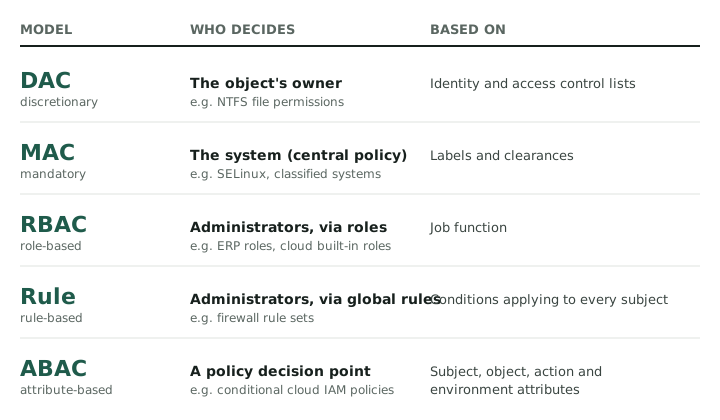
| DAC | The object's owner | User identity, ACLs | File shares, collaboration tools | Over-sharing; malware inherits user rights |
| MAC | The system, from central policy | Labels and clearances | Government, classified data, SELinux | Rigid and costly to administer |
| RBAC | Administrators, via roles | Job function | Enterprise apps, ERP, cloud roles | Role explosion and over-broad roles |
| Rule-based | Administrators, via global rules | Conditions applying to all subjects | Firewalls, time and location limits | Too coarse for business data |
| ABAC | A policy engine | Subject, object, action and environment attributes | Zero trust, cloud IAM, fine-grained data access | Complex policies; poor attribute data |
DAC is described as discretionary because owners decide. MAC, RBAC and rule-based models are often grouped as non-discretionary, because a central authority sets the rules and individual users cannot change them. Classification schemes differ between textbooks, so read exam questions carefully rather than relying on one taxonomy.
Choosing a model in practice
Real environments mix models. A typical organisation uses:
- RBAC as the backbone for business applications, because it maps to jobs and supports access reviews and joiner-mover-leaver processes.
- ABAC conditions on top for sensitive or regulated data: device posture, location, data residency, step-up authentication.
- Rule-based controls at the network edge and for time or location limits.
- DAC where users genuinely own content, such as team documents, with guardrails like expiring links and labels that block external sharing.
- MAC-style enforcement in hardened operating systems and wherever data carries formal classification labels.
Whatever the mix, the controls that make access control work are the same: a reliable identity source, least privilege by default, separation of duties for sensitive transactions, periodic access reviews by the people who own the data, and logs good enough to show who did what. Common cloud identity mistakes shows what happens when those basics slip.
How exams test access control models
- "The owner decides" means DAC. "Labels and clearances" means MAC. "Job function" or "frequent staff turnover" points to RBAC. "Context such as time, location and device" points to ABAC.
- MAC is the most restrictive and the best fit when confidentiality of classified information is paramount.
- RBAC is usually the best answer for large organisations with many users changing jobs, because it simplifies administration.
- ABAC is the most flexible and fine-grained, and the model most associated with zero trust.
- Separation of duties is enforced in RBAC through constraints on conflicting roles.
- Bell-LaPadula protects confidentiality; Biba protects integrity. Mixing them up is one of the most common mistakes on the CISSP.
Frequently asked questions
What is the difference between DAC and MAC?
In discretionary access control the owner of a resource decides who can access it. In mandatory access control a central policy based on labels and clearances decides, and owners cannot override it.
Is RBAC discretionary or non-discretionary?
Role-based access control is usually classed as non-discretionary, because administrators assign permissions to roles centrally and individual users cannot grant their own access to others.
What is the difference between RBAC and ABAC?
RBAC grants permissions through roles that reflect job functions. ABAC evaluates attributes of the user, the resource, the action and the environment against a policy, so it can express conditions such as device health, location or data classification that roles alone cannot.
Which access control model is the most secure?
Mandatory access control offers the strongest, most consistent protection of confidentiality, but it is rigid. Most organisations get better overall security from well-maintained RBAC with ABAC conditions for sensitive data.
Where is rule-based access control used?
Mostly in network and perimeter controls such as firewalls, and for global conditions like time-of-day or location restrictions that apply to every user.
Test yourself
10 CISSP practice questions from Domain 5, Identity and Access Management, each with an explanation of the best answer.
Sources and further reading
Written and reviewed by the DigiTrust Asia editorial team. How we research, review and correct articles.
Test yourself on the fundamentals
Free CISSP lessons and practice questions, with an explanation for every answer.
Create a free account