
Security is never finished. Threats change, the business changes, and controls that worked last year drift out of shape. The Plan-Do-Check-Act cycle is the simplest widely used model for dealing with that: make a deliberate change, see whether it worked, and adjust. It sits underneath ISO 27001, ISO 22301, ISO 42001 and most other management system standards, which is why anyone working in governance, risk or audit meets it sooner or later.
Where PDCA comes from
The idea grew out of quality management. Walter Shewhart described a cycle of specification, production and inspection in the 1930s, and W. Edwards Deming taught a version of it in Japan after the Second World War, where it became widely known as Plan-Do-Check-Act. Deming himself later preferred Plan-Do-Study-Act (PDSA), arguing that "check" suggests inspection, while the point is to study results and learn. Both names describe the same loop.
The four steps in security terms
Plan. Understand the context and decide what you are trying to achieve. In security that means identifying the information and processes in scope, assessing risk, setting objectives and choosing controls. A good plan includes how you will measure success before anything is built.
Do. Implement the plan: deploy the controls, write and communicate the procedures, train people, and run the process. "Do" also means operating the control day to day, not just installing it.
Check. Measure and evaluate. Monitor metrics, review logs, run internal audits and control tests, and compare results with the objectives set in Plan. The question is not "did we do it?" but "did it work?"
Act. Respond to what Check found. Fix nonconformities, address root causes, update the plan and feed lessons into the next cycle. Act is where improvement actually happens; without it, PDCA is just a reporting routine.
How PDCA maps onto ISO 27001
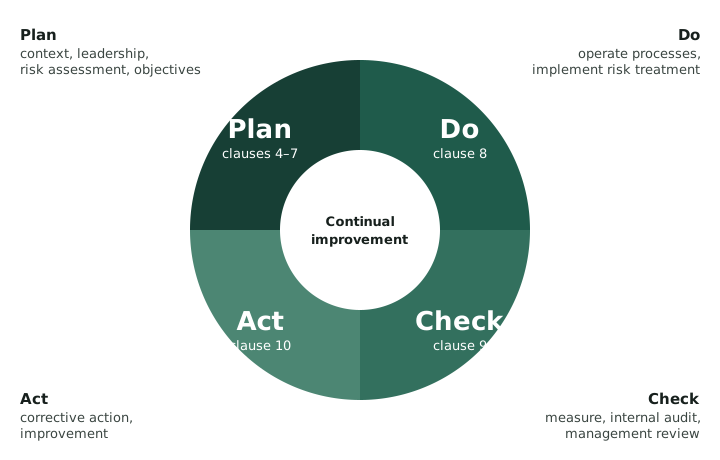
The 2005 edition of ISO 27001 described PDCA explicitly. Since the early 2010s, ISO management system standards have followed a common structure (first called the high-level structure, now the harmonised structure), and the 2022 edition no longer names PDCA, but its clauses still follow the same loop:
| PDCA step | ISO/IEC 27001:2022 clauses | What happens |
|---|---|---|
| Plan | 4 Context of the organisation, 5 Leadership, 6 Planning, 7 Support | Scope, interested parties, policy, roles, risk assessment and treatment plan, objectives, resources, competence |
| Do | 8 Operation | Operating the processes, carrying out risk assessments and the risk treatment plan |
| Check | 9 Performance evaluation | Monitoring and measurement, internal audit, management review |
| Act | 10 Improvement | Continual improvement, nonconformity and corrective action |
Two details trip people up. Management review sits in Check (clause 9.3), although its outputs, such as decisions on changes and resources, drive Act. And corrective action is Act (clause 10.2): it means removing the cause of a problem so it does not recur, not just fixing the symptom.
The same mapping works for ISO 22301 (business continuity) and ISO/IEC 42001 (AI management systems), which is one reason organisations can run an integrated management system across several standards. For the Annex A controls themselves, see ISO 27001:2022 controls explained.
A worked example: cutting phishing-related incidents
Here is an illustrative improvement taken round the loop twice. The numbers are examples, but the pattern is common.
Cycle 1
- Plan: phishing caused most account compromises last year. Objective: reduce successful phishing compromises by half within two quarters. Measures: report rate and click rate in simulations, and confirmed compromises. Controls chosen: quarterly simulations, a one-click "report phishing" button, and short training for people who click.
- Do: roll out the report button, run the first simulation, assign training.
- Check: the click rate fell from 14% to 9%, but confirmed compromises barely moved. Analysis showed most compromises came from MFA fatigue (attackers bombarding users with push requests), not from clicking links.
- Act: the original objective was right but the control mix was wrong. Feed the finding into the next plan.
Cycle 2
- Plan: add number-matching MFA, block legacy authentication, and alert the security operations team on repeated push denials.
- Do: deploy the changes in stages, starting with privileged users.
- Check: confirmed compromises fell by more than half over the next quarter; help desk calls rose briefly and then settled.
- Act: make number matching the standard, update the access control policy, and set the next review date.
Without the Check step, cycle 1 would have been reported as a success because the click rate fell. That is the value of PDCA: it forces you to test whether a control changes the outcome you care about.
PDCA compared with other cycles
- OODA (Observe, Orient, Decide, Act) comes from military strategy and is about deciding faster than an adversary. It suits incident response and threat hunting, where the cycle is minutes or hours. PDCA suits programme management, where the cycle is weeks or months.
- DMAIC (Define, Measure, Analyse, Improve, Control) from Six Sigma is a more data-heavy improvement method. Its Control step is close to PDCA's Act-then-sustain.
- The NIST Cybersecurity Framework 2.0 functions (Govern, Identify, Protect, Detect, Respond, Recover) describe what a security programme does, not a sequence. You can use PDCA to improve how well you perform each function.
- The incident response lifecycle ends with lessons learned, which is a small PDCA loop of its own: what happened, what we will change, and how we will check it worked. See the tabletop exercise guide.
Common mistakes
- Treating Check as the annual audit. Audits are one input. Check should run continuously through metrics and monitoring.
- Skipping Act. Findings are recorded, reported and closed without anything changing. Ask of every finding: what will be different next cycle?
- Measuring activity instead of outcomes. "Training completed by 95% of staff" is activity. "Fewer successful phishing compromises" is an outcome. Useful key risk indicators track the outcome.
- Cycles that are too long. An annual cycle for a fast-changing control means you learn once a year. Match the cycle length to how quickly the risk changes.
- Planning without a baseline. If you do not measure where you started, Check cannot tell you whether anything improved.
How exams test PDCA
- ISO 27001 lead implementer and lead auditor exams ask which clause or activity belongs to which step. Risk treatment planning is Plan, implementing the treatment is Do, internal audit and management review are Check, and corrective action is Act.
- CISM frames PDCA as continual improvement of the information security programme. The best answer usually uses metrics to show whether the programme meets business objectives, then adjusts.
- CRISC uses the same logic for risk monitoring: key risk and control indicators feed decisions about whether risk responses still work.
- CISSP expects you to recognise PDCA as the improvement loop behind security governance and management systems.
Frequently asked questions
What does PDCA stand for?
Plan, Do, Check, Act: plan a change, carry it out, check whether it achieved what you intended, and act on the results so the next cycle is better.
Does ISO 27001:2022 still use PDCA?
The standard no longer names it, but its clause structure follows the cycle: clauses 4 to 7 plan, clause 8 operates, clause 9 evaluates performance and clause 10 drives improvement.
Which PDCA step does management review belong to?
Check. Management review is part of performance evaluation (clause 9.3 of ISO 27001), and its decisions feed the Act step.
What is the difference between PDCA and PDSA?
They describe the same loop. Deming later preferred "Study" to "Check" to stress learning from results rather than simply inspecting them.
How often should a security PDCA cycle run?
As often as the risk changes. Annual cycles suit the management system as a whole, but fast-moving controls such as vulnerability management or phishing defence need monthly or quarterly checks.
Test yourself
10 CISM practice questions from Domain 3, Information Security Program, each with an explanation of the best answer.
Sources and further reading
Written and reviewed by the DigiTrust Asia editorial team. How we research, review and correct articles.
Test yourself on the fundamentals
Free CISSP lessons and practice questions, with an explanation for every answer.
Create a free account