
5.2 Sharing findings: threat statements, reports and audiences
In this lesson you will:
- Write clear, specific threat statements using a five-part template.
- Structure a threat model report and threat register that others can act on.
- Tailor findings for developers, product owners, executives and auditors.
- Communicate risk in business terms, without fear, jargon or blame.
- Handle sensitive findings, such as unfixed critical flaws, appropriately.
Opening case: two reports, one finding
After the partner API session, two people write up the most serious threat.
The first writes: "OAuth implementation insecure — refresh token revocation (STRIDE: S/E). Critical."
The second writes: "A vendor whose access a merchant has revoked can keep reading that merchant's transactions for up to 90 days, because revoking access deletes the access token but not the refresh token. About 1,200 merchants have revoked a vendor in the last year. This breaches the consent commitment in our partner terms and the DPDP Act's requirement to stop processing when consent is withdrawn."
The engineering manager fixed the second one in a week. The first sat in the backlog for a month because nobody was sure what it meant. By the end of this section you will be able to write the second kind every time.
Writing a threat statement
A threat statement should let someone who was not in the room understand who could do what, how, and why it matters. A useful template has five parts [1].
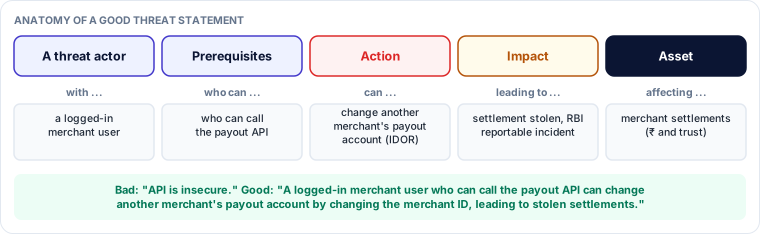
[Threat actor] with [prerequisites] can [action], leading to [impact], affecting [asset].
- Threat actor: who? An anonymous internet user, a logged-in merchant, a partner vendor, an operations analyst, someone who can submit a support ticket.
- Prerequisites: what they need: a valid account, network access, a stolen token, the ability to send an email to an inbox the agent reads.
- Action: what they do, specifically enough to test: "change the merchant ID in the payout request", "plant instructions in a support ticket".
- Impact: the consequence in business terms: money lost, data exposed, regulatory breach, outage, customers misled.
- Asset: what is harmed: merchant settlements, customer personal data, the payment API's availability.
Add, as separate fields: the weakness that enables it (the vulnerability), the STRIDE category, the location on the diagram, and existing controls.
Before and after
| Weak statement | Strong statement |
|---|---|
| "SQL injection risk" | "An anonymous user can inject SQL through the search parameter of the public payment-link page, because the query is built by string concatenation, leading to disclosure of all merchants' customer phone numbers from the transactions database." |
| "DoS" | "A single merchant account or bot can create payment links without limit, exhausting the payments service and the bank's API quota during festival sales and making payments unavailable to all merchants." |
| "Prompt injection in Kira" | "Anyone who can submit a support ticket can plant hidden instructions that Kira retrieves and follows when answering other merchants, leading to phishing links shown inside Kestrel's portal and possible data exfiltration through rendered images." |
| "Agent too powerful" | "Anyone who can email the disputes inbox can embed instructions that the Disputes agent follows, using its unrestricted refund tool and service account to refund arbitrary transactions to attacker-controlled accounts." |
Strong statements are longer, but they are faster to act on, harder to dismiss, and easier to test.
The threat model report
A threat model is shared as a report or, increasingly, as a living page in a wiki or tool. Either way, the same six parts make it usable.
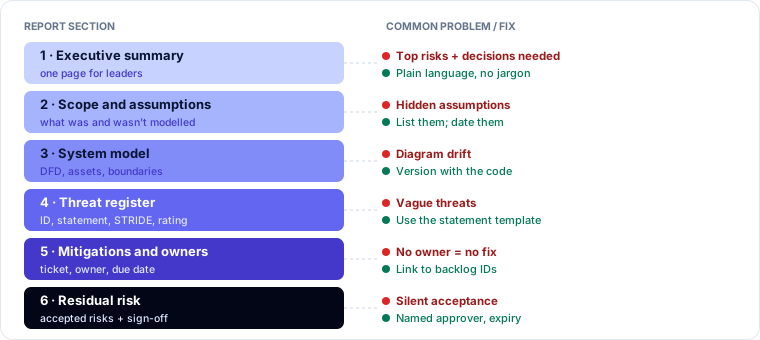
1. Executive summary (one page). What was modelled, the three to five most important risks in plain language, the decisions needed and by whom, and the overall position ("two red risks must be fixed before launch; one needs a decision from the Head of Payments").
2. Scope and assumptions. What was and was not in scope, the date and version of the system modelled, the participants, the method used, and every assumption with its status (confirmed, unconfirmed, false).
3. System model. The DFD (Level 1, and Level 2 where used), the assets, the entry points, and for AI systems the lifecycle elements, untrusted-content entry points and tool and permission table.
4. Threat register. The full list of threats in a table: ID, statement, STRIDE (and OWASP or ATLAS mapping for AI), location, existing controls, likelihood, impact, rating, response (mitigate, eliminate, transfer, accept), owner, ticket ID, status.
5. Mitigations and owners. For red and amber threats, the agreed controls, owners, due dates and how each will be verified.
6. Residual risk and acceptance. Every threat that will not be fully mitigated before release, with the reason, any compensating controls, the named person accepting it, and an expiry date for the acceptance.
Practitioner tip. Version the report with the system. A threat model that does not say which version of the system it describes cannot be trusted six months later.
Tailoring for the audience
The same threat model serves different people, who need different things from it.
| Audience | What they need | How to present it |
|---|---|---|
| Developers and testers | Exactly what to build and test | Tickets with the threat statement, acceptance criteria and test cases; link to the DFD |
| Product owner | What matters most and what it costs to fix | Ranked list of red and amber threats with effort estimates and options |
| Executives and board | Business exposure and decisions | One page: top risks in business terms (money, customers, regulator, reputation), trend, decisions needed |
| Risk, compliance and audit | Evidence that risks were identified and managed | Full report with scope, method, register, acceptance records and traceability to tests |
| Partners and customers | Assurance, without exposing exploitable detail | Summary of the method and control themes; detailed findings only under NDA where justified |
Translating for executives
Executives do not need STRIDE categories. They need to know what could happen to the business, how likely it is, and what decision is being asked of them.
Technical: "T2: IDOR on /merchant/payout-account (CWE-639), STRIDE T/E, rated 9."
Executive: "Any merchant's settlement could currently be redirected by another logged-in merchant. This is easy to find and exploit. A single incident would mean direct losses, a report to CERT-In within six hours and notification to our sponsor bank. The fix takes the team about two days. Decision needed: none; it is scheduled for this sprint."
Communicating risk well
Be specific about likelihood and impact. "This could be catastrophic" invites either panic or dismissal. "Easy to exploit by any merchant; would expose payout details of all 40,000 merchants" invites a decision.
Credit what is already working. Listing existing controls in the register shows the team that their work is recognised, and makes it easier to accept the remaining gaps.
Avoid blame. Threats are properties of a design, often the result of reasonable decisions under time pressure. "The design trusts the merchant ID in the request" is better than "the developers forgot authorisation".
Offer options, not only problems. For each red threat, give at least one practical response and its rough cost. Where there is a cheaper partial control, say so.
Do not cry wolf. If everything is critical, nothing is. Use the rating scale honestly, and accept that some threats are green.
Handling sensitive findings
Threat models describe how to attack your systems. Treat them accordingly.
- Classify threat models (for example "Internal — restricted") and store them where access is controlled, not in a public wiki.
- For a critical, unfixed flaw that is easy to exploit, share details on a need-to-know basis until it is fixed, and consider whether it needs to be handled as a security incident (for example, checking logs for past exploitation).
- When sharing with customers, partners or auditors, share the method and control themes; share specific unfixed threats only under appropriate agreements.
- If a threat model finding reveals that something has already been exploited, it is an incident. Follow incident response procedures, including regulatory reporting timelines.
The opening case, resolved
The second write-up worked because it followed the template: an actor (a vendor whose access was revoked), a prerequisite (an earlier refresh token), an action (keep reading transactions), an impact in business and legal terms (breach of partner terms and the DPDP Act consent requirement, about 1,200 merchants), and the weakness (revocation deletes only the access token). The engineering manager could see the size of the problem, the fix and the reason for urgency. Kestrel now requires every red and amber threat to use the template before it enters the backlog.
Check your understanding
1. Rewrite "Admin console — EoP risk" as a threat statement using the five-part template.
Answer (one possibility): "Any operations analyst (actor) with access to the admin console (prerequisite) can change any merchant's payout account without a second approval (action), leading to redirected settlements and possible insider fraud (impact), affecting merchant settlement funds (asset)."
2. What should an executive summary of a threat model contain?
Answer: What was modelled; the three to five most important risks in business terms; the decisions needed and who must make them; and the overall position (for example, what must be fixed before launch).
3. A customer's security team asks for your full threat model of the payment API, including open findings. What should you share?
Answer: A summary of the method, scope and control themes, with evidence of the process. Share specific open findings only where justified, under an NDA, and never exploitable detail of unfixed critical flaws.
Key takeaways
- Write threats as: actor, prerequisites, action, impact, asset; record weakness, STRIDE, location and existing controls separately.
- A usable report has six parts: executive summary, scope and assumptions, system model, threat register, mitigations and owners, residual risk and acceptance.
- Tailor the same findings for developers (tickets and tests), product owners (ranked options), executives (business exposure and decisions) and auditors (evidence).
- Be specific, credit existing controls, avoid blame, offer options and rate honestly.
- Threat models are sensitive; control access, and treat evidence of past exploitation as an incident.