
2.3 Other methodologies: PASTA, LINDDUN, attack trees and more
In this lesson you will:
- Describe the seven stages of PASTA and say when its business-risk focus is worth the extra effort.
- Use LINDDUN to find privacy threats that STRIDE does not prompt for.
- Build and read an attack tree, and use it to find the cheapest attack path.
- Recognise OCTAVE, Trike, VAST, the hybrid threat modelling method and kill-chain approaches.
- Choose a method, or a combination, for a given system, team and question.
Opening case: the regulator's question
Kestrel is preparing for an inspection of its payment-aggregator operations. The inspection team will want to see how the company identifies and manages risks to customer funds and data.
The security lead shows the STRIDE threat register. A compliance colleague asks three questions it does not answer: "Which of these risks matter most to the business objectives the board approved? What about the merchants' personal data, which the DPDP Act cares about even when nobody attacks us? And for the one thing that would end the company, a large theft of settlement funds, have we looked at every path an attacker could take?"
By the end of this section you will be able to pick a method that answers each question, and explain why STRIDE alone was not designed to.
Methods answer different questions
STRIDE is software-centric: it starts from the design and asks what could go wrong with each part. Other methods start somewhere else:
- Risk-centric methods start from business objectives and ask which threats matter most to them (PASTA).
- Privacy-centric methods ask how personal data could be misused, even by the system working as designed (LINDDUN).
- Attacker- or goal-centric methods start from what an attacker wants and work backwards (attack trees, kill chains).
- Asset- or organisation-centric methods start from the organisation's critical assets (OCTAVE).
None is best in all situations. Most mature teams use STRIDE as the default and reach for others when the question demands it.
PASTA: risk-centric threat modelling
PASTA (Process for Attack Simulation and Threat Analysis) was published by Tony UcedaVélez and Marco Morana in 2015 [8]. It is a seven-stage process that links technical threats to business impact.
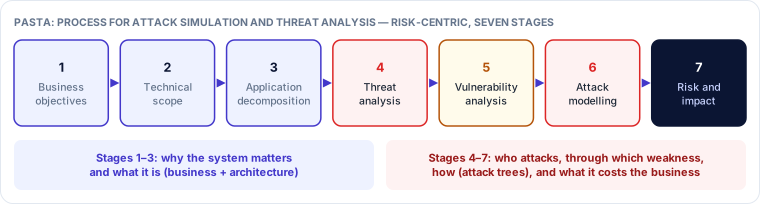
- Define business objectives. What the application must achieve, the regulatory requirements, the risk appetite. For Kestrel's settlement platform: pay 40,000 merchants accurately by 09:00 daily; comply with RBI payment-aggregator guidelines; zero tolerance for misdirected funds.
- Define the technical scope. Components, infrastructure, dependencies and third parties.
- Decompose the application. Data flow diagrams, trust boundaries, actors, assets (Module 1 skills).
- Analyse threats. Use threat intelligence: who actually attacks payment companies in India, and how? (Account takeover, insider fraud, mule accounts, SIM swap.)
- Analyse vulnerabilities and weaknesses. Map known weaknesses (from scans, pen tests, CWE) to the threats.
- Model attacks. Build attack trees and simulate attack paths through the decomposed application.
- Analyse risk and impact. Quantify business impact, identify residual risk and recommend countermeasures in business terms.
Strengths. PASTA produces results a board or regulator can relate to, because it starts and ends with business impact. It deliberately uses threat intelligence and existing vulnerability data rather than imagination alone.
Weaknesses. It is heavy: a full PASTA exercise can take days and involve business, architecture, threat intelligence and testing roles. It is too much for every user story.
Practitioner tip. Use PASTA for the few systems where a business-risk view is essential (a payments core, a trading platform, a hospital's clinical systems), and STRIDE for the rest. PASTA's Stage 3 can simply reuse your STRIDE diagram.
LINDDUN: privacy threat modelling
Security and privacy overlap but are not the same. A system can be perfectly secure and still harm privacy: it collects more data than needed, links records across contexts, or keeps data forever. LINDDUN, developed at KU Leuven, is the leading privacy threat modelling method [9]. Like STRIDE, it is applied to a DFD.
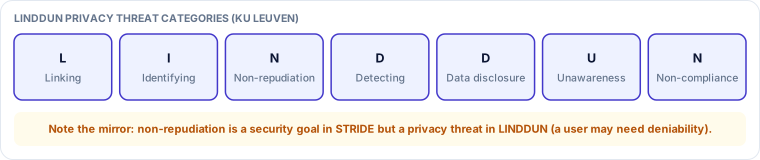
| Category | Threat | Kestrel example |
|---|---|---|
| Linking | Data items can be linked to learn more about a person | Payment links reveal which customers buy from which merchants; combined, they profile customers' habits |
| Identifying | A person can be identified from data that should not identify them | "Anonymised" analytics include pincode, merchant category and timestamp, enough to re-identify a customer |
| Non-repudiation | A person cannot deny an action when they should be able to | A "donations" merchant's records permanently prove which customers gave to a sensitive cause |
| Detecting | Someone can infer that data about a person exists | The API returns "account exists" for a phone number, revealing who is a Kestrel customer |
| Data disclosure | Personal data is disclosed beyond what is needed | Full customer phone numbers shown to merchants when the last four digits would do |
| Unawareness and unintervenability | People do not know or cannot control what happens to their data | Customers are not told payment data is used for credit scoring, and cannot object |
| Non-compliance | Processing does not follow law, policy or consent | KYC documents kept long after the retention period required by law |
Two points are worth noting. First, non-repudiation is a security goal in STRIDE but a privacy threat in LINDDUN: what helps an investigator can harm a person who should be able to act privately. Good designs reconcile the two, for example by keeping strong audit trails for staff actions and minimising what is recorded about customers. Second, unawareness and non-compliance connect directly to India's Digital Personal Data Protection Act, 2023 and its Rules: notice, consent, purpose limitation and the rights of data principals.
LINDDUN offers a lighter "GO" version with threat cards and a more thorough "PRO" version, and maps privacy threats to privacy-enhancing technologies and design patterns.
Attack trees
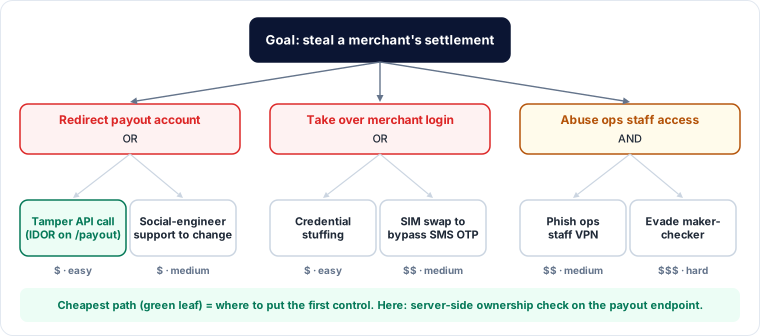
An attack tree, popularised by Bruce Schneier in 1999, represents the ways an attacker could reach one goal [10]. The goal is the root; its children are ways to achieve it; leaves are concrete attack steps.
- OR nodes: any one child is enough.
- AND nodes: all children are needed.
- Leaves can be annotated with cost, skill, time, detectability or probability, so you can find the cheapest or most likely path.
Worked example: reading the tree
The root goal in Figure 2.7 is steal a merchant's settlement. There are three ways (an OR):
- Redirect the payout account, either by tampering with the API call (the IDOR from T2, cheap and easy) or by social-engineering support into changing it.
- Take over the merchant's login, by credential stuffing or a SIM swap to bypass SMS OTP.
- Abuse operations staff access, which needs both phishing an analyst's VPN session and evading maker-checker controls (an AND node, so it is harder: the attacker must succeed at both).
Reading the annotations, the cheapest path is the IDOR. That tells the team where the first control must go. It also shows that adding maker-checker (T6's control) is valuable because it turns a single-step insider path into an AND node.
Strengths. Attack trees are excellent for deep analysis of one critical goal, for explaining risk to non-specialists, and for showing why a control matters (it cuts a branch or turns an OR into an AND).
Weaknesses. One tree covers one goal, trees grow quickly, and they do not by themselves ensure you have covered the whole system. Use them alongside STRIDE, not instead of it.
Other methods you will meet
OCTAVE (Operationally Critical Threat, Asset and Vulnerability Evaluation), from Carnegie Mellon's CERT, is an organisation-level risk assessment approach: identify critical assets, threats to them and organisational vulnerabilities. Variants include OCTAVE-S for small organisations and OCTAVE Allegro. It suits enterprise risk work more than an individual application's design [11].
Trike is a risk-based method built around a requirements model (who may perform which create, read, update and delete actions on which assets) and an implementation model. Threats are derived as violations of the allowed actions. It is rigorous but tool-dependent and less used today.
VAST (Visual, Agile and Simple Threat modelling) is associated with the ThreatModeler tool. It distinguishes application threat models (process-flow diagrams for development teams) from operational threat models (infrastructure views for operations), and is designed to scale across many teams with automation.
hTMM (the Hybrid Threat Modeling Method), from the Software Engineering Institute, combines Security Cards brainstorming, persona non grata (attacker personas) and STRIDE.
Persona non grata describes realistic attacker personas (a fraud ring, a disgruntled analyst, a hacktivist) with goals, skills and resources, and asks how each would attack the system. It is a good way to bring threat intelligence and motivation into a session.
Kill chains and ATT&CK. The Lockheed Martin Cyber Kill Chain and MITRE ATT&CK describe the stages of a real intrusion, from reconnaissance and initial access to impact. Walking an attack scenario through these stages tests whether your design has controls at more than one stage (defence in depth) and where you would detect the attacker.
Card games. Elevation of Privilege (Microsoft) turns STRIDE into a card game where each card is a specific threat prompt ("An attacker can bypass authentication because…"). Similar decks exist for privacy (LINDDUN GO), cloud and AI. Games are a very effective way to teach threat modelling and to get quieter team members contributing.
Choosing a method
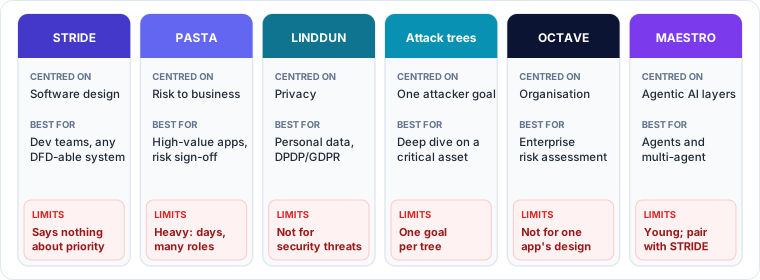
Ask three questions:
- What question are we answering? "What could go wrong with this design?" → STRIDE. "Which risks matter most to the business?" → PASTA. "How could this harm people's privacy?" → LINDDUN. "How could an attacker reach this one critical goal?" → attack tree. "What are the organisation's biggest risks?" → OCTAVE or enterprise risk assessment. "What could go wrong with this AI agent?" → STRIDE plus AI threat libraries, or MAESTRO (Module 4).
- Who is in the room, and for how long? Developers in a 60-minute session will manage STRIDE well and PASTA badly.
- What will the output be used for? A developer backlog, a regulator, a privacy impact assessment and a board paper need different outputs.
Methods combine well. A common pattern for an important system:
- STRIDE-per-interaction on the Level-1 DFD as the backbone.
- LINDDUN over the same DFD for any flow carrying personal data (this output also feeds a data protection impact assessment).
- One or two attack trees for the most critical goals.
- PASTA-style business impact language in the summary for leadership.
- AI threat libraries for any AI components.
The opening case, resolved
Each of the compliance colleague's questions maps to a method:
- "Which risks matter most to business objectives?" PASTA Stages 1 and 7. Kestrel added a business-objective section and business-impact statements to the top ten threats.
- "What about personal data?" LINDDUN. A one-hour LINDDUN session over the existing DFD found six privacy threats, including full phone numbers shown to merchants and KYC documents kept past their retention period, and fed the company's DPIA.
- "Every path to a large theft?" An attack tree for "steal settlement funds". It confirmed the IDOR and the settlement-file tampering as the cheapest paths, and showed that maker-checker plus file signing turned the insider paths into AND nodes.
STRIDE was not wrong; it was answering a different question.
Check your understanding
1. A hospital wants to understand how a new patient app could harm patients' privacy even if it is never hacked. Which method fits best?
Answer: LINDDUN. It covers privacy harms such as linking, identifying, unawareness and non-compliance that occur through normal operation, which STRIDE does not prompt for.
2. In an attack tree, a goal has two children joined by AND: "obtain an admin password" (cost: low) and "obtain the admin's hardware key" (cost: high). What is the cost of the goal, and what does this tell you about the hardware key?
Answer: Both are needed, so the cost is at least the sum and dominated by the hardware key. The hardware key is doing most of the protective work: removing it would turn the expensive path into a cheap one.
3. Why is PASTA a poor choice for a 10-minute story-level check in a sprint?
Answer: PASTA's seven stages involve business objectives, threat intelligence, vulnerability analysis and attack simulation across several roles. A story-level check needs a quick STRIDE pass over what changed.
Key takeaways
- Different methods answer different questions: software-centric (STRIDE), risk-centric (PASTA), privacy-centric (LINDDUN), goal-centric (attack trees), organisation-centric (OCTAVE).
- PASTA's seven stages link threats to business objectives and impact; it is powerful but heavy.
- LINDDUN finds privacy threats: linking, identifying, non-repudiation, detecting, data disclosure, unawareness, non-compliance.
- Attack trees analyse one goal with OR and AND nodes; annotate leaves to find the cheapest path and show what a control cuts.
- Combine methods: STRIDE as the backbone, others where the question demands it.