
2.2 STRIDE in practice: a full worked model and risk rating
In this lesson you will:
- Run STRIDE across a whole Level-1 data flow diagram and produce a threat register.
- Map each threat to a standard mitigation pattern for its category.
- Rate threats by likelihood and impact and place them on a risk matrix.
- Explain why DREAD fell out of favour and when CVSS is, and is not, the right tool.
- Use threat libraries such as CAPEC and ATT&CK to check you have not missed anything.
Opening case: forty threats and no decisions
Kestrel's first full threat modelling session on the payments platform runs for three hours. The team is enthusiastic and produces forty-one threats on sticky notes. Two weeks later, none has been fixed.
The product owner explains why: "I couldn't tell which ones mattered. Some were 'someone could DDoS us', some were 'the settlement file can be edited by anyone in ops'. They all looked equally scary."
By the end of this section you will be able to turn a STRIDE session into a short, ranked register that a product owner can act on.
The worked model
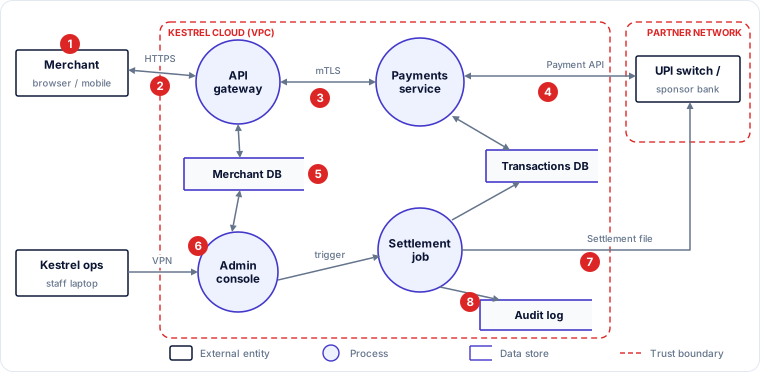
We will analyse the Kestrel Level-1 DFD from Section 1.2. Figure 2.3 shows the same diagram with eight numbered threats placed where they occur. In a real session you would find more; these eight were chosen to cover all six STRIDE categories and every boundary crossing.
Walking the diagram
A facilitator would walk the diagram from the outside in, starting at each boundary crossing.
Merchant → API gateway (crossing the internet boundary). External entity "Merchant": S and R apply. The team asks how a merchant is authenticated. Answer: password and optional SMS OTP. Threat T1 (spoofing): attackers use passwords leaked elsewhere to log in as merchants. Process "API gateway": all six apply. The team asks how the gateway decides whether a user may act on a merchant ID. Answer: it doesn't; it forwards to the payments service, which trusts the merchant ID in the body. Threat T2 (tampering leading to elevation of privilege): IDOR on the payout account and refund endpoints.
API gateway → Payments service (inside the VPC). The team asks what happens at peak. Answer: no per-merchant rate limits; the payment-link endpoint does a database write and a bank call per request. Threat T3 (denial of service): a flood from one merchant account or a bot exhausts the payments service and the bank's API quota during a sale.
Payments service → Bank (crossing into the partner network). Threat T4 (tampering, with repudiation consequences): payment requests carry no idempotency key or signed timestamp, so a captured or retried request can be replayed and pay twice, and neither side can prove which instruction was original.
Merchant DB (data store). T, I, D apply. Threat T5 (information disclosure): nightly database backups, which include KYC document links and payout account numbers, are copied to a storage bucket readable by the analytics team's role.
Kestrel ops → Admin console (crossing the staff boundary). Threat T6 (elevation of privilege): any operations analyst can change a merchant's payout account in the admin console without a second person approving it, so one compromised or dishonest account can redirect settlements.
Settlement job → Bank via settlement file (crossing two boundaries). Threat T7 (tampering): the settlement file is written unsigned to a shared SFTP folder that every operations account can modify before the bank collects it.
Audit log (data store holding logs: R applies). Threat T8 (repudiation): the admin console writes audit entries using an account that can also update and delete them, and entries record "admin" rather than the individual analyst.
The threat register
The register is the main deliverable of Question 2. Each row is a specific threat statement, with its category, location, existing controls and rating. Ratings are explained in the next part of this section.
| ID | Threat statement | STRIDE | Where | Existing controls | L | I | Score |
|---|---|---|---|---|---|---|---|
| T1 | An attacker with passwords leaked from other sites can log in as a merchant and redirect settlements or issue refunds, because MFA is optional and SMS-based. | S | Merchant, API gateway | Optional SMS OTP; lockout after 10 failures | 4 | 4 | 8 |
| T2 | A logged-in merchant user can change another merchant's payout account or refund their payments by changing the merchant ID in the request, because the server does not check ownership. | T, E | API gateway → Payments service | Login required | 4 | 5 | 9 |
| T3 | A bot or a single merchant account can flood payment-link creation during a sale and make payments unavailable for all merchants, because there are no per-merchant rate limits. | D | API gateway, Payments service | Cloud autoscaling (no cap on bank calls) | 3 | 3 | 6 |
| T4 | A captured or retried payment request can be replayed to the bank and executed twice, and neither party can prove which instruction was genuine, because requests have no idempotency key or signed timestamp. | T, R | Payments service → Bank | TLS | 2 | 5 | 7 |
| T5 | Anyone with the analytics role can read payout account numbers and KYC links from database backups stored in a shared bucket. | I | Merchant DB backups | Bucket private to the account; no per-role restriction | 3 | 4 | 7 |
| T6 | A single operations analyst (malicious, coerced or with a phished VPN session) can change any merchant's payout account with no second approval. | E | Kestrel ops → Admin console | VPN with MFA | 2 | 4 | 6 |
| T7 | Anyone with an operations account can alter the settlement file in the SFTP folder before the bank collects it, redirecting money. | T | Settlement job → Bank (file path) | Folder on internal network only | 3 | 5 | 8 |
| T8 | An analyst can change or delete audit entries and actions are attributed to a shared "admin" identity, so changes cannot be traced to a person. | R | Audit log | Logs retained for 90 days | 2 | 3 | 5 |
Practitioner tip. Keep the "existing controls" column honest. It stops the team over-rating threats that are already handled, and it records which controls the rating depends on, so you notice if someone removes one.
Rating threats
A threat register is only useful if it tells people what to fix first. That needs a rating. There are many schemes; what matters is that the team uses one consistently and that the business agrees with its impact scale.
Likelihood × impact
The simplest scheme scores likelihood and impact from 1 to 5 and multiplies or adds them. This course uses addition on a 5×5 matrix (scores 2 to 10), which keeps the numbers easy to discuss.
Likelihood considers: how easy the attack is (skill and tools needed), who can attempt it (anyone on the internet, logged-in users, insiders only), whether it is already known or exploited elsewhere, and how well existing controls stop it.
Impact considers: money lost, number of customers affected, regulatory consequences (for Kestrel: RBI, NPCI rules, CERT-In reporting, DPDP Act penalties), reputational damage, and how recoverable the harm is.
Write the scale down with examples that fit your organisation. For Kestrel:
| Score | Likelihood | Impact |
|---|---|---|
| 1 | Needs insider access plus rare skill; no known cases | Negligible; no customer harm |
| 2 | Needs insider access or chained flaws | Minor loss, a few merchants, fully recoverable |
| 3 | Needs a valid account and moderate skill | Noticeable loss or outage of hours; customer complaints |
| 4 | Any logged-in user or common automated tools | Significant loss, many merchants, regulator informed |
| 5 | Anonymous internet attacker, widely known technique | Major loss of funds or data, licence or media consequences |
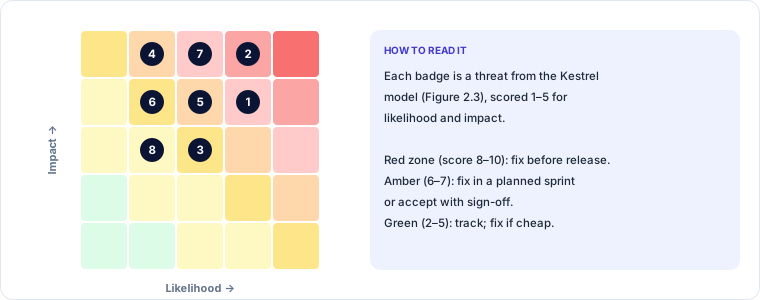
Figure 2.4 places the eight threats. Three fall in the red zone (T1, T2, T7) and should be fixed before the next release. Four are amber (T3, T4, T5, T6) and go into planned sprints or are accepted with sign-off. T8 is green, but it is cheap to fix and supports the investigation of every other threat, so a sensible team fixes it anyway.
DREAD and why it fell out of favour
DREAD was also developed at Microsoft. It scores each threat 1 to 10 on Damage, Reproducibility, Exploitability, Affected users and Discoverability, then averages them. Microsoft stopped using it in the SDL in the late 2000s, and it is now generally discouraged [3]. Its problems are instructive:
- Subjectivity. Different people give very different scores for the same threat, so rankings are unstable.
- Discoverability. Scoring a threat lower because it is "hard to discover" rewards obscurity, and attackers often discover things defenders assumed were hidden.
- Double counting. Reproducibility and exploitability overlap; averaging five correlated numbers creates false precision.
If your organisation still uses DREAD, a common fix is to drop discoverability (treat it as always 10) and calibrate scores with worked examples.
CVSS
The Common Vulnerability Scoring System (CVSS), now at version 4.0, scores the severity of a specific, known vulnerability on a 0–10 scale [4]. It is excellent for what it was designed for: comparing vulnerabilities in products, for example to prioritise patches.
It is a poor fit for most threat model entries because:
- A threat at design time is not yet a specific vulnerability in code; many CVSS metrics cannot be filled in honestly.
- CVSS severity is not risk. It deliberately excludes most business context (the value of the asset, regulatory exposure), although the environmental metrics allow some adjustment.
Use CVSS for confirmed vulnerabilities from testing; use likelihood × impact (or your enterprise risk method) for threats in the model.
Other schemes
- The OWASP Risk Rating Methodology breaks likelihood and impact into named factors (skill level, motive, opportunity, ease of discovery; loss of confidentiality, financial damage, non-compliance and so on) and is a good middle ground when you need more structure than a 5×5 matrix [5].
- FAIR (Factor Analysis of Information Risk) quantifies risk in money with ranges and simulation. It is useful for the handful of threats that need a board-level investment case, not for every row of a register.
- Bug bars define in advance which kinds of threat are, for example, "Critical: fix before release" regardless of scoring. Many large software companies use them because they remove debate for common cases.
Practitioner tip. Agree the rating scheme and the impact scale with the risk owner before the session. Rating arguments in the room are often really arguments about what the business cares about, and they are best settled once, in advance.
Mitigation patterns by category
Each STRIDE category has a family of standard controls. Knowing them lets the team move quickly from Question 2 to Question 3.
| Category | Standard mitigation patterns | Applied to Kestrel |
|---|---|---|
| Spoofing | MFA (phishing-resistant for staff), mTLS between services, signed tokens, signed webhooks, verified call-back procedures | T1: mandatory MFA for merchant users who can change money-moving settings; risk-based step-up; breached-password checks |
| Tampering | Server-side authorisation on writes, validation against business rules, signing and MACs, idempotency keys, integrity monitoring, code and artefact signing | T2: ownership check on every merchant-scoped request; T4: idempotency key and signed timestamp per request; T7: sign the settlement file in the job with an HSM-held key |
| Repudiation | Per-person identity (no shared accounts), append-only logs shipped off-host, signed records for high-value actions, synchronised clocks | T8: individual admin identities; logs written to a separate append-only store the app cannot alter |
| Information disclosure | Authorisation on reads, encryption with managed keys, minimisation, masking and tokenisation, least-privilege data access | T5: separate, encrypted backup store; analytics gets a masked replica, not backups |
| Denial of service | Rate limits and quotas per identity, input size limits, timeouts, circuit breakers, capacity planning, cost caps | T3: per-merchant and per-IP limits on payment-link creation; queue with back-pressure before the bank call |
| Elevation of privilege | Server-side checks, least privilege, maker-checker (four eyes), separation of admin interfaces, sandboxing | T6: maker-checker for payout-account changes; alert on changes within 24 hours of settlement |
Checking coverage with threat libraries
STRIDE prompts the team's imagination; threat libraries check it against what attackers are known to do.
- CAPEC (Common Attack Pattern Enumeration and Classification, MITRE) catalogues several hundred attack patterns, such as "CAPEC-62: Cross-Site Request Forgery" or "CAPEC-94: Adversary in the Middle". It is organised by mechanism and is useful at design time [6].
- MITRE ATT&CK catalogues adversary tactics and techniques observed in real intrusions, from initial access to impact. It is strongest for infrastructure and enterprise threats, and for asking "how would a real group get from the internet to the admin console?" [7].
- CWE (Common Weakness Enumeration) catalogues weakness types, such as CWE-639 "Authorization Bypass Through User-Controlled Key" (the IDOR in T2). It helps map threats to the vulnerabilities that would enable them.
- The OWASP Top 10 lists, including the AI lists in Module 4, are short awareness lists that make good final checks.
A practical pattern: run STRIDE first, then spend ten minutes scanning a relevant library section and asking "did we consider this?" for each entry.
The opening case, resolved
The forty-one sticky notes were a long list of category labels and vague worries. Rewriting them as threat statements merged duplicates and dropped those that were not real threats to Kestrel, leaving nineteen. Rating them with an agreed scale put five in the red zone. The product owner scheduled those five for the next sprint, accepted two amber threats in writing for six months, and asked for the remaining amber items to be costed. The difference was not more analysis; it was turning analysis into a ranked list with clear statements.
Check your understanding
1. Two engineers rate the same threat 3 and 8 for "damage" in DREAD. What does this illustrate, and how would you fix it?
Answer: DREAD's subjectivity. Use an agreed impact scale with concrete examples tied to the business, or move to likelihood × impact with a calibrated scale.
2. A pen tester reports a confirmed reflected XSS vulnerability. Should the team score it with CVSS or the threat model's likelihood × impact scale?
Answer: CVSS is appropriate for a confirmed, specific vulnerability (and is what the pen tester will provide). The team may also map it back to the threat model to check whether the threat was anticipated and to adjust the related threat's rating.
3. Which mitigation addresses T7 most directly: (a) moving the SFTP folder to a different server, (b) signing the settlement file inside the settlement job with a key the operations team cannot access, or (c) training operations staff?
Answer: (b). It makes any change to the file detectable by the bank, regardless of who can write to the folder. (a) only moves the problem, and (c) does not stop a malicious insider.
Key takeaways
- Walk the DFD boundary by boundary; record each threat as a specific statement with category, location and existing controls.
- Rate with an agreed likelihood × impact scale written in business terms; plot on a matrix to decide what to fix now, plan or accept.
- DREAD is subjective and rewards obscurity; CVSS scores confirmed vulnerabilities, not design threats or business risk.
- Each STRIDE category has standard mitigation patterns; knowing them speeds up decisions.
- Check STRIDE results against threat libraries (CAPEC, ATT&CK, CWE, OWASP lists).