
Protecting personal data: security, retention and privacy-enhancing techniques
In this lesson you will:
- Explain "appropriate" security as a risk-based requirement
- Select controls that protect personal data across its lifecycle
- Build a retention schedule and delete data reliably
- Describe the main privacy-enhancing technologies and where they help
Privacy laws rarely list specific technologies. Instead they require appropriate or reasonable security, judged against the risk to people. This lesson shows how to choose controls, how to stop keeping data you no longer need, and how newer privacy-enhancing technologies let you use data while exposing less of it.
1. "Appropriate" security
GDPR asks for measures appropriate to the risk, considering the state of the art, cost, and the nature, scope, context and purposes of processing. DPDP requires "reasonable security safeguards" to prevent personal data breaches, and its Rules list minimum measures: encryption, obfuscation or masking, access control, logging and monitoring, backups, and contracts that bind processors to the same standards. Failing to take reasonable safeguards carries the DPDP Act's highest penalty, up to ₹250 crore.
"Appropriate" means:
- more sensitive data, larger volumes and more vulnerable people need stronger controls
- controls must keep pace with common practice; outdated encryption or unpatched systems are not appropriate
- organisational measures (policies, training, vetting, access reviews) count as much as technical ones
- you must test and evaluate controls regularly, not just install them
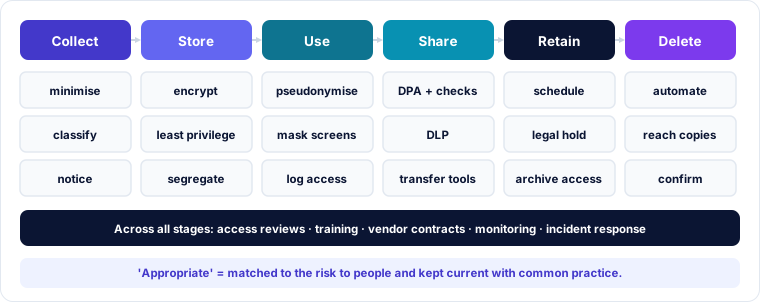
2. Controls across the lifecycle
| Control | Privacy effect |
|---|---|
| Data minimisation and classification | Less data to protect; protection matched to sensitivity |
| Least-privilege access with regular reviews | Staff see only what their role needs; curiosity browsing blocked |
| Encryption in transit and at rest, with managed keys | Stolen media or intercepted traffic stays unreadable |
| Pseudonymisation and tokenisation | Analysts and developers work without direct identifiers |
| Masking in screens and test data | Support staff see "XXXX-1234", not full numbers; no production data in test |
| Logging and monitoring of access to personal data | Detects misuse; provides evidence for investigations |
| Data loss prevention | Blocks bulk emailing or uploading of personal data |
| Secure deletion | Data really gone when retention ends |
🔐 Privacy lens
Insider misuse is a privacy breach even when no attacker is involved. A hospital clerk looking up a celebrity's record has breached confidentiality. Access logging with alerts on unusual lookups is a core privacy control, not just a security nicety.
3. Retention and deletion
Storage limitation (lesson 1.3) needs a retention schedule: for each category of record, how long it is kept, why, and what happens at the end.
- List record types from the record of processing.
- Find the drivers: legal minimums (tax, employment, health, telecom licences), limitation periods for legal claims, and business need.
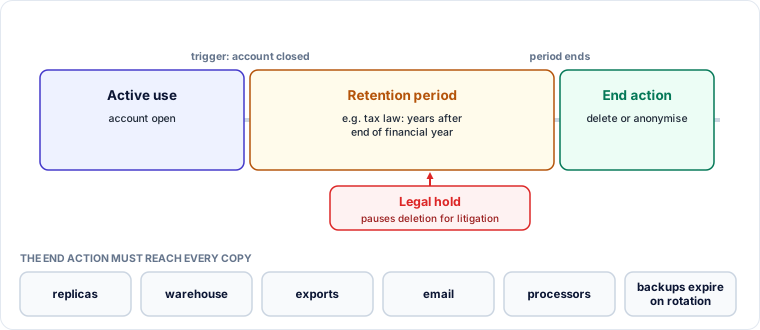
- Set the period and the trigger: "7 years after the end of the financial year", "6 months after the recruitment campaign closes".
- Choose the end action: delete, anonymise or archive with restricted access.
- Automate deletion where possible, and handle legal holds that pause deletion for litigation or investigations.
Deletion must reach copies: replicas, data warehouses, exports, email attachments, processors and backups. Backups usually expire on their normal rotation; restored backups must re-apply deletions before data is used.
4. Privacy-enhancing technologies
Privacy-enhancing technologies (PETs) let organisations get value from data while revealing less about individuals.
| Technique | What it does | Typical use |
|---|---|---|
| Aggregation and k-anonymity | Publish only groups of at least k people | Statistics, dashboards |
| Differential privacy | Adds calibrated noise so no single person's presence changes results much | Official statistics, usage analytics |
| Synthetic data | Generates artificial records with similar patterns | Testing, training, sharing |
| Federated learning / analytics | Brings the computation to the data; only results move | Mobile keyboards, hospital collaborations |
| Secure multi-party computation | Parties compute a joint result without revealing inputs | Fraud detection across banks |
| Homomorphic encryption | Computes on encrypted data | Outsourced analytics on sensitive data |
| Trusted execution environments | Processes data inside hardware-protected enclaves | Confidential cloud computing |
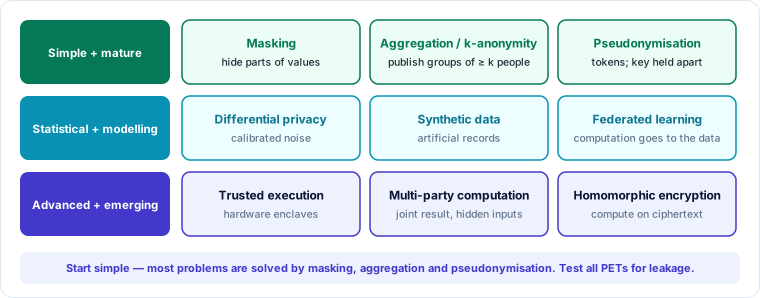
PETs reduce risk but rarely remove privacy law obligations entirely: synthetic data generated from real records can leak, and pseudonymised outputs are still personal data. Test them and document the residual risk.
Worked example — protecting a customer analytics platform
A bank's marketing team wants a dashboard of customer behaviour.
| Risk | Control chosen |
|---|---|
| Analysts see names and account numbers | Pseudonymised customer keys; identity lookup only for a small authorised team |
| Small groups reveal individuals | Suppress cells with fewer than 10 customers |
| Exports to personal spreadsheets | Export disabled; DLP alerts on bulk downloads |
| Data kept forever | Behaviour data older than 24 months aggregated, then raw rows deleted |
| Test environment copies production | Synthetic test data; masking for any production sample |
| Misuse by insiders | Access logged; monthly review of unusual queries |
Key takeaways
- Security must be appropriate to the risk to individuals and kept up to date; DPDP Rules set minimum safeguards and high penalties.
- Match controls to the lifecycle: minimise, restrict access, encrypt, pseudonymise, mask, log, prevent leaks, delete.
- A retention schedule sets period, trigger and end action for each record type, and deletion must reach every copy.
- PETs such as aggregation, differential privacy, synthetic data and federated learning reduce exposure but need testing.
Self-check
- Why is access logging a privacy control as well as a security control?
- What are the five steps to build a retention schedule?
- Is pseudonymised output from an analytics platform still personal data?