
Personal data breaches: response and notification
In this lesson you will:
- Define a personal data breach and recognise its three types
- Run the breach response lifecycle from detection to lessons learned
- Assess risk to individuals to decide who must be notified
- Meet notification deadlines across several laws
Breaches happen to well-run organisations too. What regulators and customers judge is how quickly you notice, how well you contain, whether you tell the right people on time, and what you learn.
1. What is a personal data breach?
A personal data breach is a security incident leading to the accidental or unlawful destruction, loss, alteration, unauthorised disclosure of, or access to personal data. DPDP's definition is similar: any unauthorised processing, or accidental disclosure, acquisition, sharing, use, alteration, destruction or loss of access to personal data that compromises its confidentiality, integrity or availability.
| Type | Examples |
|---|---|
| Confidentiality | Hacked database, email sent to the wrong person, laptop stolen, staff browsing records |
| Integrity | Records altered without authority, malware corrupting data |
| Availability | Ransomware encrypting the only copy, accidental deletion, long outage of a critical service |
Not every security incident is a personal data breach (an attack on a system with no personal data is not), and not every breach involves an attacker (a misdirected email is a breach).
2. The response lifecycle
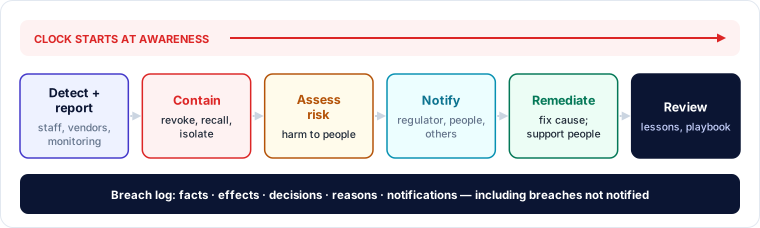
- Detect and report internally. Staff, customers, vendors and monitoring tools must know how to report suspected breaches immediately, without fear of blame.
- Contain. Stop the leak: revoke access, recall emails, isolate systems, reset credentials, ask recipients to delete.
- Assess risk to individuals (section 3).
- Notify the regulator, affected people and other bodies as required (section 4).
- Remediate. Fix root causes; support affected people (credit monitoring, password resets, guidance).
- Review. Run a post-incident review, update controls and the playbook, and record lessons.
Keep a breach log of every breach, including those you decide not to notify, with facts, effects, decisions and reasons. GDPR requires it, and it is your evidence of accountability.
3. Assessing risk to individuals
Notification usually depends on risk to people. Consider:
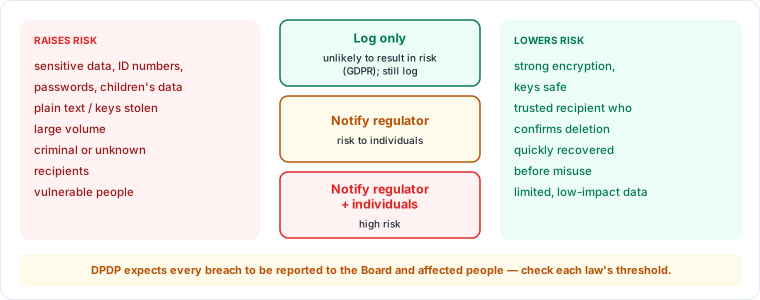
- type and sensitivity of data (health, financial, ID numbers, passwords, children's data raise risk)
- volume of records and people affected
- ease of identification (encrypted with keys safe, or plain text?)
- severity of consequences: fraud, identity theft, discrimination, physical harm, distress
- vulnerability of the people affected
- who received it: a trusted partner who confirms deletion, or criminals on the internet
- containment: was the data recovered before misuse?
🔐 Privacy lens
Strong encryption with keys that were not compromised can turn a reportable breach into a non-reportable one under several laws. That is one of the clearest returns on encryption investment. DPDP, however, expects every breach to be reported to the Board and to affected people, so check each law's threshold.
4. Notification deadlines
| Law or rule | Notify whom | When |
|---|---|---|
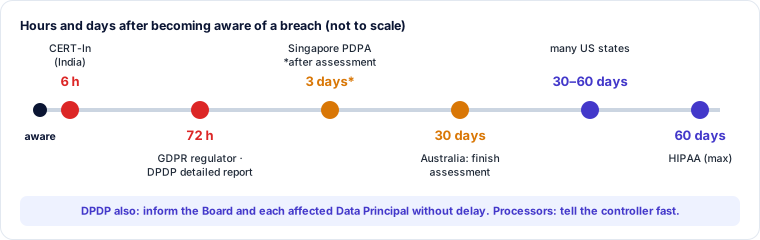
| EU / UK GDPR | Regulator, unless unlikely to result in risk | Without undue delay, within 72 hours of awareness |
| Individuals, if high risk | Without undue delay | |
| India DPDP Rules | Data Protection Board and each affected Data Principal | Without delay; detailed report to the Board within 72 hours |
| India CERT-In directions | CERT-In, for specified cyber incidents | Within 6 hours of noticing |
| Singapore PDPA | Commission and individuals, if significant harm or scale | 3 calendar days after assessing it notifiable (assessment within 30 days) |
| Australia notifiable data breaches | Regulator and individuals, if serious harm is likely | Assess within 30 days, then notify as soon as practicable |
| US state laws | Individuals, often the attorney general | Varies; commonly "without unreasonable delay" or 30–60 days |
| US HIPAA | Individuals, regulator, sometimes media | Without unreasonable delay, no later than 60 days |
| Processors | The controller | Without undue delay, usually faster under the contract |
A good notice to individuals explains, in plain language: what happened, what data was involved, likely consequences, what you are doing, what they should do (change passwords, watch for phishing), and who to contact.
Worked example — a misconfigured storage bucket
An Indian travel company with EU customers finds that a cloud storage bucket holding scanned passports was publicly readable for 10 days. Logs show downloads from unknown IP addresses.
| Hour | Action |
|---|---|
| 0 | Security team confirms exposure; incident declared; privacy lead and legal informed; breach log opened |
| 1 | Bucket made private; access keys rotated; logs preserved |
| 3 | Scope: 18,000 passport scans (12,500 Indian, 5,500 EU residents) |
| 5 | CERT-In report filed (within 6 hours) |
| 8 | Risk assessment: identity documents, downloaded by unknown parties: high risk |
| 10 | Initial intimation to the Data Protection Board; notification to the lead EU supervisory authority |
| 24–48 | Emails to all affected customers with guidance on fraud and phishing; helpline opened |
| 72 | Detailed report to the Board; supplementary information to the EU authority |
| Week 2 | Root cause: infrastructure-as-code template without a block-public-access setting; guardrail added to all accounts |
| Week 4 | Post-incident review; playbook updated; passports now deleted 30 days after travel |
Key takeaways
- A personal data breach affects confidentiality, integrity or availability of personal data; it need not involve an attacker.
- Lifecycle: detect, contain, assess, notify, remediate, review, and log everything, including breaches you do not notify.
- Risk to individuals depends on data type, volume, identifiability, consequences, vulnerability, recipients and containment.
- Deadlines range from 6 hours (CERT-In) to 72 hours (GDPR, DPDP detailed report) to longer windows elsewhere; build the playbook to the shortest.
Self-check
- Is an email with customer data sent to the wrong recipient a breach?
- Name four factors that affect breach risk to individuals.
- Why should you log breaches you decide not to notify?