
Privacy in everyday technology: tracking, AI and monitoring
In this lesson you will:
- Explain how cookies, pixels and SDKs collect data and what rules apply
- Run a cookie and tracker governance process
- Identify privacy issues when organisations use AI tools and build AI systems
- Apply privacy principles to workplace monitoring, CCTV and biometrics
Many privacy failures come not from databases but from everyday technology bolted onto products: tracking scripts on websites, SDKs in apps, AI tools pasted into workflows, cameras in offices. This lesson applies the principles you have learned to these common cases.
1. Cookies, pixels and SDKs
Cookies are small files a website stores in the browser. Pixels (web beacons) and tags are snippets that send information to third parties when a page loads. SDKs are code libraries inside mobile apps, often from analytics, advertising or crash-reporting vendors. Together they can record pages viewed, clicks, device identifiers, location and purchases, and send them to dozens of companies.
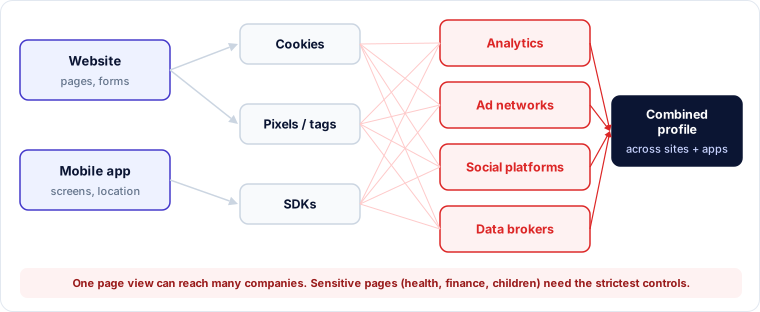
Rules differ by region:
- EU and UK: the ePrivacy rules require prior consent for storing or reading information on a device, except where strictly necessary for the service the user asked for. Analytics and advertising cookies need opt-in.
- US states: trackers used for targeted advertising usually count as "sharing" or "sale"; people can opt out, including through the Global Privacy Control browser signal, which several states require businesses to honour.
- India: tracking is processing of personal data under DPDP, so it needs consent or a legitimate use; tracking, behavioural monitoring and targeted advertising directed at children are prohibited.
| Category | Example | Typical rule |
|---|---|---|
| Strictly necessary | Login session, shopping cart, security | No consent needed; still disclose |
| Preferences | Language, region | Consent in EU/UK; low risk |
| Analytics | Page-view statistics | Consent in EU/UK unless tightly limited; opt-out elsewhere |
| Advertising / social | Retargeting pixels, social plug-ins | Consent in EU/UK; opt-out of sale or sharing in US states |
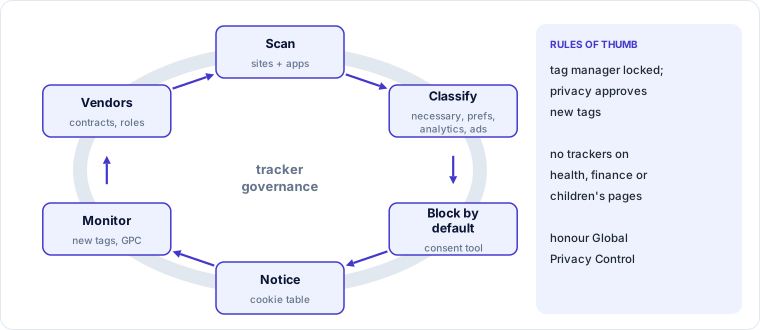
Governance steps: scan sites and apps regularly; classify every tracker; block non-essential trackers until consent (or until no opt-out applies); keep a tag approval process with marketing; honour GPC and similar signals; check vendors' contracts; and watch for trackers on sensitive pages such as health, finance or children's sections, which have led to major enforcement actions.
2. AI and privacy
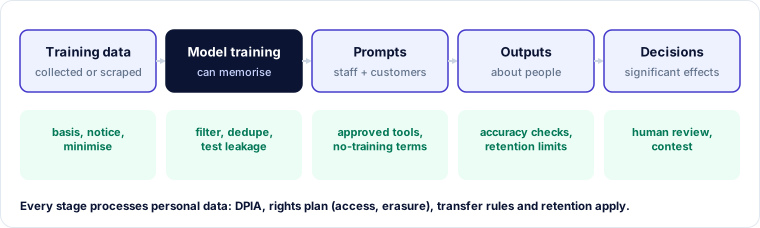
AI raises privacy issues at two points.
Using AI tools. Staff pasting customer records, contracts or health details into public AI chatbots may disclose personal data to a vendor without a contract or legal basis. Controls: an approved-tools list, enterprise agreements with no training on your data and limited retention, data loss prevention, and clear guidance on what may be entered.
Building or training AI. Training data is processing of personal data: it needs a legal basis, transparency, minimisation and a plan for rights requests. Models can memorise and repeat personal data; outputs about people can be inaccurate. Automated decisions trigger the safeguards in lesson 2.4. DPIAs are usually required.
🔐 Privacy lens
Treat prompts and AI outputs as personal data stores. They are logged, retained and sometimes reviewed by vendors. Apply retention limits, access control and the same transfer rules as any other system.
3. Workplace monitoring, CCTV and biometrics
Employers have legitimate needs: security, safety, legal compliance, protecting assets. But the power imbalance makes employee consent weak, and intrusive monitoring harms trust and dignity.
Principles for monitoring:
- Necessary and proportionate: monitor only for a defined purpose, with the least intrusive method that works.
- Transparent: tell staff what is monitored, when, why and who sees the results. Covert monitoring only in exceptional, documented cases such as a specific criminal investigation.
- Limited: no monitoring of private spaces, personal devices or communications beyond the purpose; avoid keystroke logging and constant screenshots.
- Assessed: run a DPIA and consult staff representatives where relevant.
CCTV: clear signs, cameras positioned to avoid private areas, short retention (often 30 days unless an incident is being investigated), restricted access and a process for footage requests.
Biometrics (fingerprints, face, voice) are sensitive data in many laws. Prefer alternatives (cards, PINs) where they work; if biometrics are used, offer an alternative, store templates rather than images, keep them encrypted and local where possible, and delete them when employment ends.
Worked example — tracker audit of a health-information website
| Finding | Risk | Fix |
|---|---|---|
| Social-media pixel on symptom-checker pages sends page URLs such as "/conditions/depression" | Discloses health interests to an ad network | Removed pixel from all health pages |
| Analytics fires before consent for EU visitors | Unlawful device access | Consent tool blocks analytics until opt-in |
| GPC signal ignored for California visitors | Opt-out not honoured | GPC treated as opt-out of sale and sharing |
| Session-replay tool records form fields | Captures typed symptoms | Tool removed; form fields masked in remaining tools |
| No tag approval process | New trackers added by agencies | Tag manager locked; privacy approval required |
Key takeaways
- Cookies, pixels and SDKs share data with third parties; EU/UK need prior consent for non-essential trackers, US states give opt-outs including GPC, and DPDP treats tracking as processing needing consent.
- Govern trackers continuously: scan, classify, block by default, approve tags, avoid sensitive pages.
- AI raises privacy issues when using tools (leakage to vendors) and building systems (training data, memorisation, decisions).
- Workplace monitoring, CCTV and biometrics must be necessary, proportionate, transparent and assessed.
Self-check
- Which cookies can be used without consent under EU rules?
- Name two controls for staff use of public AI chatbots.
- Why is employee consent a weak basis for workplace monitoring?