
Monitoring, audit, training and continuous improvement
In this lesson you will:
- Choose metrics and indicators that show whether privacy controls work
- Plan privacy audits and assessments
- Design role-based privacy training and awareness
- Handle complaints and regulator enquiries, and use certifications wisely
A privacy programme proves itself in operation. This final lesson covers how to measure it, check it independently, keep people capable, and respond when complaints or regulators arrive.
1. Metrics that matter
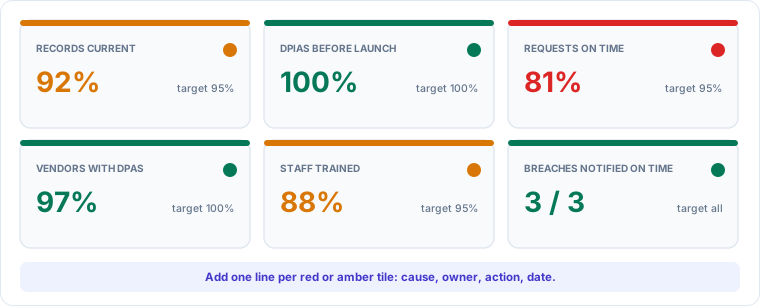
Good metrics show whether controls are working, not just whether activity happened. Combine:
- Key performance indicators (KPIs): how well the programme performs.
- Key risk indicators (KRIs): early warnings that risk is rising.
| Area | KPI | KRI |
|---|---|---|
| Records | % of processing activities with a current record | New systems found by discovery that were not registered |
| Risk | % of high-risk projects with a DPIA before launch | Projects launched without privacy review |
| Rights | % of requests closed within deadline; average days | Rising backlog; repeat complaints |
| Vendors | % of vendors with signed DPAs and current assessments | Vendors overdue for reassessment |
| Breaches | Time to contain; % notified on time | Increase in misdirected emails or access violations |
| People | % of staff trained this year | Phishing simulation failure rate |
| Retention | % of systems with automated deletion | Data stores holding records past retention |
2. Audits and assessments
Assurance comes from several sources:
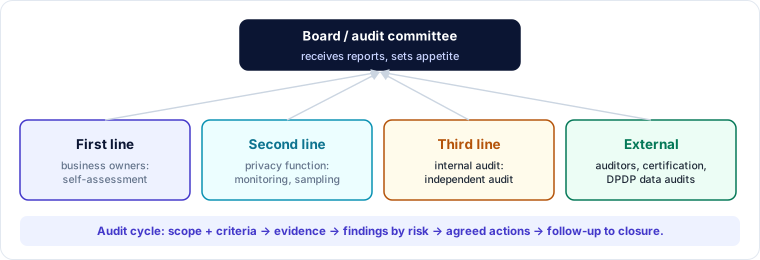
- Self-assessments by business units against privacy standards, reviewed by the privacy team.
- Second-line monitoring by the privacy function: sample rights requests, test consent records, review access logs.
- Internal audit (third line): independent audits of the programme and of high-risk processes.
- External audits and certifications: independent assessors, required in some cases (for example DPDP requires significant data fiduciaries to have periodic independent data audits).
A typical privacy audit plans scope and criteria (laws, policies, standards), gathers evidence (records, interviews, system tests, samples), evaluates findings by risk, agrees actions with owners and deadlines, and follows up until they are closed.
Certifications can provide evidence for customers and regulators. ISO/IEC 27701 sets requirements for a privacy information management system (revised in 2025 as a standalone standard); other schemes include the APEC/Global Cross-Border Privacy Rules and GDPR certification schemes approved by EU authorities. A certificate shows a management system exists; it does not guarantee that every process is compliant, so look at its scope.
3. Training and awareness
People cause and prevent most privacy incidents. Training should be:
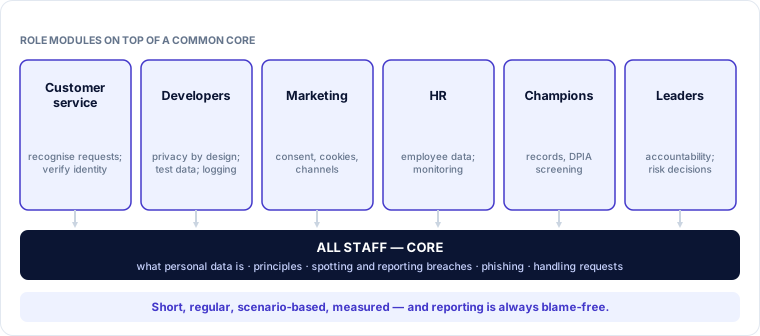
- Role-based: everyone gets the basics; customer service learns to recognise rights requests and verify identity; developers learn privacy by design; marketing learns consent and tracking rules; HR learns employee-data rules; leaders learn accountability.
- Regular and short: an annual course plus brief refreshers, rather than one long session at onboarding.
- Practical: real scenarios from your organisation; misdirected email, phishing, a request from "the customer's lawyer".
- Measured: completion, quiz results, and behaviour such as reporting suspected breaches.
🔐 Privacy lens
Make reporting easy and blame-free. A staff member who reports a misdirected email in five minutes lets you recall it and contain the breach; one who fears punishment stays silent until the customer complains to the regulator.
4. Complaints and regulators
Complaints are free audit findings. Handle them through a defined process: acknowledge, investigate, respond with reasons, and track root causes. DPDP requires data fiduciaries to provide grievance redressal before people approach the Board; GDPR lets people complain directly to a supervisory authority.
Regulator enquiries need a coordinated response:
- Route the enquiry to the privacy lead and legal immediately; note deadlines.
- Preserve relevant records and logs.
- Respond accurately and completely, using your accountability evidence.
- Fix any issues found, and say what you have changed.
- Keep a record of the engagement and the outcome.
A cooperative, well-documented response often reduces penalties; regulators consider mitigation, cooperation and previous compliance when setting fines.
5. Continuous improvement
Close the loop: metrics, audit findings, incidents, complaints, new laws and new products all feed back into the plan-do-check-act cycle from lesson 3.1. Review the programme at least yearly with leadership, reset priorities, and update policies and training.
Worked example — an annual privacy review for a SaaS company
| Input | Finding | Action for next year |
|---|---|---|
| Metrics | Rights requests on time fell from 96% to 81% after a product launch | Add the new product to the request workflow; automate data export |
| Internal audit | 30% of vendors lacked current assessments | Vendor reassessment sprint; automated reminders |
| Incidents | Four misdirected emails with attachments | Email delay-send and recipient warnings; targeted training |
| Complaints | Users confused by the cookie banner | Redesign with equal-prominence buttons; user testing |
| Legal watch | New obligations phasing in under DPDP | Gap assessment; consent records and breach playbook updated |
| Certification | Customers asking for ISO/IEC 27701 | Scope and readiness assessment planned |
Key takeaways
- Track a few KPIs and KRIs that show whether controls work: records, DPIAs, rights, vendors, breaches, training, retention.
- Assurance comes from self-assessment, second-line monitoring, internal audit and external audit or certification; check certificate scope.
- Training should be role-based, regular, practical and measured, with blame-free reporting.
- Handle complaints and regulator enquiries through defined processes; cooperation and evidence matter.
- Feed everything back into the programme cycle.
Self-check
- What is the difference between a KPI and a KRI? Give a privacy example of each.
- What does an ISO/IEC 27701 certificate show, and what does it not show?
- Which roles need specialised privacy training, and why?