
Third parties and international data transfers
In this lesson you will:
- Manage vendors that process personal data across their lifecycle
- List the essential terms of a data processing agreement
- Explain the main mechanisms for lawful international transfers
- Carry out a simple transfer risk assessment
Most personal data today flows through vendors: cloud platforms, SaaS tools, payment providers, marketing platforms, call centres. Each vendor extends your risk, and when data crosses borders, a second set of rules applies.
1. The vendor lifecycle
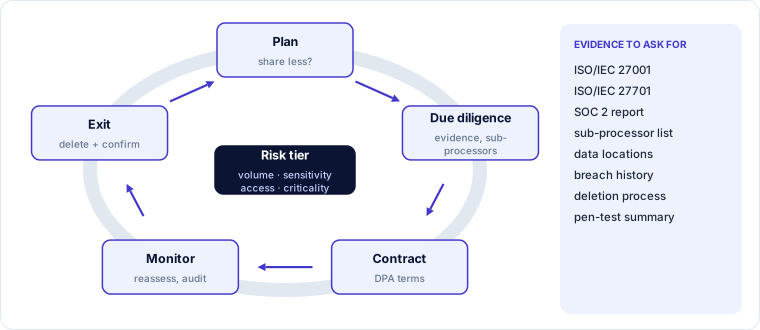
Controllers remain accountable for data their processors handle. Manage vendors across five stages:
- Plan: define what data the vendor needs. Can you share less, or pseudonymise first?
- Due diligence: security questionnaire and evidence (ISO/IEC 27001 and 27701 certificates, SOC 2 reports), privacy practices, sub-processors, data locations, breach history, financial stability.
- Contract: a data processing agreement (DPA) with the required terms (section 2).
- Monitor: periodic reassessment, sub-processor change notices, audit rights, incident reporting, performance against the contract.
- Exit: return or deletion of data, with written confirmation; revoke access and keys.
Tier vendors by risk (volume and sensitivity of data, access level, criticality) so the effort goes where it matters.
2. What a data processing agreement must cover
GDPR sets out mandatory terms for controller–processor contracts, and they are good practice everywhere:
- process data only on documented instructions of the controller
- confidentiality commitments for staff with access
- appropriate security measures
- use sub-processors only with authorisation, flowing down the same obligations
- assist the controller with rights requests, DPIAs, breach notification and consultations
- notify breaches without undue delay, with the information the controller needs
- delete or return data at the end of the service
- provide information and allow audits to demonstrate compliance
- terms on international transfers, locations and government access requests
DPDP makes the data fiduciary responsible for its processors' compliance and expects a valid contract; sector regulators such as RBI add outsourcing and data-location requirements.
3. International transfers
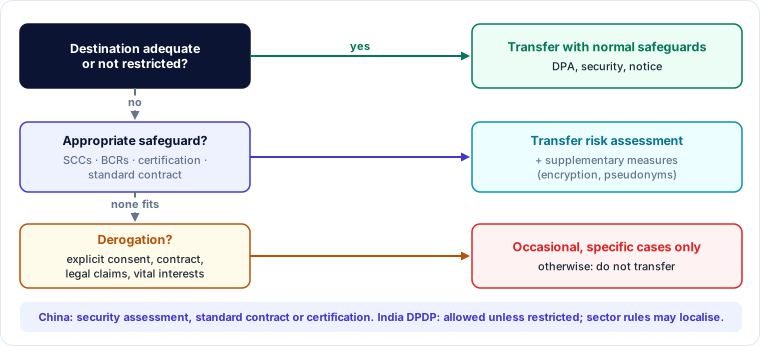
Many laws restrict sending personal data abroad, because the protection may be weaker in the destination country. "Transfer" includes remote access: a support engineer abroad viewing records counts.
| Mechanism | How it works | Examples |
|---|---|---|
| Adequacy / whitelist | The regulator or government declares a country's protection adequate | EU adequacy decisions (e.g. Japan, UK, Korea; the EU–US Data Privacy Framework for certified US companies) |
| Standard contractual clauses | Pre-approved contract terms between exporter and importer | EU SCCs; UK international data transfer agreement; China's standard contract |
| Binding corporate rules | Approved group-wide rules for intra-group transfers | Large multinationals |
| Certifications and codes | Approved schemes the importer joins | APEC CBPR / Global CBPR Forum; China PIPL certification |
| Derogations | Narrow exceptions for specific situations | Explicit consent, contract necessity, legal claims, vital interests |
| Security assessment / approval | Government review before transfer | China, for large volumes or important data |
| Negative list | Transfers allowed except to countries the government restricts | India's DPDP Act (plus sector rules, e.g. RBI payment-data localisation) |
The EU–US Data Privacy Framework was upheld by the EU General Court in 2025, and an appeal to the Court of Justice was pending in 2026. Earlier frameworks were struck down in 2015 and 2020, so many organisations keep SCCs as a fallback.
4. Transfer risk assessments
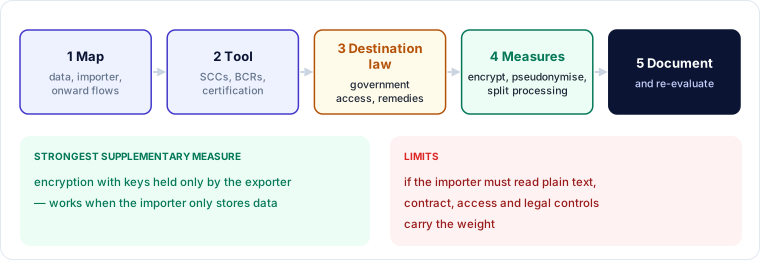
When relying on contractual clauses, EU law expects exporters to assess whether the destination's laws and practices, especially government access to data, undermine the clauses' protection. A transfer risk (or impact) assessment covers:
- map the transfer: data, purpose, importer, onward transfers, format
- identify the transfer tool
- assess destination laws and practices against the data involved
- add supplementary measures if needed: encryption with keys held by the exporter, pseudonymisation, split processing, contractual transparency commitments
- document, and re-evaluate when circumstances change
🔐 Privacy lens
Encryption only protects a transfer if the importer cannot read the data. If a foreign support team needs plain text to do its job, key management cannot be the main safeguard; contractual, legal and access controls must carry the weight.
Worked example — onboarding a customer-support SaaS
An Indian e-commerce company with EU customers wants a US-based support platform with an engineering team in Eastern Europe.
| Step | Result |
|---|---|
| Plan | Only name, email, order number and ticket text; payment data excluded |
| Due diligence | ISO/IEC 27001 and 27701 certificates; SOC 2 report; sub-processor list reviewed; breach history clean |
| Risk tier | High (customer data at scale, free text may hold sensitive details) |
| Contract | DPA with all mandatory terms; 24-hour breach notice; audit rights; deletion within 30 days of exit |
| Transfers | EU data: vendor is certified under the Data Privacy Framework, with SCCs as fallback; transfer risk assessment recorded. Indian data: allowed, as the destinations are not restricted; no sector localisation rule applies |
| Measures | EU data hosted in the EU region; ticket text pseudonymised in analytics; engineers' access just-in-time and logged |
| Monitor | Annual reassessment; alerts on sub-processor changes |
Key takeaways
- Controllers stay accountable for processors: plan, due diligence, contract, monitor and exit, scaled by risk tier.
- DPAs cover instructions, confidentiality, security, sub-processors, assistance, breach notice, deletion, audits and transfers.
- Transfer mechanisms include adequacy, standard clauses, binding corporate rules, certifications, derogations, government assessments and negative lists.
- Transfer risk assessments test destination laws and add supplementary measures where needed.
Self-check
- Does remote access from another country count as a transfer?
- Name five terms a data processing agreement must include.
- Why are derogations unsuitable for routine, large-scale transfers?