
Legal bases and valid consent
In this lesson you will:
- Explain why every processing purpose needs a legal basis
- Choose an appropriate legal basis from common options
- Test whether consent is valid and manageable
- Run a simple legitimate-interests balancing test
The first privacy principle says processing must be lawful. In practice that means each purpose needs a recognised legal reason before any data is collected. Pick the wrong basis and everything built on it is unlawful, even if the data is perfectly secure.
1. One purpose, one basis
Legal bases attach to purposes, not to datasets. An online shop processes the same customer record to deliver orders, to keep tax records, to detect fraud and to send promotions. Each purpose may rest on a different basis, and each choice changes what rights the customer has and what the shop must do.
Decide the basis before processing starts, record it, and tell people in the notice. Switching bases later, for example falling back on "legitimate interests" when consent is withdrawn, is usually unfair and often unlawful.
2. The common legal bases
GDPR lists six bases, and most laws use a similar set, sometimes under different names.
| Basis | Use it when | Example |
|---|---|---|
| Consent | The person has a genuine choice and you can honour a "no" | Marketing emails, optional cookies |
| Contract | Processing is necessary to deliver what the person asked for | Shipping address to deliver an order |
| Legal obligation | A law requires it | Keeping invoices for tax law, KYC checks |
| Vital interests | Someone's life is at risk and they cannot consent | Sharing allergy data with paramedics |
| Public task | Exercising official authority or a task in the public interest | A city council running housing services |
| Legitimate interests | A real business interest that is not overridden by the person's rights | Fraud prevention, network security, basic analytics |
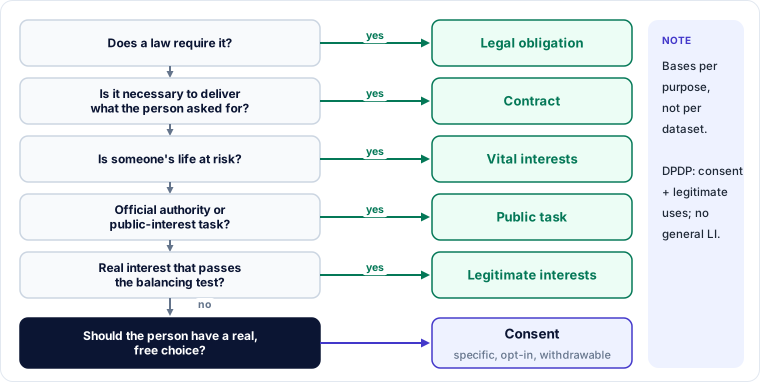
Laws vary. India's DPDP Act relies mainly on consent, but allows "certain legitimate uses" without consent, such as data a person voluntarily provides for a specific purpose, state benefits and services, legal obligations, medical emergencies, disasters and some employment purposes. It has no general "legitimate interests" basis. Brazil's LGPD has ten bases, including credit protection. Most US state laws do not require a basis for ordinary processing; they rely on notice and opt-out rights, but require opt-in consent for sensitive data in several states.
3. What makes consent valid
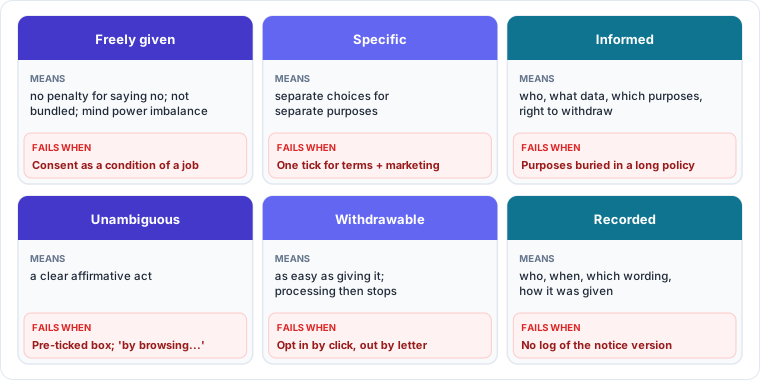
Consent is only valid if it meets every condition below. Miss one and it is not consent.
- Freely given: a genuine choice, no detriment for saying no, not bundled with unrelated terms, and not demanded where there is a power imbalance (employers, public authorities).
- Specific: separate consent for separate purposes.
- Informed: the person knows who you are, what data, which purposes, and that they can withdraw.
- Unambiguous: a clear affirmative action, such as ticking an empty box or pressing "Agree". Silence, pre-ticked boxes and inactivity are not consent.
- Withdrawable: as easy to withdraw as to give, and processing stops when consent is withdrawn.
- Recorded: you can prove who consented, when, to what wording, and how.
DPDP adds that consent must be preceded by an itemised notice, be limited to the data necessary for the purpose, and be available in English or any of the 22 languages in the Eighth Schedule of India's Constitution. It also introduces consent managers: registered intermediaries that let people give, review and withdraw consent across many organisations from one place.
🔐 Privacy lens
Consent is fragile. People can withdraw it at any time, so never choose consent for processing you cannot stop, such as records you must keep by law. Use the basis that matches reality.
4. The legitimate-interests balancing test
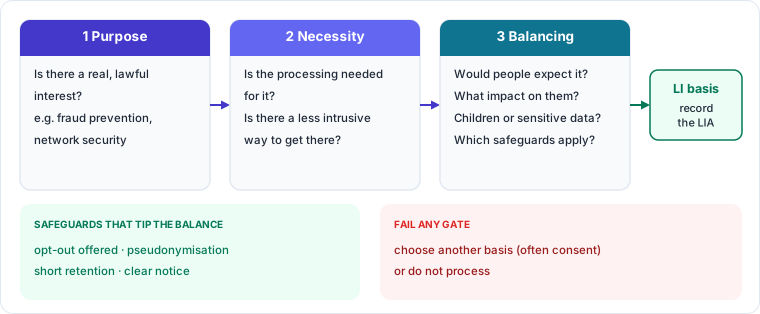
Where a law allows legitimate interests, you must show three things and record them in a legitimate interests assessment (LIA):
- Purpose test: is there a real, lawful interest (yours or a third party's)?
- Necessity test: is the processing necessary for it, or is there a less intrusive way?
- Balancing test: do the person's interests, rights and reasonable expectations override yours? Consider the type of data, the relationship, the impact, safeguards and whether children are involved.
Worked example — choosing bases for an online pharmacy
| Purpose | Basis chosen | Reasoning |
|---|---|---|
| Fulfil prescription orders | Contract (plus the health-data condition for providing care) | Needed to deliver what the customer ordered |
| Keep dispensing records for the period the law sets | Legal obligation | Pharmacy regulations require it; consent would be misleading |
| Detect fraudulent prescriptions | Legitimate interests (LIA recorded) or legal obligation where rules require checks | Expected, necessary and protective of patients |
| Send health-product promotions | Consent, separate opt-in, unticked box | Optional; health context makes it sensitive |
| Share data with a research partner | Consent, or anonymise first | Not expected by customers; high sensitivity |
Under DPDP the same pharmacy would rely on consent for most purposes, with "legitimate uses" covering legal obligations and medical emergencies.
Key takeaways
- Every purpose needs a legal basis, chosen and recorded before processing begins.
- Common bases: consent, contract, legal obligation, vital interests, public task, legitimate interests; laws differ in which they allow.
- Valid consent is freely given, specific, informed, unambiguous, withdrawable and recorded.
- Legitimate interests requires a documented purpose, necessity and balancing test.
- DPDP relies on consent plus defined legitimate uses, with consent managers as a new mechanism.
Self-check
- Why is consent a poor basis for processing an employer must do by law?
- Name three things that make consent invalid.
- What are the three parts of a legitimate-interests assessment?