
Who's who: individuals, controllers, processors and regulators
In this lesson you will:
- Identify the individual, controller, processor and sub-processor in a data flow
- Map the different names laws use for the same roles
- Explain joint controllership and why role decisions drive obligations
- Describe the role of regulators and the data protection officer
Privacy obligations attach to roles, not to job titles or company size. Before you can say what an organisation must do, you have to decide what role it plays for each processing activity. The same company can be a controller for its HR data and a processor for the client data it handles.
1. The core roles
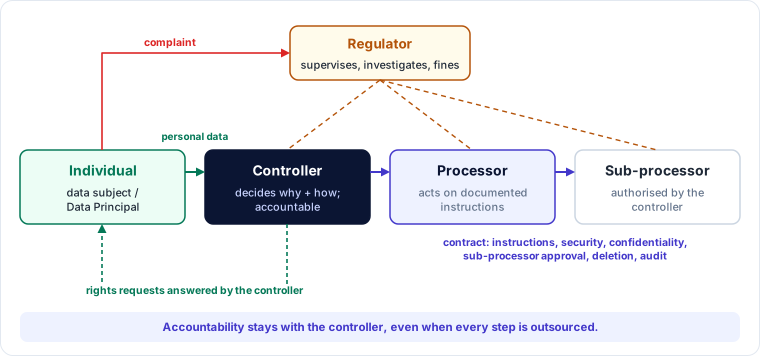
The individual the data is about. GDPR calls them the data subject, India's DPDP Act the Data Principal, California law the consumer. They hold the rights.
The controller decides why personal data is processed and the essential how (which data, whose data, for how long, who receives it). GDPR says controller, DPDP says Data Fiduciary, PIPL says personal information handler, and US state laws usually say controller or business. The controller carries primary accountability.
The processor processes personal data on behalf of a controller and only on its documented instructions: a payroll bureau, a cloud host, a call centre, an email delivery service. Laws call it processor, Data Processor or service provider.
The sub-processor is engaged by a processor to help with the work, for example the data centre behind a SaaS provider. The processor needs the controller's authorisation and must pass down the same obligations.
| Role | GDPR | India DPDP | California CCPA/CPRA | China PIPL |
|---|---|---|---|---|
| Individual | Data subject | Data Principal | Consumer | Individual |
| Decides purpose and means | Controller | Data Fiduciary | Business | Personal information handler |
| Acts on instructions | Processor | Data Processor | Service provider / contractor | Entrusted party |
| Independent authority | Supervisory authority | Data Protection Board | California Privacy Protection Agency, Attorney General | Cyberspace Administration of China |
2. Deciding the role
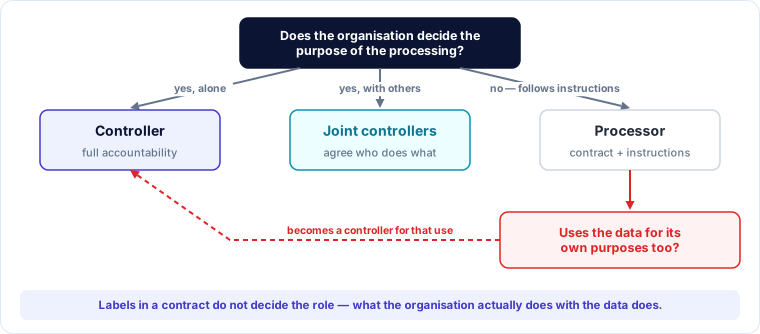
Ask who decides the purpose. If an organisation uses the data for its own goals, it is a controller for that use, whatever the contract says. Signs of a processor are: no interest in the data beyond the service, following the client's instructions, no independent decisions about whose data or how long.
Some arrangements involve joint controllers: two or more organisations decide purposes and means together, such as two companies running a co-branded loyalty programme. They must agree who handles notices and rights requests, and individuals can usually exercise rights against either.
Others are independent controllers sharing data: an employer sending salary data to a bank to pay staff. The bank uses the data for its own banking obligations, so it is a controller in its own right, not the employer's processor.
🔐 Privacy lens
A processor that uses client data for its own purposes, such as training its product on customer records without permission, becomes a controller for that use and takes on all the controller's obligations, usually in breach of its contract.
3. Regulators and enforcement
Each law appoints an independent authority to supervise it, handle complaints, investigate and impose penalties. Some, such as EU supervisory authorities, also issue guidance and approve codes and certifications. Others, such as India's Data Protection Board, focus on adjudicating breaches and complaints. In the US, privacy enforcement is split between the Federal Trade Commission (unfair and deceptive practices), state attorneys general and, in California, a dedicated privacy agency.
Penalties can be large. GDPR allows fines up to €20 million or 4% of worldwide annual turnover; India's DPDP Act allows penalties up to ₹250 crore for failing to take reasonable security safeguards. Regulators can also order processing to stop, which can hurt more than a fine.
4. The data protection officer and the privacy team
Many laws require, or strongly encourage, a named person responsible for privacy. GDPR requires a Data Protection Officer (DPO) for public bodies and for organisations whose core activities involve large-scale monitoring or sensitive data. The DPO must be independent, report to the highest management level and must not be dismissed for doing the job. DPDP requires a DPO based in India for significant data fiduciaries, and every data fiduciary must publish contact details for someone who can answer questions.
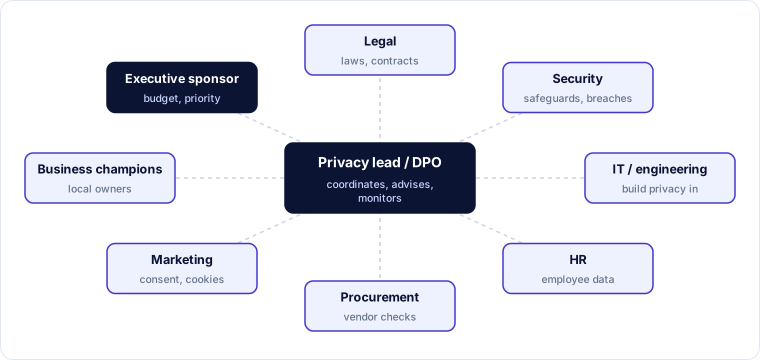
Whatever the legal requirement, a working privacy function needs: an accountable executive, a privacy lead or DPO, privacy champions in business units, and close ties with security, legal, IT, HR and procurement.
Worked example — assigning roles in a food-delivery app
| Party | What it does with personal data | Role |
|---|---|---|
| Delivery app company | Runs the platform, decides what customer data to collect and why | Controller |
| Cloud provider | Hosts the app's databases under the app's instructions | Processor |
| SMS gateway | Sends order updates on the app's instructions | Processor (sub-processor of the cloud provider if contracted by it) |
| Restaurant | Receives the customer's name and order to prepare food; keeps its own sales records | Independent controller for its records |
| Payment company | Processes the card payment and meets its own anti-fraud obligations | Independent controller for payment data |
| Analytics vendor | Wants to reuse order data to build industry benchmarks for sale | Would become a controller; needs a lawful basis and the app's contractual permission, or must not do it |
Key takeaways
- Obligations follow roles: individual, controller (fiduciary), processor and sub-processor.
- Laws use different names for the same roles; map them before comparing duties.
- The controller decides purpose and essential means and stays accountable even when it outsources.
- A processor that uses data for its own purposes becomes a controller for that use.
- Regulators supervise, investigate and fine; DPOs and privacy teams make compliance work day to day.
Self-check
- A SaaS HR platform stores employee records for 200 client companies. What role does it play for that data?
- What is the difference between joint controllers and independent controllers?
- Name three functions a privacy lead must work with closely.