
The core privacy principles
In this lesson you will:
- Trace modern privacy principles back to the fair information practices
- Explain each core principle and what it requires in practice
- Apply the principles to a new processing activity
- Explain accountability and how organisations demonstrate it
Privacy laws around the world look different on the surface but share a common core. If you understand the principles, you can work under almost any law: the details change, the logic does not.
1. Where the principles come from
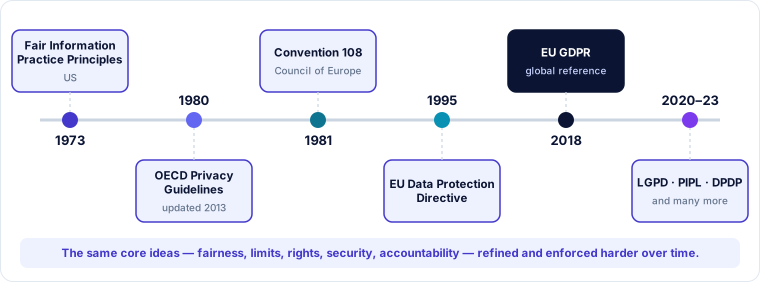
In the 1970s, governments worried about large computer databases of citizens. The US Fair Information Practice Principles (1973) and the OECD Privacy Guidelines (1980, updated 2013) set out a short list of rules for handling personal data fairly. Those ideas flowed into the Council of Europe's Convention 108, the EU's 1995 directive and then GDPR, APEC's privacy framework, and almost every national law since, including India's DPDP Act.
2. The eight core principles
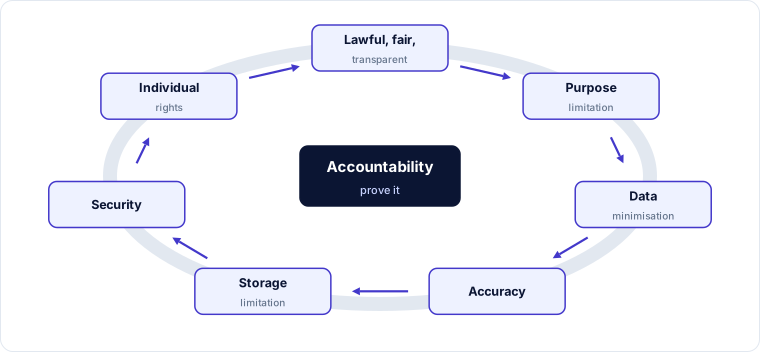
1. Lawfulness, fairness and transparency. Have a valid legal reason to process (lesson 2.1), do not use data in ways people would not reasonably expect or that harm them unjustifiably, and tell people clearly what you are doing.
2. Purpose limitation. Collect data for specified, explicit and legitimate purposes, and do not reuse it for something incompatible. Using delivery addresses to deliver parcels is fine; selling them to a debt collector is not.
3. Data minimisation. Collect and keep only what you need for the purpose: adequate, relevant and limited. A newsletter needs an email address, not a date of birth.
4. Accuracy. Keep data correct and up to date, and fix or delete inaccurate data promptly, especially when decisions about people depend on it.
5. Storage limitation. Keep identifiable data no longer than necessary. Set retention periods, then delete or anonymise.
6. Integrity and confidentiality (security). Protect data with appropriate technical and organisational measures against unauthorised access, loss or damage.
7. Individual participation (rights). Let people see their data, correct it, and in many laws delete it, move it or object to its use (lesson 2.3).
8. Accountability. The controller is responsible for complying with all of the above and must be able to prove it.
🔐 Privacy lens
Minimisation is also a security control. Data you never collect cannot be breached, subpoenaed, misused by an insider or leaked by a vendor. Every field you remove shrinks the blast radius of a future incident.
3. Principles in practice
The principles become concrete when you test a real design against them. A quick way is to ask one question per principle.
| Principle | Design question | Typical control |
|---|---|---|
| Lawful, fair, transparent | Do we have a legal basis, and would the person be surprised? | Legal-basis record, clear notice |
| Purpose limitation | Is this new use compatible with why we collected the data? | Purpose register, compatibility check |
| Minimisation | Can we achieve the goal with less data, or less identifiable data? | Field-by-field justification, pseudonyms |
| Accuracy | Will decisions rely on this data being right? | Validation, self-service correction |
| Storage limitation | When do we no longer need it? | Retention schedule, automated deletion |
| Security | What would happen if it leaked? | Access control, encryption, logging |
| Rights | Can we find, export, correct and delete one person's data? | Data map, request workflow |
| Accountability | Could we prove all of this to a regulator tomorrow? | Records, policies, training, audits |
4. Accountability: proving compliance
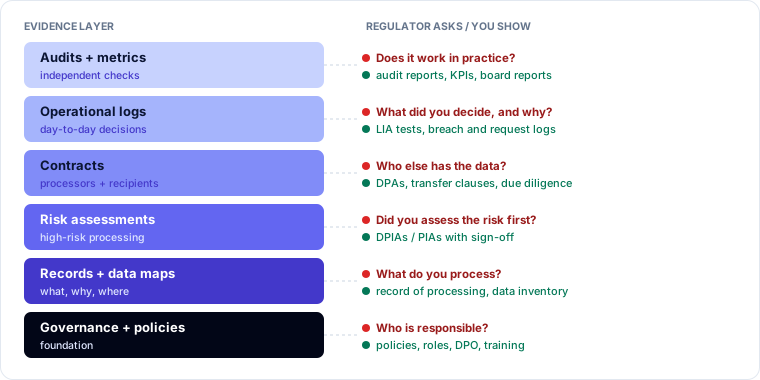
Accountability turns principles into evidence. Regulators increasingly ask not "did you comply?" but "show me how you know you comply". The usual evidence set is:
- policies and procedures approved by management
- records of processing describing each activity (lesson 3.2)
- risk assessments for high-risk processing (lesson 3.3)
- contracts with processors and data recipients (lesson 3.4)
- training records, audit reports and metrics
- logs of decisions: legitimate-interest balancing tests, breach assessments, rights-request handling
Worked example — testing a new feature against the principles
A fitness app wants to add "find workout buddies nearby", showing users within 2 km.
| Principle | Finding | Change made |
|---|---|---|
| Lawful and transparent | Location sharing with strangers is unexpected | Off by default; explicit opt-in screen explaining who sees what |
| Purpose limitation | Marketing team asks to reuse location for ads | Refused: incompatible purpose without separate consent |
| Minimisation | Exact GPS is not needed | Show distance bands ("under 2 km"), never coordinates |
| Accuracy | Stale locations mislead users | Location expires after 30 minutes |
| Storage limitation | No need for history | Keep only the latest location; no trail |
| Security | Stalking risk if location leaks | Rate-limit searches to stop triangulation; block and report button |
| Rights | Users must be able to leave | One-tap opt-out deletes the stored location |
| Accountability | Decisions must be provable | Privacy review recorded and approved by the privacy lead |
Key takeaways
- Global privacy laws share principles that trace back to the fair information practices and OECD guidelines.
- The core set: lawfulness, fairness and transparency; purpose limitation; minimisation; accuracy; storage limitation; security; individual rights; accountability.
- Each principle becomes a design question and a control.
- Accountability means being able to demonstrate compliance with records, assessments, contracts, training and audits.
Self-check
- Which principle does a "collect everything, we might need it later" approach break first?
- Give one control that supports storage limitation.
- What kinds of evidence demonstrate accountability?