
Privacy, data protection and personal data
In this lesson you will:
- Distinguish privacy, data protection and information security
- Decide whether information is personal data, using identifiability and context
- Recognise sensitive (special-category) data and why it carries extra rules
- Tell pseudonymised data from anonymised data, and explain why the difference matters
Every organisation collects information about people: customers, employees, patients, students, visitors to a website. How that information is gathered, used, shared and eventually deleted is what privacy law regulates. This lesson builds the vocabulary that the rest of the course depends on.
1. Three related ideas
Privacy is a person's ability to control information about themselves and to be left alone. It is a human value and, in many countries, a constitutional or fundamental right. India's Supreme Court recognised it as a fundamental right in 2017; the EU Charter of Fundamental Rights lists both respect for private life and the protection of personal data.
Data protection is the set of rules and practices that make privacy real when organisations process information. It answers practical questions: may we collect this, for what purpose, for how long, who may see it, and what must we tell the person?
Information security protects information of every kind, personal or not, against loss of confidentiality, integrity and availability. Security is necessary for privacy but not sufficient: a perfectly secured database can still be used unlawfully, for example to profile people who were never told.
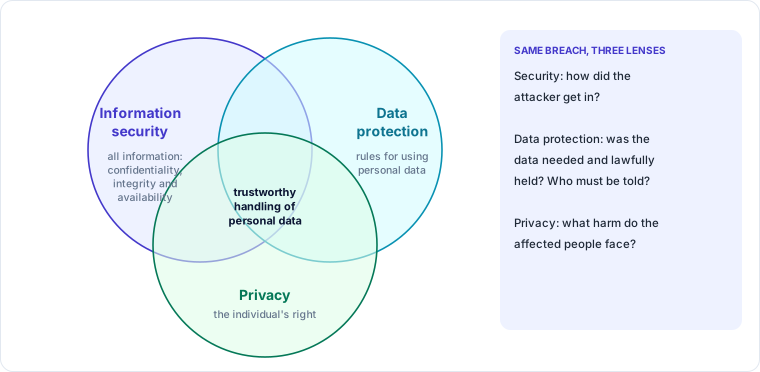
| Question | Security asks | Privacy asks |
|---|---|---|
| Who can access it? | Is access authorised and logged? | Should anyone have it at all? |
| What happens to it? | Is it protected from tampering and loss? | Is this use fair and expected by the person? |
| How long is it kept? | Is it backed up? | Is it still needed, or should it be deleted? |
2. What counts as personal data
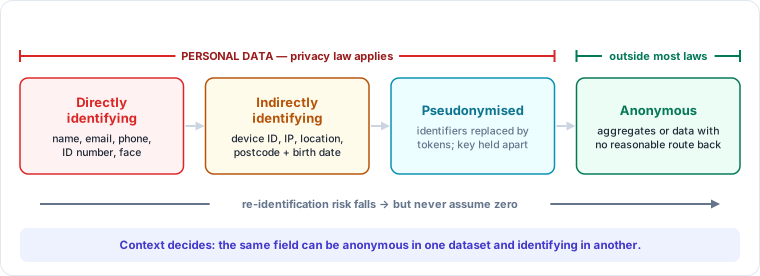
Most laws define personal data (also called personal information or PII) broadly: any information relating to an identified or identifiable living person. Three tests help.
- Does it relate to a person? Information about someone's behaviour, preferences, location, health or finances relates to them. So does an opinion about them.
- Is the person identified? A name with an address identifies someone directly.
- Or identifiable? Could someone single the person out, link records to them or infer who they are, using means reasonably likely to be used? Device IDs, IP addresses, cookie IDs, vehicle numbers, employee numbers and precise location are usually personal data because they can be linked back.
Identifiability depends on context. A postcode alone may describe thousands of people; postcode plus date of birth plus gender can single out most individuals in a country. These combinable fields are called quasi-identifiers.
🔐 Privacy lens
When you are unsure whether data is personal, treat it as personal. The cost of over-protecting a dataset is small; the cost of wrongly treating personal data as anonymous can be a breach of law, a fine and lost trust.
3. Sensitive personal data
Some categories can cause serious harm if misused: discrimination, exclusion, violence or loss of livelihood. Laws give them extra protection, usually requiring explicit consent or a specific legal ground and stronger safeguards. Names vary by law (special categories, sensitive personal information), but the lists overlap heavily:
- health, genetic and biometric data
- racial or ethnic origin, religious or philosophical beliefs, political opinions, trade-union membership
- sex life and sexual orientation
- financial account details, government identifiers and precise geolocation (in several laws)
- data about children, and data about criminal convictions (handled under separate rules in many laws)
India's DPDP Act does not create a separate sensitive category; it protects all digital personal data in the same way, with extra duties for children's data and for significant data fiduciaries. Knowing that laws differ here is part of working globally.
4. Pseudonymised versus anonymised data
Pseudonymisation replaces direct identifiers with a code (a token, a hash, a customer number) and keeps the key that links back separately. It is an excellent safeguard because it limits who can see identities. But the data is still personal data: anyone with the key, or enough other data, can re-identify people.
Anonymisation transforms data so that individuals can no longer be identified by anyone using means reasonably likely to be used. Truly anonymous data falls outside most privacy laws. In practice it is hard to achieve: rare combinations of attributes, free-text fields and linkage with public data defeat naive techniques such as just removing names.
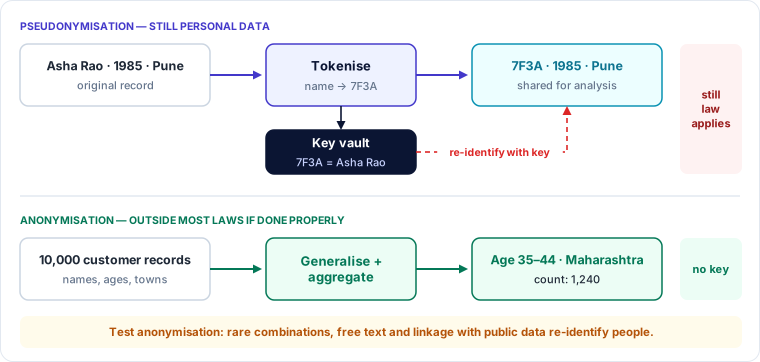
Worked example — is this dataset personal data?
A retailer wants to share "anonymised" loyalty data with a research partner.
| Field | Identifying? | Decision |
|---|---|---|
| Customer name, email | Direct identifiers | Remove |
| Loyalty number | Pseudonym; retailer holds the link | Replace with a new random code the partner cannot link back |
| Date of birth, postcode, gender | Quasi-identifiers; together they single out many people | Generalise: age band, first half of postcode, drop gender |
| Store visits with timestamps | Location trail; unique patterns | Aggregate to weekly counts per store |
| Free-text complaints | May contain names and phone numbers | Exclude |
Result: after generalisation the retailer tests re-identification risk (how many records share each combination). Because the retailer still holds the mapping, it records the shared set as pseudonymised personal data under a data-sharing agreement rather than calling it anonymous.
Key takeaways
- Privacy is the right; data protection is the rulebook for using personal data; security protects all data.
- Personal data is any information relating to an identified or identifiable person; identifiability depends on context and other available data.
- Quasi-identifiers combine to single people out.
- Sensitive categories need stronger legal grounds and safeguards, and lists differ between laws.
- Pseudonymised data is still personal data; anonymisation is hard and must be tested.
Self-check
- Give two examples of data that is personal even though it contains no name.
- Why can a perfectly secure system still breach privacy?
- A team hashes email addresses before analysis and keeps the original list. Is the result anonymous?