
The global privacy law landscape
In this lesson you will:
- Compare comprehensive, sectoral and hybrid models of privacy regulation
- Summarise the main features of major privacy laws around the world
- Work out when a foreign law applies to an organisation (territorial scope)
- Build a simple approach to complying with several laws at once
More than 140 countries now have data protection laws. You do not need to memorise them all. You need to know the main models, a handful of influential laws, and how to tell whether a given law reaches your organisation.
1. Three regulatory models
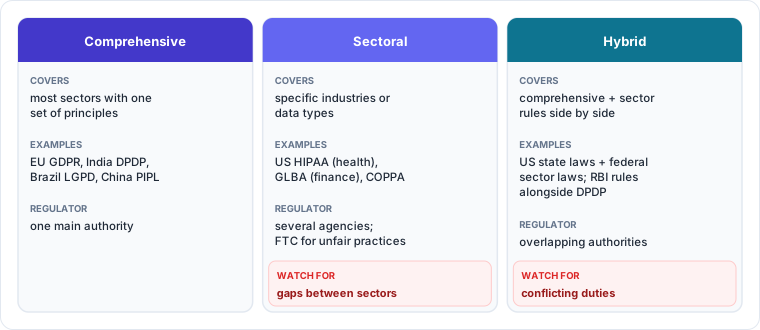
Comprehensive (omnibus) laws cover personal data across almost all sectors with one set of principles, rights and a regulator. GDPR, India's DPDP Act, Brazil's LGPD, China's PIPL and most new laws follow this model.
Sectoral laws regulate particular industries or data types. The United States is the classic example at federal level: health data under HIPAA, financial data under GLBA, children's online data under COPPA, credit reports under FCRA, plus the FTC's power against unfair and deceptive practices.
Hybrid systems combine both. The US now has comprehensive consumer privacy laws in about twenty states (California's CCPA as amended by the CPRA is the most developed), alongside federal sectoral laws. Many countries with omnibus laws also have sector rules for banking, telecoms or health, such as India's RBI and CERT-In directions.
2. Influential laws at a glance
| Law | In force | Notable features |
|---|---|---|
| EU GDPR | 2018 | The global reference: six legal bases, strong rights, DPIAs, 72-hour breach notice, fines up to 4% of global turnover, extraterritorial reach |
| UK GDPR + Data Protection Act 2018 | 2021 (post-Brexit) | Mirrors GDPR; amended by the Data (Use and Access) Act 2025 |
| India DPDP Act 2023 + Rules 2025 | Phased from Nov 2025 to 2027 | Consent-centred with defined "legitimate uses"; consent managers; verifiable parental consent for under-18s; penalties up to ₹250 crore |
| US state laws (e.g. California CCPA/CPRA) | 2020 onwards | Rights to know, delete, correct and opt out of sale or sharing; Global Privacy Control signals; dedicated California agency |
| Brazil LGPD | 2020 | GDPR-like, ten legal bases, national authority (ANPD) |
| China PIPL | 2021 | Separate consent for sensitive data and transfers; security assessments and localisation for large volumes |
| Singapore PDPA | 2014 (amended 2020) | Consent plus deemed consent and legitimate interests; breach notice within 3 days of assessment |
| Japan APPI | 2005 (amended 2022) | Rules on pseudonymously processed information and cross-border transfer consent |
| Australia Privacy Act 1988 | Amended 2024 | 13 Australian Privacy Principles; notifiable breaches scheme; statutory tort for serious privacy invasions |
Laws change often. In 2026 the EU was still negotiating a "Digital Omnibus" package that would adjust parts of GDPR, and India's DPDP obligations were being phased in. Always check the current text and official guidance before relying on a detail.
3. When does a law apply to you?
Most modern laws reach beyond their borders. Two triggers recur:
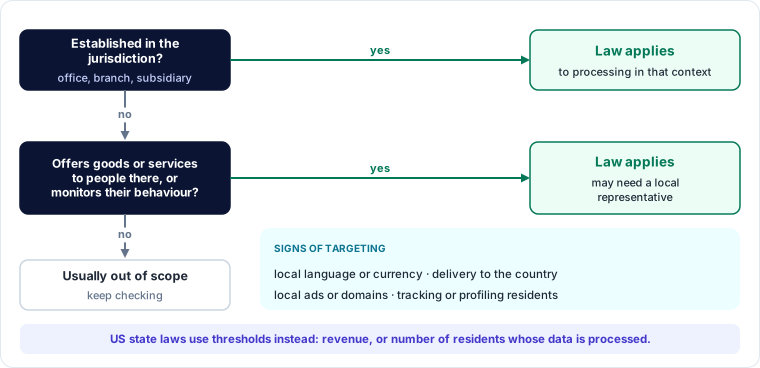
- Establishment: the organisation has an office, branch or subsidiary in the country and processes data in the context of its activities there.
- Targeting: the organisation, wherever it is, offers goods or services to people in the country or monitors their behaviour (tracking, profiling). GDPR and DPDP both use versions of this test. A website merely being accessible is not enough; signs of targeting include local language, currency, delivery or marketing.
US state laws use thresholds instead: for example annual revenue above a set amount, or processing data of more than a set number of residents.
🔐 Privacy lens
Scope is decided per processing activity, not per company. A Bengaluru start-up may be outside GDPR for its Indian customers but inside it for the analytics it runs on visitors it targets in Germany.
4. Complying with many laws at once
Global organisations rarely build a separate programme for each law. A practical approach:
- Map which laws apply to which processing activities and which people.
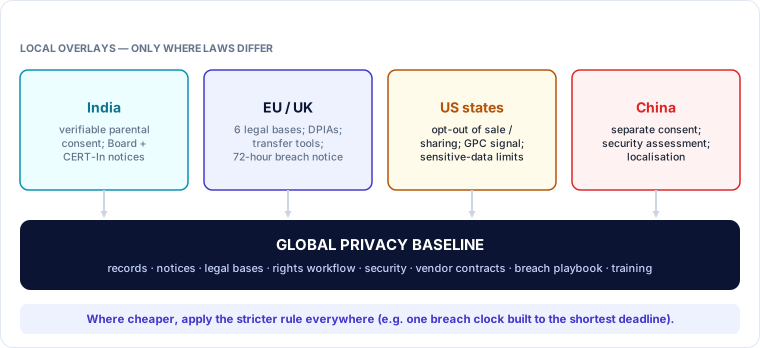
- Build a common baseline on the shared principles: records, notices, legal-basis decisions, rights handling, security, vendor contracts, breach response.
- Add local overlays where laws differ: consent ages, breach timelines, transfer rules, sale opt-outs, localisation.
- Choose "highest common denominator" defaults where it is cheaper to apply the stricter rule everywhere, such as one global breach playbook built to the shortest deadline.
- Monitor changes through a regulatory watch with clear owners.
Worked example — which laws apply to an online tutoring platform?
A company based in India runs an online tutoring platform with users in India, Germany and California, and a support team in the Philippines.
| Processing | Laws to consider | Why |
|---|---|---|
| Indian students' accounts and lessons | DPDP Act and Rules; CERT-In directions for incidents | Established in India; digital personal data |
| German students' accounts | GDPR | Targets people in the EU (German-language courses, euro pricing); EU representative needed |
| California users | CCPA/CPRA, if thresholds are met | Revenue or volume thresholds decide |
| Support staff in the Philippines viewing records | Transfer rules of each source law; Philippine Data Privacy Act for local staff data | Cross-border access counts as transfer |
| Children under 18 | DPDP verifiable parental consent; GDPR age of consent (13–16 by country); US COPPA for under-13s | Child protections overlap and differ |
Approach: one global baseline (records, notices, rights workflow, security, breach playbook) plus overlays for children's consent, EU transfers and California opt-outs.
Key takeaways
- Regulation follows three models: comprehensive, sectoral and hybrid.
- GDPR is the global reference point; DPDP, LGPD, PIPL, PDPA, APPI and US state laws share its core but differ in detail.
- Laws reach abroad through establishment and targeting tests or volume thresholds.
- Multi-law compliance works best as a common baseline plus local overlays, with a watch for legal changes.
Self-check
- What is the difference between a sectoral and a comprehensive privacy law?
- Name two signs that a foreign website is targeting people in a country.
- Why do many organisations build one breach playbook to the shortest deadline?