
Management review and board reporting (9.3)
In this lesson you will:
- List the inputs and outputs ISO 22301 requires for management review
- Run a management review that produces decisions, not just presentations
- Report operational and cyber resilience to the board in a way that supports oversight
- Connect management review with regulatory expectations of board accountability
Management review is where top management steps back and asks whether the BCMS is working and what should change. In regulated finance, the board's oversight of operational resilience sits above it. This lesson covers both: the ISO 22301 review and the board reporting that regulators expect.
1. What ISO 22301 requires
Top management must review the BCMS at planned intervals to ensure its continuing suitability, adequacy and effectiveness.
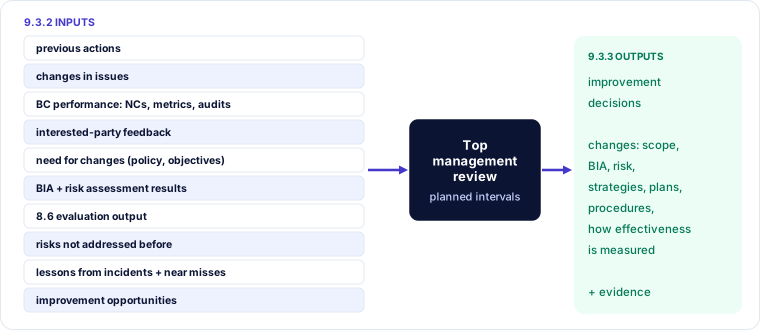
Inputs (9.3.2) must include consideration of:
- the status of actions from previous reviews;
- changes in external and internal issues relevant to the BCMS;
- information on BC performance, including trends in nonconformities and corrective actions, monitoring and measurement results, and audit results;
- feedback from interested parties;
- the need for changes to the BCMS, including the policy and objectives;
- procedures and resources that could improve BCMS performance and effectiveness;
- information from the BIA and risk assessment;
- the output from the evaluation of BC documentation and capabilities (8.6);
- risks or issues not adequately addressed in any previous risk assessment;
- lessons learned and actions arising from near misses and disruptions;
- opportunities for continual improvement.
Outputs (9.3.3) must include decisions related to continual improvement opportunities and any need for changes to the BCMS to improve its efficiency and effectiveness. That may cover variations to scope; updates to the BIA, risk assessment, strategies and solutions, and plans; modification of procedures and controls to respond to internal or external events; and how the effectiveness of controls will be measured. Results must be retained as documented information, and the organisation must communicate them to relevant interested parties and take appropriate action.
2. Running a review that decides
Common failure: a two-hour slide presentation that ends with "noted". Better practice:
- Circulate a pack in advance containing the dashboard, the 8.6 evaluation, audit and exercise findings, incidents and near misses, regulatory changes and customer feedback.
- Structure the meeting around decisions: approve tolerance changes, fund a gap, accept a residual risk, change scope, set next year's objectives.
- Record decisions with owners and dates in the minutes; these become actions tracked to the next review.
- Hold it at least yearly, and more often in the first year or after major incidents. Many BFSI organisations hold a short quarterly review at steering level and a full annual review.
- Integrate with the ISMS management review where the same leaders attend, but give the BCMS its own agenda items and outputs.
3. Board reporting
Regulators expect boards to own operational resilience: RBI's guidance places responsibility with the board and senior management; SEBI's CSCRF requires board-level oversight of cyber resilience; IRDAI routes BCP/DR results to the ISRMC. The Basel principles and the UK regime go further and expect board approval of tolerances and an annual self-assessment of resilience.
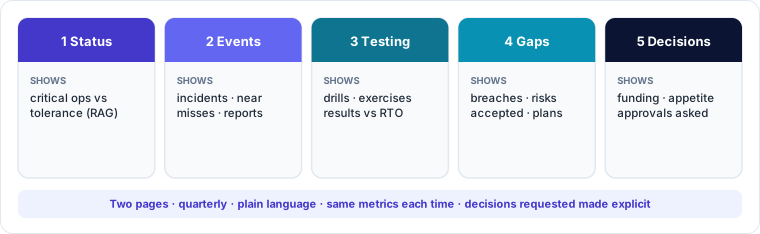
A board report should:
- show critical operations against tolerance, using RAG status with evidence;
- summarise incidents and near misses, including reporting timeliness and any tolerance breach;
- summarise testing: drills, cyber exercises and results versus RTO;
- set out gaps and accepted risks, with remediation plans and dates;
- state decisions requested explicitly (funding, appetite, approvals);
- stay short, consistent and in plain language: two pages, the same metrics each quarter, technical detail in an appendix.
Annual self-assessment. Even where not mandated, an annual written assessment covering critical operations, tolerances, mapping, scenario testing results, vulnerabilities and investment plans, approved by the board, is strong evidence of oversight. It also prepares the organisation if Indian requirements move in that direction.
Board competence. Board members need enough understanding to challenge. Short briefings, participation in an executive tabletop (Lesson 7.4) and access to independent views (internal audit, external reviewers) help.
Regulator lens
Inspectors read board and committee minutes. They look for evidence that the board approved critical operations and tolerances, received testing and incident information, challenged management, and made decisions such as funding remediation. Minutes that record only "the board noted the BCP update" suggest weak oversight.
Case study — Tarang Ledger: first management review (month 11)
Pack: dashboard (Lesson 8.1), 8.6 evaluation (Lesson 7.5), internal audit findings (Lesson 8.2), PA-1 incident review (Lesson 6.5), drill and clean-room reports, customer feedback from Sahyadri and two other NBFCs, and regulatory changes (IRDAI guidelines affecting a new insurance customer).
Decisions (minuted with owners and dates):
| Decision | Owner | Due |
|---|---|---|
| Fund incremental reconciliation to bring ransomware recovery under 12 h (₹12 lakh) | CTO | Month 14 |
| Extend BCMS scope to the insurance premium collection product | Anil | Month 13 |
| Accept, until month 14, the residual risk that full recovery after ransomware exceeds 12 h, relying on customers' workarounds; report to the board | CEO | Board, month 12 |
| Year-2 objectives: ransomware recovery ≤ 10 h; MTTD < 20 min; 100% supplier DR evidence | Meera | Month 12 |
| Proceed to ISO 22301 Stage 1 in month 12 | Anil | Month 12 |
The board's audit and risk committee receives the two-page report in month 12, approves the residual-risk acceptance with a dated remediation plan, and asks for a cyber tabletop for board members in year 2.
Key takeaways
- 9.3 management review at planned intervals with the required inputs, including BIA and risk results, the 8.6 evaluation, lessons from disruptions and near misses, and improvement opportunities.
- Outputs are decisions on improvement and changes (scope, BIA, risk, strategies, plans, procedures, measurement), retained and communicated.
- Run reviews around decisions with owners and dates, not presentations.
- Board reporting: tolerance status, events, testing, gaps and accepted risks, decisions requested; two pages, consistent and quarterly; consider an annual self-assessment.
Self-check
- Name four required inputs to an ISO 22301 management review.
- What distinguishes a useful board resilience report from a status presentation?
- What evidence of board oversight do inspectors look for in minutes?