
Nonconformity, corrective action and continual improvement (10.1, 10.2)
In this lesson you will:
- Apply the ISO 22301 nonconformity and corrective action process
- Distinguish correction from corrective action and find root causes
- Run a single corrective action log for audits, exercises, incidents and complaints
- Drive continual improvement of resilience over a multi-year horizon
Every source in this course produces findings: audits, exercises, drills, real incidents, supplier reviews, regulatory inspections and customer complaints. Clause 10 makes sure they lead to lasting change, not just quick fixes, and that resilience keeps improving as threats and the business change.
1. What ISO 22301 requires
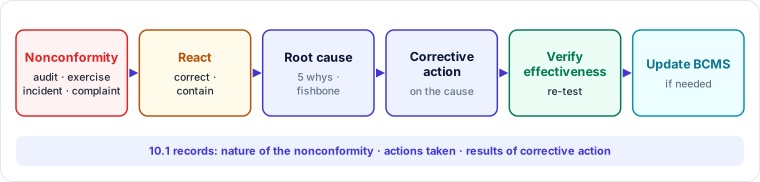
10.1 Nonconformity and corrective action. When a nonconformity occurs, the organisation must:
- react: take action to control and correct it, and deal with the consequences;
- evaluate the need for action to eliminate the causes, so that it does not recur or occur elsewhere, by reviewing the nonconformity, determining its causes and determining whether similar nonconformities exist or could occur;
- implement any action needed;
- review the effectiveness of any corrective action taken;
- make changes to the BCMS, if necessary.
Corrective actions must be appropriate to the effects of the nonconformities. Documented information must be retained as evidence of the nature of the nonconformities, any subsequent actions taken and the results of corrective action.
10.2 Continual improvement. Continually improve the suitability, adequacy and effectiveness of the BCMS, considering the results of analysis and evaluation and the outputs of management review, to determine needs or opportunities to improve.
2. Correction versus corrective action
| Correction | Corrective action | |
|---|---|---|
| What | Fix the specific problem now | Remove the cause so it does not recur |
| Example | Update the outdated phone number in the crisis contact list | Feed contact lists automatically from HR and test quarterly |
| Example | Add the new product to the BIA | Add a "BIA impact?" check to the product approval process |
Auditors look for both. A log full of corrections with no corrective actions suggests the same problems will recur.
3. Finding root causes
Simple, well-used techniques:
- Five whys: keep asking "why?" until you reach a cause you can act on, usually a process, design or governance gap rather than a person.
- Fishbone (Ishikawa) diagram: group possible causes under headings such as people, process, tools, information, measurement and suppliers.
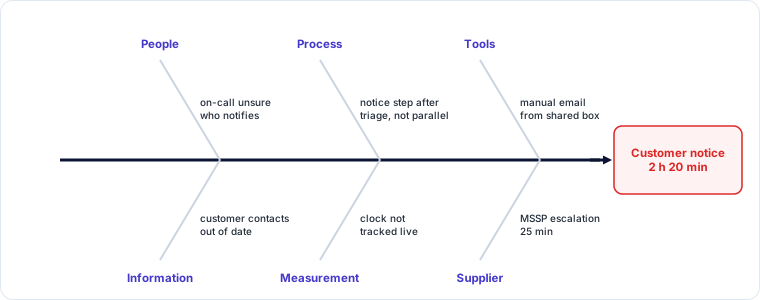
Also ask the clause 10.1 question: could this happen elsewhere? If one BC plan lacks stand-down criteria, check all plans. If one supplier's DR report is missing, check all critical suppliers.
4. One corrective action log
Run a single log for all sources: internal and external audits, exercises and drills, real incidents and near misses, 8.6 evaluations, regulatory inspections, customer audits and complaints. For each entry:
| Field | Purpose |
|---|---|
| Source and reference | Traceability |
| Description and requirement | What went wrong, against what |
| Correction | Immediate fix |
| Root cause | From analysis |
| Corrective action | What will remove the cause |
| Owner and due date | Accountability |
| Status and evidence | Closure proof |
| Effectiveness check | How and when verified (often a re-test) |
Report ageing and overdue items to the steering group and management review. Regulators often ask for this log or its equivalent, especially for drill observations and audit findings.
5. Continual improvement over years
Continual improvement is broader than fixing findings. It means raising resilience over time:
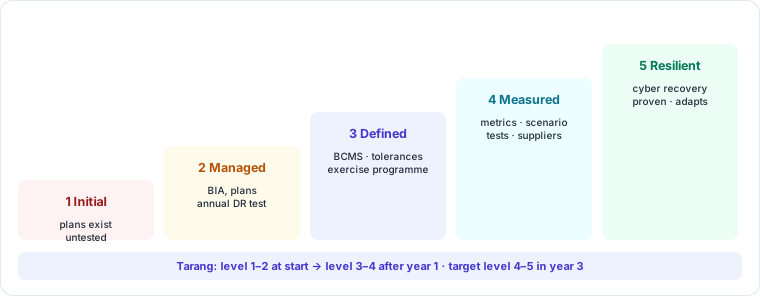
Improvement drivers include:
- tightening targets as capability grows (ransomware recovery from 12 hours to 10 hours to 8);
- new scenarios from sector incidents and threat intelligence;
- architecture changes that remove single points of failure;
- automation of failover, restore and notification;
- wider scope: new products, sites and suppliers;
- better integration with ERM, ORM, the ISMS and product management.
Use management review to set the improvement agenda for the year and the board report to track it.
Auditor lens
Auditors sample closed actions and ask for evidence of effectiveness. "Closed" because a document was updated is weaker than "closed" because the next drill showed the problem fixed. They also look for the extent-of-condition check ("could this occur elsewhere?") for significant nonconformities.
Case study — Tarang Ledger: the late customer notice
Nonconformity: in a real SEV-2 incident (suspected credential stuffing on the customer portal), the contractual 2-hour notice to NBFC customers was sent after 2 h 20 min.
Correction: the notice was sent; customers were told about the delay; Sahyadri recorded it in its outsourcing log.
Root cause (fishbone, Figure 8.8): the notification step came after full triage instead of starting in parallel with it. Notices were sent by hand from a shared mailbox. Two customer contacts were out of date. The MSSP escalated after 25 minutes. Nobody tracked the clock live.
Corrective actions:
| Action | Owner | Due |
|---|---|---|
| Incident tool starts a customer-notice timer at SEV-1/SEV-2 creation and pre-fills the template | Meera | Month 13 |
| Customer security contacts verified quarterly by customer success | Head of CS | Ongoing |
| MSSP contract SEV-1/2 escalation 15 min (already agreed, now monitored) | Meera | Month 12 |
| Playbook changed: notice runs in parallel with triage | Anil | Month 12 |
Extent of condition: the same weakness was found in the regulator-reporting step (CERT-In), and that was fixed with the same tool change. Effectiveness: verified in the year-2 cyber simulation, where the notice went out at 1 h 10 min.
Key takeaways
- 10.1: react and correct, find causes, check elsewhere, implement, verify effectiveness, update the BCMS, keep records.
- Correction fixes the instance; corrective action removes the cause.
- Use five whys and fishbone to reach process or design causes, not people.
- Keep one corrective action log for all sources, with owners, dates, evidence and effectiveness checks.
- 10.2: raise resilience continually through targets, scenarios, architecture, automation, scope and integration.
Self-check
- Give an example of a correction and the matching corrective action.
- What question does clause 10.1 ask beyond fixing the specific nonconformity?
- Why is a re-test stronger evidence of effectiveness than an updated document?