
Internal audit and regulatory audits (9.2)
In this lesson you will:
- Plan a risk-based BCMS internal audit programme that meets ISO 22301 clause 9.2
- Integrate BCMS audits with ISMS and regulatory audit requirements
- Prepare for SEBI cyber audits, RBI IS audits, supervisory inspections and customer audits
- Write audit findings that lead to real improvement
A BCMS in BFSI is audited from many directions: internal audit, the certification body, regulators' mandated audits, supervisory inspections and customers auditing their suppliers. Each asks similar questions with different emphases. A well-run internal audit programme prepares for all of them and makes sure problems are found internally first.
1. What ISO 22301 requires
Clause 9.2 requires internal audits at planned intervals to provide information on whether the BCMS:
- conforms to the organisation's own requirements for its BCMS and to the requirements of ISO 22301;
- is effectively implemented and maintained.
The organisation must plan, establish, implement and maintain an audit programme (frequency, methods, responsibilities, planning requirements and reporting) that takes into account the importance of the processes concerned and the results of previous audits. For each audit, define criteria and scope; select auditors who ensure objectivity and impartiality; report results to relevant management; take necessary actions without undue delay; and retain evidence.
ISO 19011 gives guidance on auditing management systems. ISO/TS 17021-6 sets competence requirements for BCMS auditors at certification bodies, and is a useful benchmark for internal auditors too.
2. The audit programme
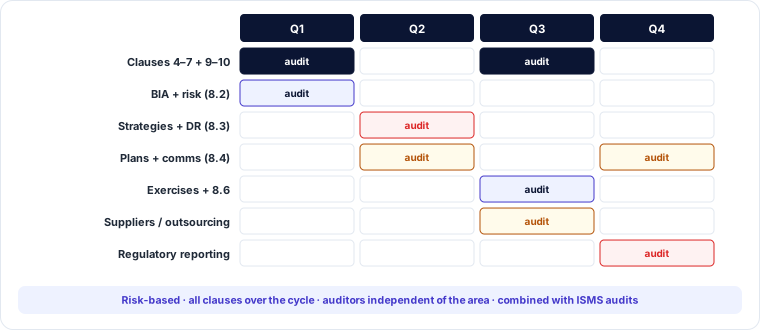
Design principles:
- Risk-based: audit high-risk areas more often, such as Tier 1 DR, third-party resilience and regulatory reporting.
- Full coverage over the cycle: every clause and every critical operation over the certification cycle (three years).
- Follow-up: re-audit areas with previous major findings.
- Integrated: combine with ISMS (ISO 27001) audits where processes are shared (document control, competence, management review, incident management), with a BCMS-competent auditor on the team.
- Independent: auditors must not audit their own work. The BCM manager should not audit the BIA they ran.
Process-based audits are more revealing than clause-by-clause checklists. Follow one critical operation from BIA to tolerance, strategy, plan, exercise, report and corrective action. Many gaps appear at the joins.
3. Regulatory and external audits
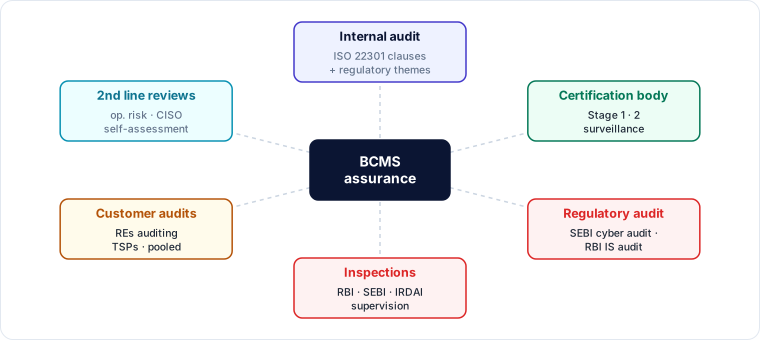
| Source | What to expect |
|---|---|
| SEBI cyber audits | Under CSCRF, MIIs and Qualified REs are audited twice a year, others annually, by CERT-In empanelled auditors; BCP/DR, incident handling and reporting are covered; findings reported to the governing board and SEBI as specified |
| RBI IS audit and inspections | Risk-based IS audits under the cyber and technology Directions; supervisory inspections review BCP/DR, drill results, outsourcing oversight and incident reporting |
| IRDAI | Information and cyber security audits per the 2026 guidelines, covering BCP/DR testing |
| Customer audits (for TSPs) | Regulated customers audit their material outsourcing providers; pooled audits reduce repetition |
| Certification body | Stage 1, Stage 2, surveillance and recertification against ISO 22301 (Lesson 8.5) |
| Second-line reviews | Operational risk and CISO reviews, control self-assessments |
Use one evidence base. The same drill report, BIA and corrective action log serve every auditor. Map regulatory audit checklists to the integrated requirements map (Lesson 1.5) so internal audit tests regulatory themes in advance.
4. Writing useful findings
A good finding has four parts:
| Part | Example |
|---|---|
| Requirement | ISO 22301 8.5 and RBI Directions: DR drills for critical systems at least half-yearly with results documented |
| Condition (what was found) | The reconciliation service, classified critical, was not included in the last two DR drills |
| Evidence | Drill reports of month 3 and month 9; critical systems register v2.1 |
| Impact | Recovery of a critical system is unproven; possible regulatory non-compliance |
Grade findings (major nonconformity, minor nonconformity, observation or opportunity for improvement) consistently with the certification body's approach. Report to management promptly, and track actions in the corrective action log (Lesson 8.4).
Auditor lens
Certification auditors check the internal audit programme itself: does it cover all clauses over the cycle? Is it risk-based? Are auditors independent and competent? Were findings acted on? A programme that audits only "easy" clauses, or audit reports with no findings year after year, raise doubts about effectiveness.
Case study — Tarang Ledger: first BCMS internal audit
Tarang's internal auditor (who already audits the ISMS) completes a BCMS competence course and is paired with an external BCMS lead auditor for the first audit in month 10. They use a process-based approach, following collections from BIA to drill.
Findings (extract):
| Grade | Finding |
|---|---|
| Minor NC (8.2.2) | The insurance premium collection product (launched month 8) was not included in the BIA |
| Minor NC (8.4.4) | The invoicing BC plan has no stand-down criteria |
| Minor NC (8.6) | No evaluation of PA-1's BC capability; DR report not obtained |
| Observation | Exercise reports rate results "good" without stating evidence against objectives |
| Strength | Drill pack for the regional failover is complete and timestamped |
All three nonconformities go into the corrective action log with owners and dates. Two Sahyadri auditors observed part of the audit as their annual outsourcing review and accepted the internal audit report as evidence, avoiding a separate customer audit.
Key takeaways
- 9.2: audit at planned intervals for conformity (own requirements and ISO 22301) and effective implementation; a programme based on importance and previous results; objective, impartial auditors; report; act; keep evidence.
- Make the programme risk-based, full-coverage over the cycle, integrated with ISMS audits and independent; prefer process-based audits that follow a critical operation end to end.
- Prepare for SEBI cyber audits (twice a year for MIIs and Qualified REs, by CERT-In empanelled auditors), RBI IS audits and inspections, IRDAI audits, customer and pooled audits and the certification body, using one evidence base.
- Write findings with requirement, condition, evidence and impact, graded consistently.
Self-check
- What two things must internal audits determine under clause 9.2?
- Why is a process-based audit following one critical operation useful?
- Who must conduct SEBI cyber audits for MIIs and Qualified REs, and how often?