
ISO 22301 certification, integrated audits and inspection readiness
In this lesson you will:
- Describe the ISO 22301 certification process and how to choose a certification body
- Plan an integrated ISO 22301 and ISO 27001 audit
- Keep a regulatory inspection readiness pack current
- Set a two-to-three-year roadmap to sustain and mature the BCMS
Certification is not the goal of a BCMS, but for many organisations, especially TSPs serving regulated customers, it is an important milestone. It gives independent assurance that customers and regulators recognise. This final lesson covers the certification process, combining it with ISO 27001, being ready for regulatory inspection at any time, and planning the years after the certificate.
1. The certification process
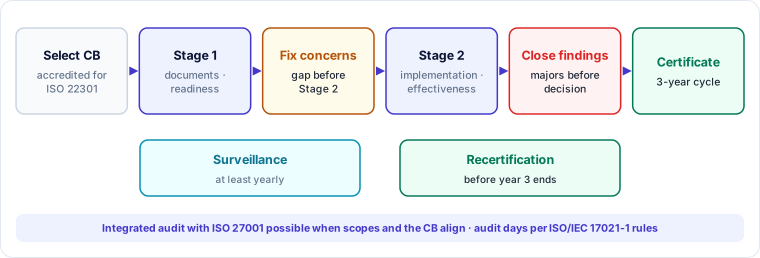
Choosing a certification body (CB). As with ISO 27001, choose a CB that is accredited for ISO 22301 by a recognised accreditation body (NABCB in India, or others in the international accreditation network). Check auditor competence in BFSI and cyber resilience, and whether the CB can run integrated audits with your ISO 27001 certification.
Readiness before Stage 1. Typical expectations:
- the BCMS has operated for long enough to produce records, often 3–6 months;
- BIA and risk assessment complete and approved;
- strategies selected and the critical ones implemented;
- plans in place;
- at least one exercise programme cycle started, with exercises run and reported;
- one internal audit and one management review completed.
Stage 1 reviews documentation, scope, the BIA and risk assessment, the exercise programme, and readiness for Stage 2. Stage 2 evaluates implementation and effectiveness. Auditors interview the executive owner and plan owners, sample exercise reports and drill packs, trace one critical operation end to end, test document availability, and review corrective actions.
Findings. Major nonconformities must be closed, with evidence, before the certification decision. Minor ones need an accepted action plan. Then come annual surveillance audits and recertification before the third year ends.
The certificate states the scope, products and services, and sites. Make sure it matches what customers rely on. A certificate for "IT infrastructure" will not satisfy a customer whose concern is collections.
2. Integrated audits with ISO 27001
Because both standards share the harmonized structure, an organisation certified to ISO 27001 can often:
- run combined surveillance or recertification audits covering both standards;
- share evidence for common clauses: context, leadership, competence, documented information, internal audit, management review and corrective action;
- reduce total audit days compared with separate audits, depending on the CB's rules.
The ISMS and BCMS also reinforce each other at the control level: ISO 27001 controls 5.29 (security during disruption), 5.30 (ICT readiness), 8.13 (backup) and 8.14 (redundancy) are implemented and tested through the BCMS. Make sure the scopes align or are explained.
3. Inspection readiness
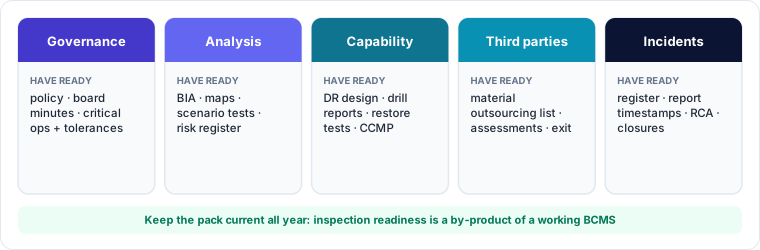
Regulatory inspections, whether RBI supervisory reviews, SEBI inspections or IRDAI audits, may come with little notice. Keep a readiness pack current at all times:
| Area | Evidence |
|---|---|
| Governance | Board-approved BC and cyber policies; critical operations and tolerances with approval dates; committee minutes showing oversight |
| Analysis | BIA; dependency maps; scenario library and test results; risk register |
| Capability | DR architecture; drill reports with times; restore and clean-room tests; CCMP; exercise programme and reports |
| Third parties | Material outsourcing register; continuity assessments; contract clauses; exit plans and tests |
| Incidents | Incident register with detection and reporting timestamps; RCAs; corrective action status |
| Assurance | Internal audit reports; regulatory audit reports (for example SEBI cyber audits) and closure status; certificates |
If the BCMS works, the pack is a by-product. Each item already exists as a BCMS record. Assign an owner to check it quarterly.
4. Sustaining the BCMS: a roadmap
Certification at the end of year one is the start of the cycle, not the end. A typical roadmap:
| Year | Focus |
|---|---|
| Year 1 | Establish: BIA, tolerances, strategies, plans, first exercises, first audit and review, certification |
| Year 2 | Prove and deepen: tighter targets (for example ransomware recovery), wider scope, supplier joint tests, board cyber tabletop, automation of failover and notification |
| Year 3 | Mature: scenario testing of all critical operations, annual board self-assessment, sector exercises, recertification, alignment with any new regulatory requirements |
Keep watching the regulatory environment. Indian instruments have changed rapidly (RBI's 2026 Directions, IRDAI's 2026 guidelines, SEBI's 2025 CSCRF clarifications), and the BCMS must absorb such changes through clause 4.2.2 and management review.
Auditor lens
In Stage 2, auditors look for a living system: exercises with real findings, corrective actions closed with evidence, management review decisions that changed something, and staff who know their roles. A perfect set of documents with no evidence of operation fails. An imperfect but honest system that finds and fixes its own gaps usually succeeds.
Case study — Tarang Ledger: certification and year 2
Stage 1 (month 12): one area of concern. The insurance premium collection product was being added to scope, and the CB asked for the updated BIA and plan before Stage 2.
Stage 2 (month 13), combined with the second ISO 27001 surveillance audit. Auditors traced collections from Sahyadri's tolerance to Tarang's BIA, DR design, drill pack, clean-room report and corrective actions. Findings:
- Minor NC: the invoicing BC plan's contact appendix was updated but the printed crisis pack in Bengaluru was an old version.
- Observation: consider customers' participation in the cyber simulation as a standard part of the programme.
- No major nonconformities. Certificate issued for "the provision of collections, invoicing, customer portal and API services, including insurance premium collection, from Pune and Bengaluru and supporting cloud regions".
Year-2 roadmap approved at management review: ransomware recovery ≤ 10 h; automated regional failover; joint DR test with PA-1; board cyber tabletop; annual resilience self-assessment shared with major customers.
Sahyadri records Tarang's certificate and drill evidence in its outsourcing file. Its own year-2 plan includes scenario testing of all four critical operations and an annual board self-assessment, ahead of any formal requirement.
Key takeaways
- Choose a CB accredited for ISO 22301; be ready before Stage 1 (operating records, BIA, strategies, plans, exercises, internal audit, management review).
- Stage 1 checks readiness; Stage 2 checks effectiveness; close majors before certification; then surveillance and recertification. Make sure the certificate scope matches what customers rely on.
- Integrate with ISO 27001 audits and controls 5.29, 5.30, 8.13 and 8.14; align scopes.
- Keep an inspection readiness pack current: governance, analysis, capability, third parties, incidents and assurance.
- Follow a multi-year roadmap: establish, prove and deepen, mature; track regulatory change.
Self-check
- What should normally be complete before an ISO 22301 Stage 1 audit?
- Which ISO 27001 Annex A controls are most directly tested through the BCMS?
- Name four items in a regulatory inspection readiness pack.