
Warning and communication: staff, customers, regulators and media (8.4.3)
In this lesson you will:
- Describe the warning and communication procedures ISO 22301 requires
- Build a communication matrix for staff, customers, regulators, partners, media and the board
- Prepare templates, channels and fallbacks that work during a disruption
- Set a communication cadence that maintains trust
In many disruptions, how an organisation communicates shapes the outcome as much as how fast it recovers. Customers forgive outages more readily than silence. Regulators react badly to learning about incidents from the news. Staff who hear nothing fill the gap with rumour. Clause 8.4.3 makes communication a planned capability.
1. What ISO 22301 requires
The organisation must document procedures for:
- communicating internally and externally with relevant interested parties, including what, when, with whom and how;
- receiving, documenting and responding to communications from interested parties, including any national or regional risk advisory system or equivalent (for example weather warnings or CERT-In advisories);
- ensuring the availability of the means of communication during a disruption;
- facilitating structured communication with emergency responders;
- providing details of the organisation's media response following an incident, including a communications strategy;
- recording the details of the disruption, the actions taken and the decisions made.
Where applicable, it must also consider and implement procedures for alerting interested parties potentially affected by an actual or impending disruption, and for interoperability of multiple responding organisations and personnel. Warning and communication procedures must be exercised as part of the exercise programme.
2. The communication matrix
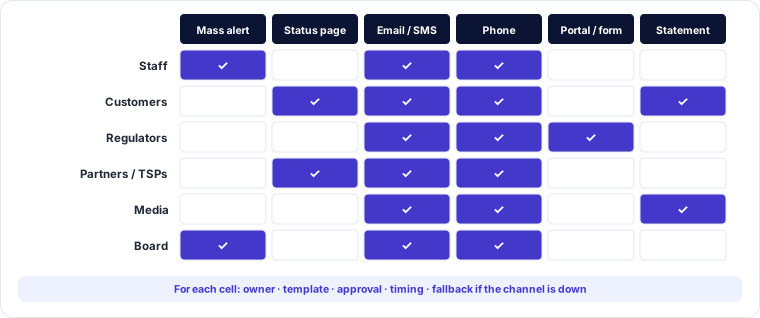
For each audience, define the owner, message templates, approval route, timing and fallback channel:
| Audience | What they need | Owner | Notes |
|---|---|---|---|
| Staff | Safety, where to work, what to tell customers, what not to say | HR + internal comms | Mass notification with acknowledgement; manager cascades |
| Customers | Is my money safe? Can I transact? What should I do? When will it be fixed? | Customer service + comms | Status page, SMS, app banners, IVR messages; branch scripts |
| Regulators | Facts, impact, actions, timeline, formal reports | Compliance + CISO | Reporting matrix (Lesson 5.5); relationship managers called early |
| Payment-system operators, exchanges | Operational impact on shared systems | Operations | Operator-specific channels and rules |
| Partners and suppliers | Coordination; their action needed | Vendor management | Pre-agreed contacts both ways |
| Corporate customers (for TSPs) | Contractual notices, technical details for their own reporting | Customer success + CISO | Named contacts; notice windows |
| Media and social | Accurate public statement | Communications, approved spokesperson | Holding statements; monitor social media |
| Board | Situation, decisions needed, regulatory exposure | CEO or company secretary | Scheduled briefings |
| Emergency services | Site access, hazards, people | Facilities | Building plans and contacts ready |
3. Making communication work during a disruption
The disruption may take out the channels you normally use:
- Mass notification tool hosted independently of corporate systems, with current staff data fed from HR.
- Status page hosted outside your own infrastructure.
- Out-of-band voice and messaging for crisis teams; printed contact lists.
- Pre-approved templates for the most likely scenarios: outage, cyber incident, data breach, branch closure, natural disaster. Pre-approval by legal and communications saves hours.
- Spokespeople named and trained, with deputies.
- Language: customers in India may need messages in regional languages as well as English and Hindi.
- Social media monitoring to spot misinformation and customer distress early.
Interoperability. Where several organisations respond together, such as a bank and its TSP or an exchange and its members, agree in advance on contacts, bridges, terminology and who speaks publicly about what.
4. Cadence and tone
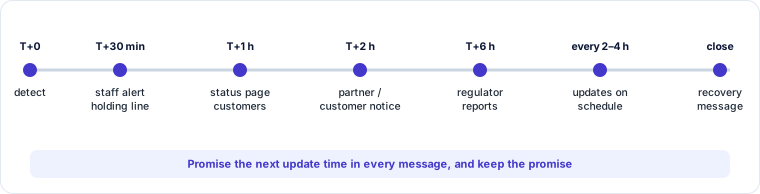
Principles that maintain trust:
- Speak early, even if all you can say is that you know and are working on it.
- Be accurate: never say "no customer data was affected" until you know.
- Tell people what to do: an alternative channel, what to ignore (phishing lures often follow public incidents) and whom to contact.
- Promise the next update time and keep the promise.
- Be consistent across channels and audiences, using one fact base.
- Show empathy: acknowledge the inconvenience and harm.
- Close the loop with a recovery message and, for significant events, a summary of what happened and what will change.
Auditor lens
Auditors ask to see templates and the evidence that warning and communication procedures were exercised (clause 8.4.3.2 makes this explicit). They often test a call tree or mass notification and compare response rates with the plan's assumptions. A mass notification test reaching 60% of staff when the plan assumes 95% is a finding.
Case study — Sahyadri: customer communication for a collections outage
Sahyadri prepares a communication kit for CO-02:
| Time | Channel | Message (summary) | Approver |
|---|---|---|---|
| T+30 min | Branch and call-centre script | "Online EMI payments are temporarily unavailable. You can pay at any branch or through [bank payment link]. Late fees will not apply for today." | Head of collections (pre-approved) |
| T+45 min | SMS to borrowers with EMIs due in 3 days (sent through the second SMS gateway) | Same, with the bank payment link and the next update time | Pre-approved |
| T+1 h | App banner and website | Same | Digital head |
| T+2 h | Co-lending partners and NACH sponsor bank | Operational impact and workaround | Treasury head |
| On recovery | SMS and app | "Online payments restored. Payments made through alternative channels are reflected in your account by [date]." | Head of collections |
The late-fee waiver is pre-approved by the board for outages caused by Sahyadri or its suppliers. This removes a decision from the crisis and reassures borrowers. The kit is exercised in the cyber tabletop (Lesson 5.5); the SMS was sent to a test group of 200 staff, reaching 97% within 5 minutes.
Key takeaways
- 8.4.3 covers what, when, with whom and how; receiving communications and advisories; availability of means; emergency responders; media; recording; alerting; interoperability; and exercising.
- Build a matrix for staff, customers, regulators, operators, partners, media, board and emergency services, with owners, templates, approval and fallbacks.
- Host notification and status pages outside your infrastructure; pre-approve templates; train spokespeople; consider regional languages.
- Speak early, accurately and consistently; tell people what to do; promise and keep update times.
Self-check
- Name four elements ISO 22301 clause 8.4.3 requires communication procedures to cover.
- Why should a status page be hosted outside the organisation's own infrastructure?
- What should every update message include to maintain trust?