
Business continuity plans that work (8.4.4)
In this lesson you will:
- List what ISO 22301 requires business continuity plans to contain
- Structure a set of plans so that they are usable under pressure
- Write a time-phased BC plan for a critical operation
- Keep plans current and accessible
A BC plan is read under stress, often at night, by someone who may not have written it, possibly from a phone. Many plans fail this test: 80 pages of policy language, an organisation chart from three years ago and no clear first step. This lesson covers what ISO 22301 requires and how to write plans people can actually use.
1. What ISO 22301 requires
Clause 8.4.4 requires documented plans and procedures that help teams respond to a disruption and continue or recover prioritised activities within the identified timeframes. The plans collectively must contain:
- details of the actions teams will take to continue or recover prioritised activities within the predetermined timeframes, and to monitor the impact of the disruption and the response;
- reference to the pre-defined thresholds and the process for activating the response;
- procedures to enable delivery of products and services at the agreed capacity;
- details to manage the immediate consequences of a disruption, with regard to the welfare of individuals, the prevention of further loss or unavailability of prioritised activities, and the impact on the environment.
Each plan must include:
- purpose, scope and objectives;
- roles and responsibilities of the team that will implement it;
- actions to implement the solutions;
- information needed to activate (including activation criteria), operate, coordinate and communicate the team's actions;
- internal and external interdependencies;
- resource requirements;
- reporting requirements;
- a process for standing down.
Every plan must be usable and available at the time and place it is needed.
2. A set of plans, not one document
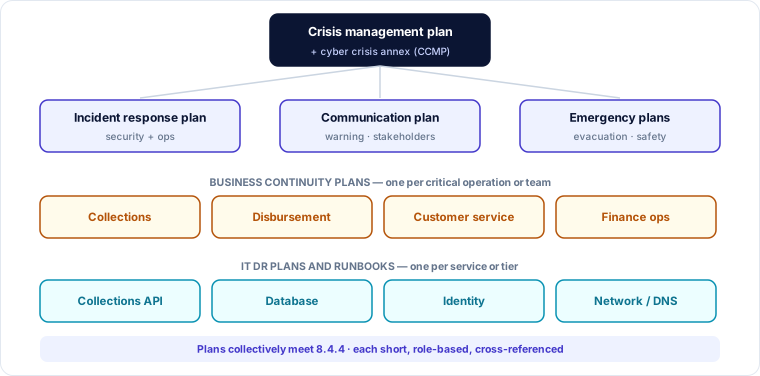
Note the word "collectively": ISO 22301 does not require one big plan. A typical BFSI plan set includes:
- a crisis management plan with the cyber crisis annex (CCMP);
- an incident response plan (security and operations, one severity scheme);
- a communication plan with templates;
- emergency plans for sites (evacuation, shelter, first aid);
- BC plans per critical operation or team (collections, disbursement, customer service, treasury);
- IT DR plans and runbooks per service or tier (Lesson 6.4).
Cross-reference them, and avoid repeating content that will go out of date in several places at once, contact lists especially.
3. Anatomy of a usable BC plan
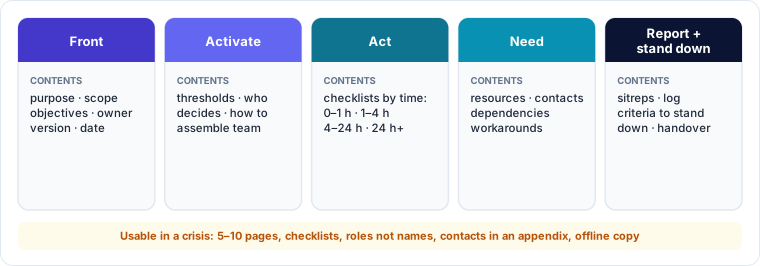
Design rules that make plans usable:
- 5 to 10 pages for a team plan, plus appendices.
- Checklists by time phase: first hour, 1–4 hours, 4–24 hours, beyond 24 hours. People under stress follow lists well and prose badly.
- Roles, not names, in the body ("collections operations lead"). Names and numbers go in a contact appendix that is updated automatically.
- Decision points stated clearly: "If the Tarang platform is not expected back within 2 hours, switch borrowers to the bank payment page."
- Workarounds described step by step, with forms and templates attached.
- Scenario-independent where possible. Plan for the loss of resources (people, premises, technology, information, suppliers), not for each cause. A short scenario-specific annex can cover cyber, where the response differs.
- Version, date and owner on every page; review at least yearly and after changes.
4. Welfare and immediate consequences
Plans must address the welfare of individuals and immediate consequences. In practice:
- staff safety and accounting for people;
- support for staff working extended hours (transport, food, rest);
- customer welfare: vulnerable customers, waivers, hardship;
- preventing further loss, such as stopping a corrupted batch job before it posts more transactions;
- environmental impact where relevant, for example generator fuel, or disposal of damaged equipment after a fire.
5. Keeping plans current and available
- Triggers for review: organisational change, new systems or suppliers, BIA updates, exercise findings, incidents.
- Contact data fed from HR and the supplier register; tested quarterly with call trees or notification tests.
- Availability: offline and off-site copies (Module 2), including on phones, so plans can be reached when corporate systems are down.
- Version control: superseded versions withdrawn from crisis packs.
Auditor lens
Auditors pick a plan and check it against the 8.4.4 list: purpose and scope, roles, actions, activation information, interdependencies, resources, reporting and stand-down. Then they ask a team member to find the plan "as if the intranet were down" and to explain the first three actions. A plan the team has never seen is not usable, however complete.
Case study — Sahyadri: the collections BC plan (extract)
Purpose: keep borrowers able to pay EMIs and payments posted within tolerance (4 h peak, 12 h other days) when the collections channel is disrupted. Owner: head of collections. Version 1.2.
Activation: Tarang or internal monitoring reports payment links failing for > 15 minutes on a peak day (> 1 hour otherwise); or a Tarang notice of a SEV-1 incident.
| Phase | Actions (collections operations lead unless stated) |
|---|---|
| 0–1 h | Confirm the outage with Tarang (24×7 number); log the start time · Inform the head of collections and IMT · Decide: expected > 2 h? If yes, activate the bank payment page workaround · Send branch and call-centre scripts |
| 1–4 h | SMS to borrowers due within 3 days with the bank link (second gateway) · Monitor payments through the bank page every 30 min · Sitrep to IMT hourly |
| 4–24 h | Manual reconciliation of bank-page receipts (team of 6, remote) · Late-fee waiver applied · Daily NACH continues via the sponsor bank directly |
| 24 h+ | Consider exit-plan triggers with the CRO · Scale the reconciliation team to 16 (Nashik displacement) |
Dependencies: bank payment page (sponsor bank), SMS gateway 2, LMS, NACH portal. Resources: 6 laptops with VPN, bank portal access for two people. Reporting: sitreps hourly to IMT; daily summary to CRO. Stand-down: Tarang service stable for 2 hours with reconciliation complete; borrowers informed; handover to normal operations and post-incident review booked.
Key takeaways
- Plans collectively contain actions within timeframes, thresholds and activation, delivery at agreed capacity and management of immediate consequences (welfare, further loss, environment).
- Each plan has purpose and scope, roles, actions, activation information, interdependencies, resources, reporting and stand-down.
- Write short, time-phased checklists with roles not names, clear decision points and step-by-step workarounds.
- Keep plans current, available offline and known to the team.
Self-check
- What does "collectively" mean for the contents of BC plans under 8.4.4?
- Why should plans use roles rather than names in the body?
- Name four elements every individual BC plan must include.