
Response structure and incident command (8.4.1, 8.4.2)
In this lesson you will:
- Explain what ISO 22301 requires of the response structure
- Design strategic, tactical and operational response levels with clear roles and deputies
- Set pre-defined thresholds for activating each level
- Run effective crisis meetings, decision logs and situation reports
Plans do not respond to disruptions; people do. Clause 8.4 starts with the response structure: the teams, roles and authority that take over when normal management cannot cope. A good structure lets an organisation move from "something is wrong" to coordinated action in minutes, and scale up or down as the situation changes.
1. What ISO 22301 requires
8.4.1 General. Identify and document plans and procedures based on the strategies and solutions. Implement and maintain a response structure that enables timely warning and communication to relevant interested parties. Plans and procedures must be specific, precise and actionable.
8.4.2 Response structure. Implement and maintain a structure that identifies one or more teams responsible for responding to disruptions, with defined roles, responsibilities, authority and competence. Collectively, the teams must be able to:
- assess the nature and extent of a disruption and its potential impact;
- assess the impact against pre-defined thresholds that justify starting a formal response;
- activate an appropriate business continuity response;
- plan the actions to be taken;
- establish priorities, using life safety as the first priority;
- monitor the effects of the disruption and the organisation's response;
- activate the business continuity solutions;
- communicate with relevant interested parties, authorities and the media.
For each team there must be identified personnel and their alternates with the necessary competence, and documented procedures to guide their actions, including those for activating and standing down.
2. Three levels of response
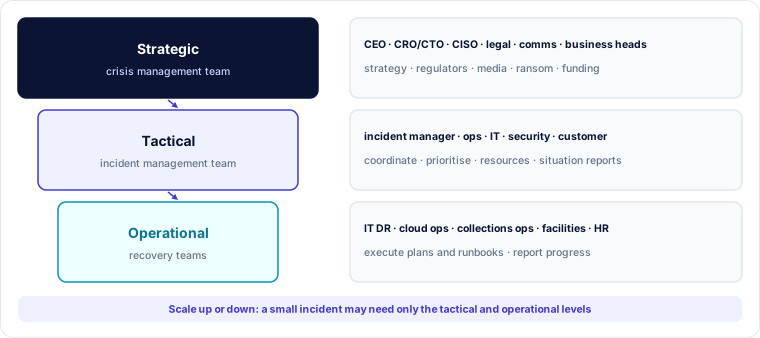
Many organisations use three levels, sometimes called gold, silver and bronze:
| Level | Team | Focus | Typical members |
|---|---|---|---|
| Strategic | Crisis management team (CMT) | Protecting the organisation: strategy, regulators, media, major spending, ransom, legal exposure | CEO (or deputy), CRO or COO, CTO, CISO, legal, communications, affected business heads |
| Tactical | Incident management team (IMT) | Coordinating response: priorities, resources, situation awareness, handoffs | Incident manager, operations, IT, security, customer service, BCM manager |
| Operational | Recovery teams | Executing plans and runbooks | IT DR, cloud operations, collections operations, facilities, HR |
Keep the levels separate in purpose. Crisis teams that start debugging servers, or recovery engineers who are pulled into every executive call, both slow recovery. The incident manager links the levels.
Scale to the event. A failed deployment may need only an operational team with a tactical lead. A ransomware attack needs all three, plus the cyber crisis annex. ISO 22320 (incident management) and ISO 22361 (crisis management) give guidance on structures and leadership.
3. Thresholds and activation
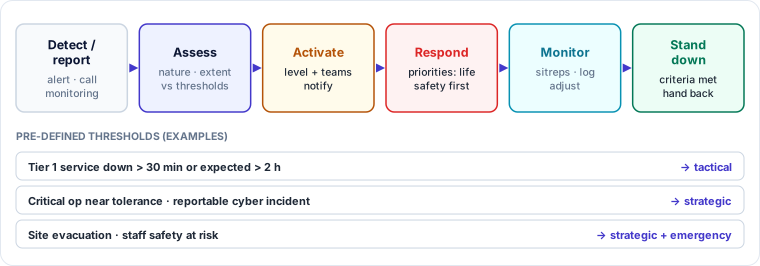
Pre-defined thresholds remove hesitation. Express them in terms people can judge quickly:
- Service: "Tier 1 service unavailable for 30 minutes, or expected to exceed 2 hours."
- Tolerance: "A critical operation is expected to come within 50% of its tolerance."
- Cyber: "Any suspected compromise of Tier 1 systems or customer data."
- Safety: "Any evacuation, injury or threat to staff."
- External: "Regulator or media inquiry about a disruption."
Name who can activate each level (with deputies) and how the team assembles: a conference bridge that works without corporate systems, a physical command room, or both. Activation should take minutes.
4. Running the response
The first meeting. Use a fixed agenda: situation (what we know, what we do not), impact on critical operations and tolerances, actions under way, decisions needed, communications, and the next meeting time.
Situation reports (sitreps). Short, scheduled updates from the tactical to the strategic level, and to the board where needed. Use a standard template so information is comparable.
Decision log. Record every significant decision: time, decision, options considered, rationale and owner. This protects decision-makers later, feeds regulatory reports and makes the post-incident review possible. ISO 22301's communication requirements also call for recording details of the disruption, actions taken and decisions made.
Fatigue. Disruptions can last days. Plan shift rotation for every team from the start. Exhausted people make poor decisions.
Stand-down. Define the criteria (critical operations back within normal parameters, backlog under control, monitoring stable) and the handover to normal management, including the post-incident review.
Auditor lens
Auditors check that every team has named members and alternates, that alternates have taken part in exercises, and that thresholds and activation authority are written down. In exercise reports they look for decision logs and sitreps. A structure that exists only as an organisation chart, never activated in an exercise, is weak evidence.
Case study — Tarang Ledger: response structure
| Level | Team | Lead (alternate) | Activated when |
|---|---|---|---|
| Strategic | Crisis management team | CEO (CTO) | SEV-1; any reportable cyber incident; Tier 1 outage expected > 2 h; media inquiry |
| Tactical | Incident management team | Incident manager on rota (head of cloud operations) | SEV-1 and SEV-2 |
| Operational | Cloud DR, database, app, customer success, finance ops | Team leads (named deputies) | As tasked by the IMT |
Practical arrangements:
- Bridge: a conferencing service on a separate tenant from corporate email, with dial-in numbers printed in crisis packs.
- Sitreps: every 60 minutes during SEV-1, using a one-page template (situation, customer impact, tolerance status, actions, decisions needed, next update).
- Decision log: a shared document in the separate plan repository, written by a designated scribe from customer success.
- Shifts: for incidents expected to exceed 8 hours, the IMT lead rotates every 8 hours; the CEO names a deputy chair overnight.
Key takeaways
- 8.4.2 requires teams with roles, authority, competence and alternates, able to assess, use thresholds, activate, prioritise life safety first, monitor, activate solutions and communicate.
- Use strategic, tactical and operational levels with separate purposes, linked by the incident manager; scale to the event.
- Write pre-defined thresholds and activation authority; assemble in minutes, without depending on corporate systems.
- Run the response with fixed agendas, sitreps, a decision log, shift rotation and clear stand-down criteria.
Self-check
- What is the first priority ISO 22301 sets for response teams?
- Why should the crisis management team not direct technical recovery in detail?
- What should a decision log record?