
IT disaster recovery plans and runbooks (ISO/IEC 27031, SP 800-34)
In this lesson you will:
- Structure an IT contingency or DR plan using NIST SP 800-34 and ISO/IEC 27031
- Write runbooks with sequenced steps, estimated times, owners and verification
- Plan DR declaration and failover decisions that meet regulatory time limits
- Keep DR documentation aligned with a changing technology estate
IT DR plans turn the technology strategies from Module 4 into actions. They are the most technical documents in the BCMS, and the ones most likely to drift out of date as architectures change. Done well, they let a team that has never failed over a system do it correctly at 3 am.
1. Two reference frameworks
NIST SP 800-34 Rev. 1 describes an information system contingency plan (ISCP) for each system:
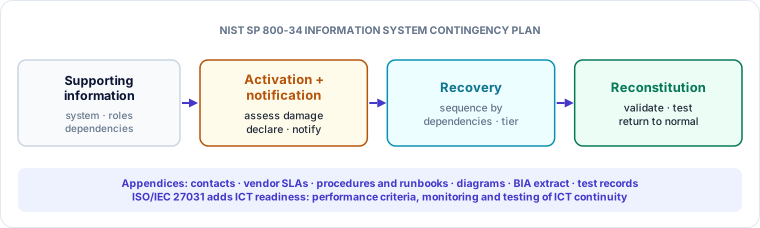
| Section | Contents |
|---|---|
| Supporting information | System description, architecture, roles, dependencies, BIA extract (RTO, RPO) |
| Activation and notification | Criteria for activation, damage assessment, who is notified and how |
| Recovery | Sequenced recovery procedures, escalation, alternate processing |
| Reconstitution | Validating data and functionality, testing, deactivating alternate site, returning to normal |
| Appendices | Contacts, vendor SLAs, detailed procedures, diagrams, inventory, test records |
ISO/IEC 27031:2025 frames this as ICT readiness for business continuity: establishing ICT continuity requirements from the BIA, designing readiness, implementing it, testing it, and monitoring performance against criteria. It connects to ISO/IEC 27001 control 5.30.
Use SP 800-34 for the plan structure and ISO/IEC 27031 for the readiness programme around it.
2. Plans versus runbooks
- DR plan: per service or tier. Covers when to activate, who is involved, what the recovery strategy is, dependencies and the overall sequence. Read by managers and incident leads.
- Runbook: per technical procedure. Step-by-step instructions an engineer follows, such as "promote DR database", "switch DNS" or "restore from vault into clean room". Read by the person doing the work.
A good runbook has:
- preconditions: what must be true before starting (for example, DR confirmed clean in a cyber event);
- numbered steps with the exact commands, consoles or scripts;
- estimated time for each step, so the incident manager can predict completion;
- an owner role for each step;
- a verification check after each significant step ("replica lag shown as 0; write test succeeds");
- rollback instructions where a step can fail;
- links to credentials processes (break-glass), never the credentials themselves.
Automation helps: scripted or pipeline-driven failover reduces error and time. But keep a manual path, and make sure the automation itself survives the disruption (it should not depend on the failed region or the compromised identity provider).
3. Declaring a disaster
Recovery time is often lost before any technical step begins, in deciding whether to fail over. DR plans should state:
- Who can declare a disaster (named roles with deputies).
- Criteria, such as Tier 1 down for 30 minutes with no fix expected, a provider-confirmed regional incident, or data corruption confirmed.
- Maximum decision time. SEBI requires MIIs to declare a disaster within 30 minutes of an incident and restore within 45 minutes. Other entities should set their own limits consistent with their RTOs.
- Cyber precondition: the CISO or IR lead confirms that DR is not compromised.
- Recording: the declaration time and decision-maker go in the decision log; the RTO clock is measured against it and against the start of the incident.
4. Dependencies and sequencing
DR plans must reflect the dependency maps (Module 3) and the recovery sequence (Lesson 5.2):
- identity, DNS, keys and secrets before applications;
- databases before the applications that use them;
- upstream feeds (bank files, aggregator APIs) checked and re-pointed;
- monitoring active in DR before handing over to the business.
State the expected overall time and compare it with the RTO. If the sum of the steps exceeds the RTO, the plan says so and the gap is in the risk register. Planning to meet an RTO you cannot meet is worse than reporting the gap.
5. Keeping DR plans current
- Change management integration: any change to a Tier 1–2 system asks "does this change the DR plan or runbook?"
- Infrastructure as code keeps DR environments consistent with production; drift detection flags differences.
- Test after significant change, not just on the annual calendar.
- Ownership: each plan and runbook has a technical owner who reviews it at least every six months for Tier 1.
Regulator lens
Regulators expect DR drills to follow the documented procedures, and they compare drill reports with plans. Inspectors ask: "Who declared the disaster in the last drill, at what time, and how long did each step take?" A drill run by the one engineer who wrote the scripts, without the runbook, proves little about readiness.
Case study — Tarang Ledger: the collections DR plan
Tarang's DR plan for collections (Tier 1) contains:
- Supporting information: architecture diagram, dependency map, BIA values (RTO 3 h; RPO 0 for confirmations via aggregator reconciliation, 5 minutes otherwise), target failover time 2 h.
- Activation: criteria and authority (CTO, deputy head of cloud operations); in cyber events, CISO confirmation that DR is clean.
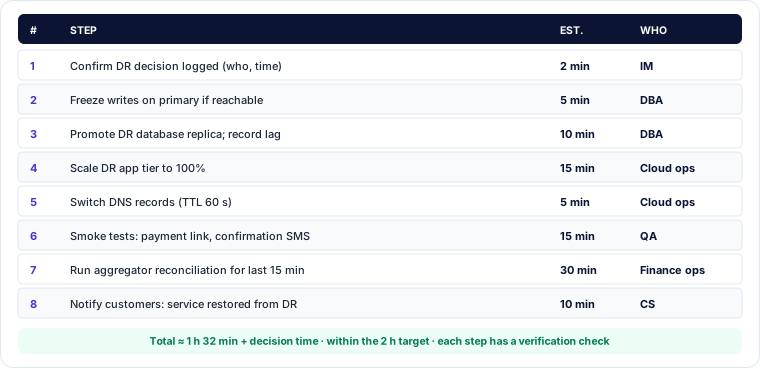
- Recovery: two runbooks. R-1 Regional failover (Figure 6.8, about 1 h 32 min plus decision time). R-2 Clean-room recovery (about 11–12 h, Lesson 5.2), used with customers' MBCO workarounds.
- Reconstitution: validation checklist (reconciliation complete, monitoring green, customers informed), then the fail-back runbook R-3, scheduled as a planned change outside peak days.
- Appendices: contacts, aggregator and SMS gateway DR IP registrations, cloud provider support escalation, last drill report.
The first walkthrough found that step 5 (DNS) required a token held in the primary region's secrets store. The token was moved to the replicated store, and R-1 now includes a verification that it is accessible from DR.
Key takeaways
- Use SP 800-34 for the ISCP structure (supporting information, activation and notification, recovery, reconstitution, appendices) and ISO/IEC 27031 for ICT readiness.
- Plans say what and when; runbooks say exactly how, with times, owners, verification and rollback.
- Define who declares, criteria, decision time limits (SEBI MIIs: 30 minutes to declare, 45 to restore) and the cyber precondition.
- Sequence by dependencies; compare total time with RTO and report gaps.
- Keep plans current through change management, IaC and testing after change.
Self-check
- What are the main sections of an SP 800-34 information system contingency plan?
- Name four features of a good runbook.
- Why should DR automation not depend on the primary region's identity provider?