
Recovery, restoration and return to business as usual (8.4.5)
In this lesson you will:
- Plan the return from temporary measures to normal operations
- Manage fail-back, backlog processing and data reconciliation safely
- Remediate customers and close regulatory obligations after a disruption
- Run a post-incident review that improves the BCMS
Many organisations plan the first hours of a disruption carefully and then improvise the return to normal. Yet the return is where some of the worst damage happens: rushed fail-backs that cause a second outage, backlogs processed twice, customers charged late fees for payments they made on time, and regulatory reports never closed. Clause 8.4.5 makes recovery a planned process.
1. What ISO 22301 requires
The organisation must have documented processes to restore and return business activities from the temporary measures adopted to support normal business requirements after a disruption. Simply put: you planned how to get onto your workarounds and DR, so plan how to get off them.
2. The stages of return
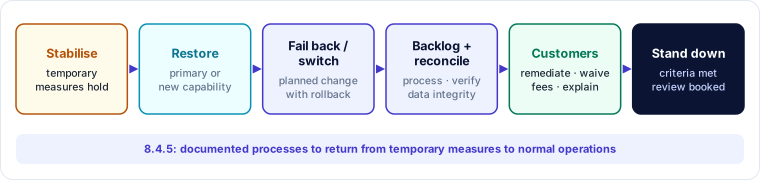
| Stage | Key activities |
|---|---|
| Stabilise | Make sure temporary measures (DR, workarounds, alternate sites) can run as long as needed; plan staffing and capacity |
| Restore | Repair or rebuild the primary capability, or decide to stay on the new one (sometimes DR becomes the new primary) |
| Fail back or switch | Treat as a planned change: approval, timing outside peaks, rollback plan, communication |
| Backlog and reconciliation | Process queued work in order; reconcile data across primary, DR and workaround channels; detect duplicates and gaps |
| Customers | Correct errors, waive charges, explain what happened, handle complaints |
| Stand down | Confirm criteria are met; hand back to normal management; book the review |
3. Fail-back done safely
Fail-back is often riskier than failover. During the disruption, data was written in DR or captured through workarounds, and it must come back without loss or duplication. Practices:
- Do not rush. Unless DR capacity or cost forces it, fail back at a quiet time, after the primary is proven stable.
- Reverse replication from DR to primary and verify that it has caught up before switching.
- Freeze or drain transactions briefly at the switch, with customers informed.
- Rollback plan: be able to return to DR if fail-back fails.
- After cyber incidents, fail back only to a primary environment that has been rebuilt and verified clean.
4. Backlog and data integrity
Disruptions create backlogs: payments captured manually, files not processed, claims not registered, trades not confirmed. The recovery process should:
- estimate the backlog size and the time to clear it at available capacity, and add staff or extend hours if needed (the BIA's "backlog cleared within 24 hours" is often part of the tolerance);
- process in a controlled order (by value date, regulatory deadline or customer impact);
- reconcile across all channels used during the disruption, such as the bank payment page, branch cash and the restored platform, to catch duplicates, missing items and misapplied payments;
- confirm control totals before declaring recovery complete.
5. Customers and regulators after the event
Customers:
- correct account errors (late fees, interest, bureau reporting) caused by the disruption;
- apply pre-approved waivers;
- explain what happened in plain language, and what will change;
- track complaints linked to the incident and respond within ombudsman timelines.
Regulators:
- submit follow-up and final reports, including root cause analysis, within the periods the regulator sets. SEBI, for example, has defined timelines for root cause analysis of technical glitches by market intermediaries;
- record any tolerance breach and the actions taken;
- update the board, and the regulator where required, on remediation progress.
6. The post-incident review
Every significant disruption, and every exercise, ends with a review that feeds improvement (clause 10). A good review:
- is blameless in tone but rigorous in finding causes;
- reconstructs the timeline from the decision log and system data;
- compares actual performance with the plan: RTO met? Tolerance kept? Thresholds right? Communications on time?
- identifies root causes, not just symptoms;
- produces actions with owners and dates in the corrective action log;
- checks whether the BIA, risk assessment, strategies or plans need updating.
Share the lessons with interested parties where appropriate, such as customers, regulators or the sector. Lesson 1.1 showed how much the industry learns from public incidents.
Auditor lens
Auditors look for evidence that the organisation planned the return as well as the response: fail-back runbooks, reconciliation procedures, customer remediation records and closed regulatory reports. For any real disruption in the audit period they trace the post-incident review to completed corrective actions.
Case study — Tarang and Sahyadri: a real (minor) disruption
In month 10, PA-1 (the primary aggregator) suffers a 3-hour outage on the 6th of the month. Tarang switches routing to PA-2 within 20 minutes; most borrowers notice nothing. The return to normal reveals issues:
| Issue | Root cause | Action |
|---|---|---|
| 412 payments confirmed by PA-1 just before the outage were not posted to loan accounts | PA-1's settlement file arrived 9 hours late; the reconciliation job assumed on-time files | Reconciliation now runs against PA-1's API as well as its file; alert if file is late |
| 38 borrowers charged late fees in error | Posting delay crossed the late-fee cut-off | Waivers applied automatically; rule changed to use payment confirmation time |
| Switching back to PA-1 was done at 17:00 on a peak day and failed once | No fail-back procedure; done ad hoc | Fail-back runbook written; switch only after 22:00 or next non-peak day |
Sahyadri records no tolerance breach (borrowers could pay throughout) but logs the posting errors as customer harm. The joint post-incident review is completed within 10 working days, and its actions are tracked in both companies' corrective action logs.
Key takeaways
- 8.4.5 requires documented processes to return from temporary measures to normal.
- Stages: stabilise → restore → fail back (planned change) → backlog and reconciliation → customers → stand down.
- Fail back carefully: reverse replication, a brief freeze, rollback plan and clean environments after cyber events.
- Reconcile across every channel used during the disruption; confirm control totals.
- Remediate customers, close regulatory reports and run a blameless, rigorous post-incident review with tracked actions.
Self-check
- Why is fail-back often riskier than failover?
- What should be reconciled after a disruption that used workaround channels?
- Name four things a post-incident review should compare or produce.