
Ransomware and destructive attacks: resilience patterns and recovery sequencing
In this lesson you will:
- Describe the stages of a modern ransomware attack and the resilience control for each
- Plan the order in which systems are recovered after a destructive attack
- Balance speed of recovery against forensic preservation and reinfection risk
- Prepare governance for decisions such as ransom demands and data-leak extortion
Ransomware is the most likely severe cyber disruption for a financial institution or its suppliers. The 2023 attack on a global bank's US broker-dealer and the 2024 attack on an Indian banking TSP showed how it can stop critical operations for days. This lesson treats ransomware as a continuity problem: how to keep critical operations going and recover cleanly.
1. Anatomy of an attack
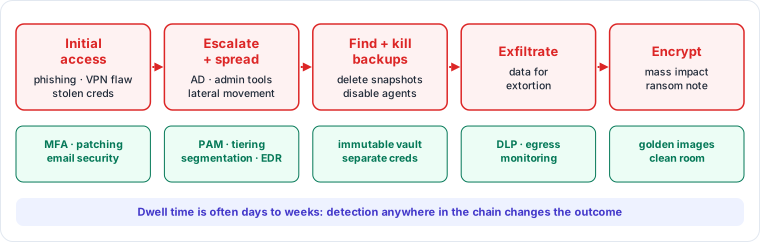
Most human-operated ransomware follows a pattern:
- Initial access: phishing, exploitation of an internet-facing system (VPN, firewall, file transfer), stolen credentials or a compromised supplier.
- Privilege escalation and lateral movement: harvesting credentials, abusing Active Directory or cloud IAM, and using legitimate admin tools.
- Finding and destroying recovery options: deleting snapshots and backups, disabling EDR and logging.
- Exfiltration: copying data to threaten publication (double extortion).
- Encryption or destruction: usually timed for nights, weekends or holidays to maximise impact.
The gap between initial access and encryption can be days or weeks. Detection at any stage changes the outcome, which is why Lesson 5.3 matters as much as backups.
2. Resilience patterns
| Pattern | What it achieves |
|---|---|
| Immutable, isolated backups (Lesson 4.4) | A clean copy survives even if administrators are compromised |
| Tiered administration and PAM | Compromise of a workstation or server does not give domain or cloud-wide control |
| Segmentation | Payment systems, core databases, backup and DR are not reachable from user networks |
| EDR everywhere with tamper protection | Detects and blocks common tools; harder to disable |
| Golden images and infrastructure as code | Rebuild rather than clean; faster, more trustworthy recovery |
| Out-of-band communication | Crisis team can coordinate if email, chat and phones on the corporate network are down |
| Offline copies of plans, contacts and network diagrams | Responders can work without corporate systems |
| Business workarounds at MBCO | Customers keep being served while IT recovers |
3. Recovery sequencing
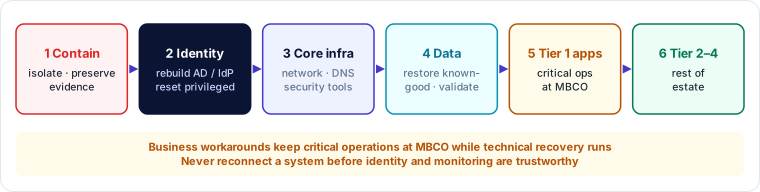
After a destructive attack you cannot simply restart everything. Dependencies dictate an order:
- Contain: isolate affected networks and systems, block attacker access paths, and preserve evidence (memory captures, logs, disk images of key systems).
- Identity: rebuild or recover the identity platform (Active Directory, cloud IAM, SSO) from a trusted state. Reset privileged accounts and service credentials. Rotate keys and secrets. Nothing else can be trusted until identity is.
- Core infrastructure and security tooling: networks, DNS, time, logging, EDR and monitoring, so you can see what happens next.
- Data: restore from known-good recovery points, through the clean room, and validate integrity.
- Tier 1 applications: in BIA priority order, at MBCO first.
- The rest of the estate: Tier 2–4, then full capacity and backlog clearance.
Build this sequence into IT DR plans before an incident. It should reflect the dependency maps and tiers from Module 3, and include estimated times for each step. Exercises (Module 7) test whether those estimates hold.
4. Speed versus safety
Recovery under ransomware involves real tensions:
| Pressure | Counter-pressure | Practical answer |
|---|---|---|
| Restore service fast | Restoring before eradication risks reinfection | Use workarounds to buy time; restore into the clean room |
| Wipe and rebuild infected systems | Forensics need evidence | Image key systems before rebuilding; agree evidence needs with forensics at the start |
| Tell customers quickly | Facts are uncertain | Issue holding statements; update on a schedule |
| Bring everything back at once | Monitoring may not be ready | Stage reconnection under heightened monitoring |
Pre-agree these trade-offs in the cyber crisis plan, with named decision-makers, so they are not argued from scratch at 3 am.
5. Governance decisions: ransom and extortion
Boards and crisis teams must be ready to decide on:
- Whether to pay a ransom. Payment does not guarantee decryption or deletion of stolen data, may fund further crime, and may raise legal and sanctions issues depending on the group involved. Regulators and law enforcement generally discourage payment. Decide the organisation's policy in advance, record who has authority, and involve legal counsel and law enforcement.
- Data-leak extortion. Plan for the publication of stolen data: legal assessment, DPDP breach notification, customer communication and monitoring of leak sites.
- When to restore. The crisis team, advised by IR and forensics, decides when systems are clean enough to reconnect.
Auditor lens
For ransomware readiness, auditors ask for: the recovery sequence with estimated times; evidence that identity can be recovered independently; the date of the last clean-room or full-restore test; and the documented ransom decision policy and authority. A plan that ends at "restore from backup" is incomplete.
Case study — Tarang Ledger: the ransomware recovery runbook
Tarang's IT DR plan now contains a destructive-attack annex with estimated times, built from the restore test and a tabletop:
| Step | Activity | Estimate | Owner |
|---|---|---|---|
| 0 | Customers switch borrowers to bank-hosted payment pages (MBCO workaround) | ≤ 1 h after decision | Customer success, with each customer |
| 1 | Contain: revoke sessions, isolate VPCs, preserve evidence (snapshots of affected volumes, logs exported to the vault) | 1–2 h | IR lead + cloud ops |
| 2 | Identity: recover cloud IAM from break-glass; rotate all admin and service credentials; rebuild SSO integration | 2–3 h | Cloud ops + security |
| 3 | Core: logging, EDR, DNS, CI/CD in the clean account | 1–2 h | Cloud ops |
| 4 | Data: restore last known-good database in clean room; integrity validation against aggregator totals | 5–6 h | DBA + finance ops |
| 5 | Tier 1 collections API and payment links live from clean environment | 1 h | App team |
| Total to Tier 1 | ≈ 11–12 h |
The board approves a policy that Tarang will not pay ransoms except by a board decision on legal advice where life or national security is at stake. The policy names the CEO as the person who convenes that discussion.
Key takeaways
- Ransomware moves through access → escalation → backup destruction → exfiltration → encryption, often over weeks; detection anywhere helps.
- Key patterns: immutable isolated backups, tiered admin and PAM, segmentation, EDR, golden images, out-of-band comms, offline plans, business workarounds.
- Recover in order: contain → identity → core infrastructure and security tools → data → Tier 1 → the rest, with estimated times.
- Pre-agree speed vs safety trade-offs and the ransom and extortion policy and authority.
Self-check
- Why must identity be recovered before applications after a destructive attack?
- What evidence should be preserved before rebuilding infected systems?
- Who should decide on a ransom payment, and when should that policy be set?