
Detection and the security operations centre
In this lesson you will:
- Explain why detection speed is a resilience capability
- Describe SOC models, including RBI's C-SOC expectation and SEBI's Market SOC
- Plan log sources, retention and detection use cases for critical operations
- Use threat intelligence and metrics to improve detection
You cannot respond to what you do not see. The time between an attacker's first foothold and the organisation noticing, the dwell time, largely decides whether an incident is a contained event or a multi-day disruption. Detection is therefore a resilience capability, and Indian regulators treat it that way.
1. Regulatory expectations
| Regulator | Expectation |
|---|---|
| RBI | Banks maintain a cyber security operations centre (C-SOC) for continuous monitoring, with capabilities scaled to size; NBFC and UCB requirements are proportionate to their layer or level |
| SEBI CSCRF | REs need SOC capability according to category. Smaller REs may use a Market SOC offered by exchanges or a third-party SOC; MIIs and Qualified REs need their own or a managed SOC with defined coverage |
| IRDAI | Continuous security monitoring and incident detection for insurers |
| CERT-In | Logs of ICT systems retained for 180 days within India and provided on request; time synchronised to specified NTP sources |
2. SOC models
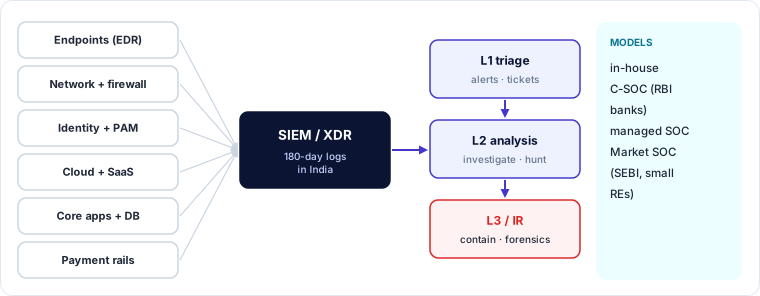
| Model | Strengths | Watch |
|---|---|---|
| In-house SOC | Deep knowledge of the business; control | Cost; 24×7 staffing; skill retention |
| Managed SOC (MSSP) | 24×7 coverage; economies of scale | Limited business context; clear escalation needed; the MSSP is a critical supplier |
| Hybrid | In-house for high-value use cases, MSSP for 24×7 triage | Clear division of responsibility |
| Shared or sector SOC (Market SOC) | Affordable coverage for small entities | Standardised use cases; check what is monitored |
Whichever model, the organisation remains responsible for detecting and responding to incidents and for meeting reporting deadlines. Contracts with MSSPs must define escalation times consistent with the six-hour regulatory clock.
3. Log sources and use cases for critical operations
Start from the critical operations and dependency maps. For each critical service, ask what an attacker would do and what log would show it.
| Source | Detects |
|---|---|
| Identity and PAM | Impossible travel, MFA fatigue, new admin accounts, privilege escalation |
| Endpoints (EDR) | Malware, credential dumping, use of admin tools, ransomware behaviour |
| Cloud control plane | Changes to IAM, logging disabled, snapshot or backup deletion, new regions used |
| Network and firewall | Lateral movement, command-and-control, large outbound transfers |
| Core applications and databases | Unusual queries, mass changes, admin activity outside change windows |
| Payment rails | Abnormal transaction patterns, beneficiary changes, out-of-hours volumes |
| Backup systems | Retention changes, deletion attempts, job failures, unusual change rates |
Resilience-specific use cases deserve priority: attempts to delete or modify backups, disabling of security tools, changes to logging, and mass data changes are strong signals that a destructive attack is imminent.
Log retention and protection. Keep logs for at least 180 days (CERT-In), in a store the attacker cannot alter. Make sure monitoring itself survives the disruption it is meant to detect. Monitoring hosted inside the compromised environment goes blind exactly when needed.
4. Threat intelligence
Threat intelligence feeds the anticipate goal. Sources relevant to Indian BFSI include:
- CERT-In advisories and its financial-sector CSIRT (CSIRT-Fin);
- sector information-sharing such as IB-CART (run by IDRBT for banks);
- regulator alerts and advisories;
- vendor and commercial threat reports;
- NCIIPC alerts for protected systems.
Use intelligence to update detection rules, the scenario library and exercise injects. Record what was received and what was done. "Received and filed" is not a process.
5. Measuring detection
| Metric | Why it matters |
|---|---|
| Mean time to detect (MTTD) | Shorter detection limits attacker progress |
| Mean time to respond / contain (MTTR) | Measures how quickly detection turns into action |
| Coverage | Percentage of critical assets sending logs and protected by EDR |
| Use-case coverage | Mapping detections to common attack techniques (for example MITRE ATT&CK) for critical services |
| True-positive rate | Too many false positives cause alert fatigue |
| Time to escalate to incident management | Drives whether the 6-hour reporting window can be met |
Test detection through purple-team exercises and red-team engagements (Lesson 7.4), not just by counting alerts.
Regulator lens
Inspectors check that critical systems actually send logs to the SOC, that logs are retained for the required period, and that alerts on critical assets are reviewed within defined times. They may pick an alert from the last month and trace it to the response.
Case study — Tarang Ledger: detection for the collections platform
Tarang uses a managed SOC for 24×7 triage with an in-house security engineer for tuning. Anil and Meera map detection to the collections dependency map and find gaps:
| Gap | Fix |
|---|---|
| Cloud backup deletion not alerted | New high-priority rule; alert pages on-call and the MSSP |
| MSSP escalation time "best effort" | Contract amended: SEV-1 escalation within 15 minutes, call to Tarang's incident manager |
| Logs stored in the production account | Log archive moved to the vault account with object lock; 365-day retention (exceeds CERT-In's 180 days) |
| No threat intelligence process | Subscribed to CERT-In advisories and an MSSP feed; weekly review records actions |
| Aggregator-side anomalies invisible | Daily reconciliation mismatch now raises an alert |
Measured MTTD for simulated attacks in the first purple-team exercise: 42 minutes. Target for year 2: under 20 minutes.
Key takeaways
- Dwell time decides whether an incident becomes a disruption, so detection is a resilience capability.
- RBI expects a C-SOC for banks; SEBI allows Market SOC or third-party SOCs for smaller REs; CERT-In requires 180-day logs in India.
- Prioritise use cases that signal destructive attacks: backup deletion, disabled security tools, logging changes, mass data changes.
- Keep monitoring and logs outside what they monitor; use threat intelligence with recorded actions; measure MTTD, MTTR and coverage.
Self-check
- Why should logs be stored outside the environment they monitor?
- What must a contract with a managed SOC specify to support the six-hour reporting clock?
- Name three detection use cases that signal an imminent destructive attack.