
Cyber resilience engineering: anticipate, withstand, recover, adapt
In this lesson you will:
- Explain the cyber resiliency goals, objectives and techniques in NIST SP 800-160 Vol. 2
- Relate them to NIST CSF 2.0 and SEBI CSCRF's resiliency goals
- Apply an assume-breach mindset to the design of critical services
- Select resilience techniques proportionate to a BFSI organisation
Cybersecurity has traditionally focused on keeping attackers out. Cyber resilience starts from a harder assumption: a capable adversary will eventually get in, and may already be inside. The question becomes whether critical operations can keep going, recover and improve despite that. This module builds cyber resilience into the BCMS. This first lesson provides the engineering vocabulary.
1. Why cyber is different from other disruptions
Most continuity planning assumes a non-adaptive cause: a fire does not follow you to the DR site. A cyber adversary is adaptive and persistent:
- they target recovery capabilities, deleting backups, disabling security tools and compromising administrators before striking;
- they spread: through replication, shared identity and trusted connections between production and DR;
- they wait: dwell times of weeks mean corruption may predate your recent backups;
- they return: incomplete eradication leads to reinfection;
- they extort, threatening to publish stolen data even after you recover.
Traditional DR, which fails over fast to an identical copy, can make things worse in a cyber event. Cyber resilience adds design choices that assume compromise.
2. NIST SP 800-160 Vol. 2: goals, objectives and techniques
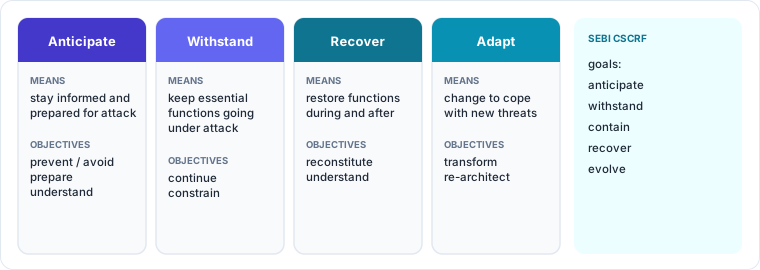
NIST SP 800-160 Volume 2 Revision 1 (2021) defines four goals:
| Goal | Meaning | BFSI example |
|---|---|---|
| Anticipate | Maintain a state of informed preparedness for adversity | Threat intelligence on groups targeting Indian NBFCs; exercises; known recovery dependencies |
| Withstand | Continue essential mission or business functions despite adversity | Payments keep flowing through a segmented channel while the core is contained |
| Recover | Restore functions during and after adversity | Clean-room restoration of the platform within 12 hours |
| Adapt | Modify functions or capabilities to handle predicted changes in the threat or technical environment | Re-architect admin access after an incident; retire a vulnerable integration |
The goals break into objectives (prevent or avoid, prepare, continue, constrain, reconstitute, understand, transform, re-architect). Objectives are achieved through techniques.
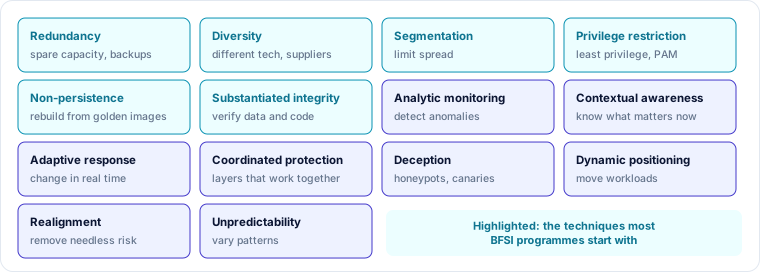
Six techniques give the most value early in most BFSI programmes:
- Redundancy: spare capacity and protected backups (Module 4).
- Diversity: avoid a single technology or supplier being a common point of compromise, for example a backup system that does not share the production OS or identity.
- Segmentation: limit how far an attacker can move. Separate admin networks; isolate payment systems; no direct trust from production to backup or DR.
- Privilege restriction: least privilege, privileged access management, tiered administration, just-in-time access, and break-glass with dual control.
- Non-persistence: rebuild rather than repair. Immutable infrastructure and golden images let you replace compromised systems quickly.
- Substantiated integrity: verify that code, configuration and data have not been tampered with: signed builds, file integrity monitoring, reconciliations.
3. Mapping to CSF 2.0 and SEBI CSCRF
NIST CSF 2.0 organises outcomes into Govern, Identify, Protect, Detect, Respond and Recover. Resilience goals cut across them: "anticipate" draws on Govern and Identify, "withstand" on Protect and Detect, "recover" on Respond and Recover, and "adapt" on lessons learned feeding Govern.
SEBI's CSCRF states its own resiliency goals: anticipate, withstand, contain, recover and evolve. It organises requirements under functions aligned with the CSF (governance, identify, protect, detect, respond, recover). An implementer can map CSCRF requirements, CSF outcomes and SP 800-160 techniques in one table. The BCMS then shows how each contributes to keeping critical operations within tolerance.
| CSCRF goal | Nearest SP 800-160 goal | Example evidence |
|---|---|---|
| Anticipate | Anticipate | Threat intelligence process; scenario library; cyber exercises |
| Withstand | Withstand | Segmentation; DDoS protection; continued operation at MBCO |
| Contain | Withstand (constrain) | Isolation playbooks; network kill switches |
| Recover | Recover | Clean-room recovery tests; RTO evidence |
| Evolve | Adapt | Post-incident changes; architecture reviews |
4. Assume breach in design
Applying an assume-breach mindset to a critical service means asking design questions:
- If an attacker controls a domain or cloud administrator account, what cannot they destroy? (Answer should include an immutable vault and break-glass access.)
- If production is encrypted at 2 am, how do customers keep being served? (Workarounds, MBCO.)
- How would we know which data is trustworthy? (Integrity checks, independent sources.)
- Can the attacker reach DR from production? (Segmentation, separate credentials.)
- How do we rebuild without reintroducing the attacker? (Golden images, clean room, secret rotation.)
These questions sit naturally in architecture review and change approval, alongside the continuity question added in Module 2.
Auditor lens
Auditors and inspectors increasingly ask for evidence that recovery capabilities themselves are protected: "Who can delete backups?", "Is the DR environment reachable with production credentials?" and "When did you last rebuild a critical server from a golden image?" They look for cyber scenarios in the BCMS, not just in the security team's documents.
Case study — Tarang Ledger: an assume-breach review
Meera runs an assume-breach review of the collections platform with the architects:
| Question | Finding | Action |
|---|---|---|
| What can a cloud admin destroy? | Everything, before the vault project | Vault in separate account with object lock (Module 4) |
| Can production credentials reach DR? | Yes: same admin roles | Separate DR admin roles; access only via break-glass |
| Can we rebuild app servers quickly? | Yes: containers from signed images | Extend to database hosts and bastions |
| Is payment data integrity verifiable? | Partly | Daily reconciliation with aggregator totals; alerts on mismatch |
| Is the CI/CD pipeline a path into production? | Yes: pipeline has broad rights | Scoped deployment roles; signed artefacts; pipeline in separate account |
The review becomes an annual control in the BCMS, owned by the CISO, and its actions go onto the risk treatment plan.
Key takeaways
- Cyber adversaries are adaptive and persistent: they target recovery, spread, wait, return and extort.
- SP 800-160 Vol. 2: four goals (anticipate, withstand, recover, adapt), eight objectives, fourteen techniques.
- Start with redundancy, diversity, segmentation, privilege restriction, non-persistence and substantiated integrity.
- Map CSCRF goals (anticipate, withstand, contain, recover, evolve), CSF 2.0 and SP 800-160 in one table.
- Build assume-breach questions into architecture review.
Self-check
- Give three ways a cyber adversary differs from a natural hazard in continuity planning.
- Which SP 800-160 technique does rebuilding servers from golden images represent?
- Name SEBI CSCRF's five resiliency goals.