
Incident response lifecycle and playbooks (SP 800-61r3)
In this lesson you will:
- Describe incident response as organised in NIST SP 800-61 Revision 3
- Classify incidents by severity and link severity to escalation
- Write playbooks for the scenarios most likely to disrupt critical operations
- Connect incident response with business continuity and crisis management
Incident response (IR) is where cybersecurity and business continuity meet in real time. A well-run IR process limits the damage of an attack. A poorly connected one leaves the business unaware while technical teams work in isolation, or invokes DR into a compromised environment. This lesson covers IR and its interface with the BCMS.
1. NIST SP 800-61 Revision 3
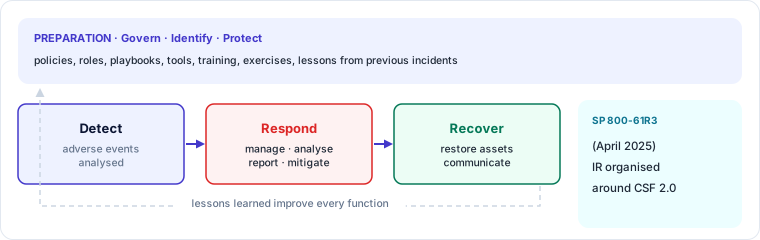
For years, incident response followed the four-phase lifecycle of SP 800-61 Rev. 2: preparation; detection and analysis; containment, eradication and recovery; and post-incident activity. Rev. 3 (April 2025) reorganises incident response around the CSF 2.0 functions:
- Govern, Identify and Protect together provide preparation: policies, roles, risk understanding, playbooks, tools, training and protective controls that reduce incidents.
- Detect: finding and analysing adverse events.
- Respond: incident management, analysis, reporting and communication, and mitigation (containment and eradication).
- Recover: restoring assets and operations, and communicating recovery.
- Lessons learned run through everything and improve all functions.
The message: incident response is not a separate process that starts when an alarm rings. It is woven into how the organisation governs, protects and recovers.
2. Severity and escalation
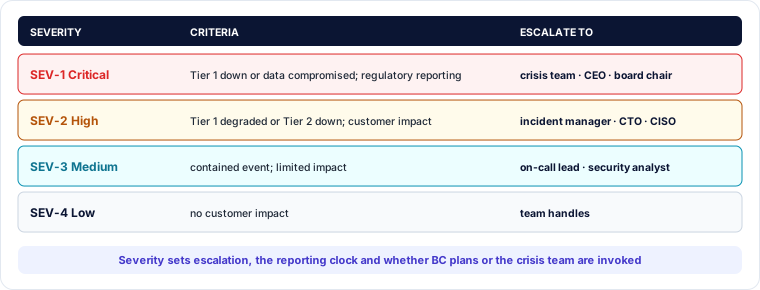
A severity scheme lets everyone act consistently. Good criteria include:
- impact on critical operations and tiers (from the BIA);
- data: confirmed or suspected compromise of personal or financial data;
- regulatory: whether the incident is reportable to CERT-In, RBI, SEBI or IRDAI, and to customers under contract;
- spread: contained or spreading;
- reputation: likely media or social media attention.
Tie each level to who is told and when, and to whether BC plans or the crisis team are activated. Make it easy to escalate: it is better to raise a SEV-1 and downgrade it than to discover four hours later that a reportable incident has been sitting in a queue.
3. Playbooks
A playbook is a short, scenario-specific guide for responders. Prioritise playbooks for the scenarios in your library (Lesson 3.4):
| Playbook | Key contents |
|---|---|
| Ransomware or destructive malware | Isolation steps; evidence preservation; identity recovery; link to the recovery sequence and clean room; ransom policy |
| DDoS on customer channels | Upstream scrubbing activation; status-page messages; alternate channels |
| Data breach or exfiltration | Scope assessment; DPDP notification triggers; customer communication; legal hold |
| Compromised privileged account | Session revocation; credential rotation; review of actions taken |
| Supplier compromise (software update, TSP breach) | Isolate integrations; assess exposure; coordinate with supplier; notify customers and regulators |
| Payment fraud or rail manipulation | Stop payments; contact banks and NPCI; preserve evidence |
Each playbook should state triggers, first actions (first 15 and first 60 minutes), decision points (for example: isolate a payment system?), who to call, reporting obligations and when to invoke BC.
4. Connecting IR with BCM and crisis management
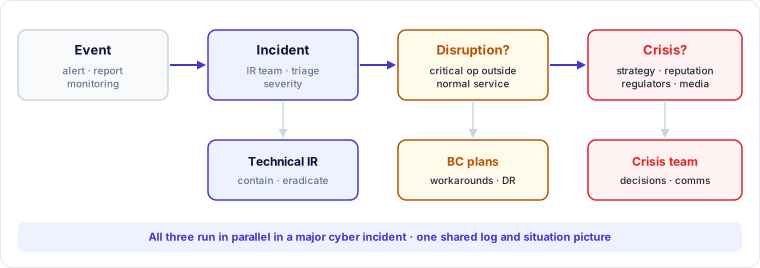
A major cyber incident triggers three streams at once:
- Technical IR contains, investigates and eradicates.
- Business continuity keeps critical operations going at MBCO, using workarounds and, when safe, DR.
- Crisis management makes strategic decisions, handles regulators, customers and media, and owns the ransom question.
Interface points must be defined in advance:
- IR to BCM: when does an incident become a disruption that needs BC plans? (Usually when a critical operation is outside normal service, or is expected to be.)
- BCM to IR: is it safe to fail over to DR? IR must confirm DR is not compromised.
- IR to crisis team: regular situation reports on a fixed schedule; known, unknown and decisions needed.
- Shared incident log: one record of events, decisions and times, used later for regulatory reports and the post-incident review.
ISO 22301 clause 8.4.2 (response structure, Module 6) and the cyber crisis management plan (Lesson 5.5) formalise these links.
Auditor lens
Auditors check that the IR procedure and the BC plans reference each other and use the same severity and escalation language. In exercises they observe whether the IR team tells the business promptly and whether anyone asks "is DR clean?" before failover.
Case study — Tarang Ledger: one severity scheme
Before the BCMS, Tarang had a security incident scale (P1–P4) and an operations outage scale (S1–S3) that did not match. A customer-facing outage caused by an attack was rated "P2 security, S1 operations", and nobody knew who was in charge.
Anil and Meera merge them into a single SEV-1 to SEV-4 scheme (Figure 5.7) used by operations, security and customer success. Rules:
- Any suspected cyber incident touching Tier 1 data or systems starts at SEV-1 until proven otherwise.
- SEV-1 automatically opens a bridge with the incident manager, CISO, CTO and customer success. The customer-notification clock (2 hours) starts at detection.
- The incident manager decides whether to invoke BC plans. Failover to DR in a cyber SEV-1 needs the CISO's confirmation that DR is not affected.
- All SEV-1 and SEV-2 incidents get a post-incident review within 10 working days, with actions logged in the corrective action register.
Key takeaways
- SP 800-61r3 (2025) organises IR around CSF 2.0: Govern, Identify, Protect for preparation; Detect, Respond, Recover; lessons learned throughout.
- One severity scheme across operations and security, tied to escalation, reporting and BC invocation; easy to escalate.
- Playbooks for library scenarios: triggers, first actions, decisions, contacts, reporting and BC links.
- Run IR, BC and crisis management in parallel with defined interfaces, a shared log, and a check that DR is clean before failover.
Self-check
- How does SP 800-61r3 change the way incident response is organised?
- Why should a suspected cyber incident on Tier 1 systems start at the highest severity?
- What question must IR answer before the business fails over to DR in a cyber incident?