
Cyber crisis management plans and regulatory reporting
In this lesson you will:
- Structure a cyber crisis management plan (CCMP) that meets Indian regulatory expectations
- Build a reporting matrix covering CERT-In, RBI, SEBI, IRDAI, DPDP and contractual obligations
- Run the first hours of a cyber crisis against the reporting clock
- Prepare templates and decision logs that support accurate, timely reports
When a serious cyber incident hits a financial institution, the clock starts immediately. Within hours the institution may owe reports to CERT-In, its sector regulator, payment-system operators and customers. Within days it may owe a personal-data breach report. A cyber crisis management plan (CCMP) prepares the governance, people, playbooks and templates so that those obligations are met while the organisation is under pressure.
1. The CCMP
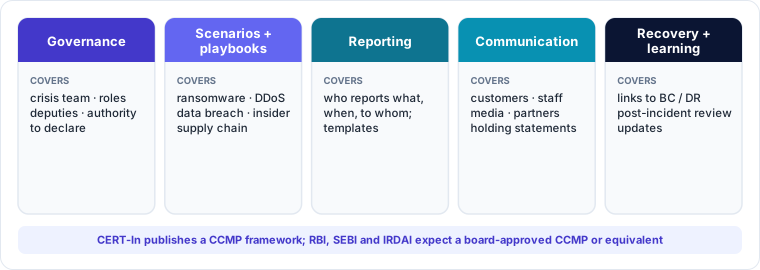
CERT-In promotes cyber crisis management plans across government and critical sectors and publishes a framework for them. Indian financial regulators expect regulated entities to maintain a board-approved CCMP or equivalent, linked to the BCP. A practical CCMP for a BFSI organisation contains:
| Section | Content |
|---|---|
| Governance | Crisis team membership and deputies; authority to declare a cyber crisis; decision rights (DR invocation, isolation of payment systems, ransom); links to the board |
| Scenarios and playbooks | References to IR playbooks (Lesson 5.4) and business workarounds |
| Reporting | Who reports what, to whom, by when; templates; portals and credentials held securely offline |
| Communication | Internal, customers, partners, media; holding statements; spokespeople |
| Coordination | Law enforcement, CERT-In, regulator contacts, forensic retainer, legal counsel, insurer, key suppliers |
| Recovery and learning | Links to BC and DR plans; post-incident review; plan updates |
Keep the CCMP short and usable, as an annex to the BCMS incident response structure (Module 6), not a separate bureaucracy.
2. The reporting matrix
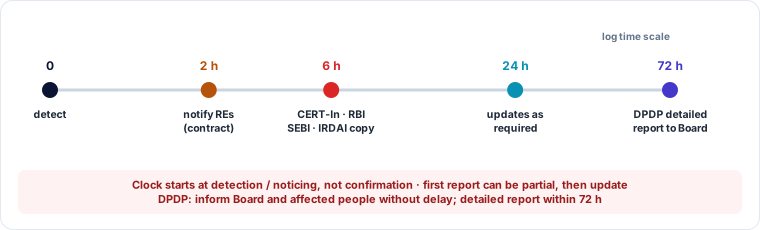
Build a single matrix that the crisis team can follow. Typical entries for an Indian BFSI organisation (check the current instrument for each):
| Recipient | Trigger | Deadline | Channel |
|---|---|---|---|
| CERT-In | Specified types of cyber incident | 6 hours from noticing | CERT-In reporting form or email |
| RBI (REs) | Cyber incidents as defined in the 2026 Directions | 6 hours from detection | DAKSH portal |
| SEBI (REs) | Cyber incidents under CSCRF | 6 hours from detection | SEBI reporting channel and, for intermediaries, the exchange or depository as specified |
| IRDAI (insurers) | Cyber incidents | Copy of the CERT-In report, within 6 hours | As specified in the guidelines |
| Data Protection Board and affected individuals (DPDP) | Personal data breach | Intimation without delay; detailed report within 72 hours to the Board | Board's digital platform; direct notice to individuals |
| NPCI / payment-system operators | Incidents affecting payment participation | As per operator rules, often immediate | Operator channels |
| NCIIPC | Incidents on protected systems | As specified | NCIIPC channels |
| Customers (for TSPs) | Suspected cyber incident affecting their service or data | Per contract, often 2–4 hours | Named contacts, status page |
| Law enforcement | Criminal acts (extortion, fraud) | As soon as practical | Cyber crime portal, local cyber cell |
| Insurer | Insured events | Per policy, often 24–72 hours | Broker or claims line |
Key practices:
- The clock starts at detection or noticing, not at confirmation. Report what you know, mark it as preliminary, and update.
- Pre-register on portals; keep credentials and templates offline, since email may be down.
- Name the people who submit each report, with deputies.
- Keep one fact base: the same timeline and facts across all reports. Inconsistent reports to different regulators damage credibility.
3. The first six hours
A typical timeline for a SEV-1 cyber incident:
| Time | Action |
|---|---|
| T+0 | Detection; incident manager opens SEV-1 bridge; incident log started |
| T+15 min | CISO and IR lead assess; containment begins; crisis team alerted |
| T+30 min | Crisis team convenes (out-of-band if needed); severity confirmed; BC invocation decision |
| T+1 h | Holding statement for staff; customer-facing teams briefed; forensic retainer engaged |
| T+2 h | Contractual notices to customers (for TSPs); first situation report |
| T+4 h | Draft regulatory reports reviewed by compliance and legal |
| T+6 h | Reports submitted to CERT-In and sector regulator; schedule for updates agreed |
| T+24–72 h | Updates; DPDP assessment and reports where personal data is involved; customer communications |
4. Communication under uncertainty
- Be early and honest. Say what happened as far as known, what customers should do, and when you will update.
- Do not speculate on cause or attribution.
- Coordinate with regulators before major public statements where practical.
- Prepare for extortion leaks with legal and communications advice ready.
- Remember your staff. They will be asked by family and customers; give them what they can say.
Regulator lens
After an incident, regulators examine the timeline: when the incident was detected, when it was escalated, and when each report was filed. Late reports, or reports that contradict each other, often attract more regulatory attention than the incident itself. Inspectors also ask to see the board-approved CCMP and the last exercise that tested it.
Case study — Sahyadri: a cyber tabletop on the reporting clock
Sahyadri runs a 3-hour tabletop: "Tarang notifies at 09:40 that it has detected ransomware on the collections platform; payment links are failing."
| Time (simulated) | What happened | Lesson |
|---|---|---|
| 09:40 | Tarang's notice arrives at a shared mailbox nobody monitors on Saturdays | Notices now go to a 24×7 phone number and the CISO's mobile |
| 10:30 | Crisis team convenes; debate on whether Sahyadri's own systems are affected | Pre-agreed triage questions added to the CCMP |
| 11:00 | Collections switches to the bank-hosted payment page | Worked; borrowers informed by SMS through the second gateway |
| 13:45 | Compliance discovers the DAKSH login is held by one person who is travelling | Two named submitters; credentials in the offline crisis pack |
| 15:10 | RBI and CERT-In reports drafted with different start times | One incident log; reports use the detection time from Tarang's notice |
| 15:35 | Reports submitted (simulated), inside 6 hours of 09:40 | Clock was met, but only just |
Five actions go into the corrective action log, owned by the CISO and head of compliance, due within 30 days.
Key takeaways
- A CCMP covers governance, playbooks, reporting, communication, coordination, recovery and learning; regulators expect it to be board-approved and linked to the BCP.
- Build one reporting matrix: CERT-In 6 h, RBI DAKSH 6 h, SEBI 6 h, IRDAI copy, DPDP without delay plus 72 h detailed, payment operators, NCIIPC, customers, law enforcement, insurer.
- The clock starts at detection: report early, mark as preliminary, update; keep one fact base.
- Pre-register on portals, keep credentials and templates offline, and name deputies.
Self-check
- When does the six-hour CERT-In reporting clock start?
- Why should a TSP's customers receive notice before the regulatory deadline?
- What two DPDP notifications follow a personal data breach, and when?