
Disruption risk assessment and severe-but-plausible scenarios (8.2.3)
In this lesson you will:
- Run a risk assessment for disruption that meets ISO 22301 clause 8.2.3
- Build a library of severe-but-plausible scenarios for a BFSI organisation
- Test critical operations against tolerances using scenario analysis
- Decide which risks require treatment and feed them into strategy selection
The BIA says what matters and how fast. The risk assessment says what could go wrong and whether we could cope. In ISO 22301 these sit side by side in clause 8.2. In operational resilience regulation they come together in scenario testing: can each critical operation stay within its tolerance under severe but plausible scenarios?
1. What ISO 22301 requires
Clause 8.2.3 requires a risk assessment process that:
- identifies risks of disruption to the organisation's prioritised activities and to the resources they need;
- analyses and evaluates the identified risks;
- determines which risks require treatment.
The standard notes that risks here relate to disruption of prioritised activities. Organisations often use ISO 31000 as the method. Treatment of these risks is carried through into business continuity strategies and solutions (8.3), so the risk assessment and strategy work must connect.
2. Two complementary approaches
Risk register approach. Identify threats to each critical resource, rate likelihood and impact, and compare with risk criteria. This is good for prevention and mitigation: fixing a single point of failure, adding a generator, hardening a system.
Scenario approach. Start from extreme but realistic events and ask whether the operation stays within tolerance. This is good for response and recovery: proving the ability to cope when prevention fails. Regulators emphasise this, because it does not depend on estimating likelihood for rare events.
Use both. The risk register keeps day-to-day risk visible and owned; the scenario analysis tests resilience.
3. Identifying and rating risks
For each prioritised activity and its key resources (from the dependency map), consider:
| Threat category | Examples |
|---|---|
| Cyber | Ransomware, destructive malware, DDoS, insider sabotage, compromise of a supplier's software update |
| Technology | Failed change, capacity exhaustion, database corruption, certificate expiry |
| Supplier | Cloud region outage, TSP insolvency, aggregator outage, telecom cut |
| Facilities | Fire, flood, power failure, access denial |
| People | Pandemic, strike, key-person loss |
| Environment | Heavy rain, cyclone, heatwave |
Analyse each using the organisation's risk scales, reused from the ISMS or ERM framework. Likelihood reflects history, threat intelligence and existing controls. Impact comes straight from the BIA impact-over-time ratings at the expected duration of disruption. Evaluate against risk criteria and decide which risks require treatment.
4. Severe-but-plausible scenarios
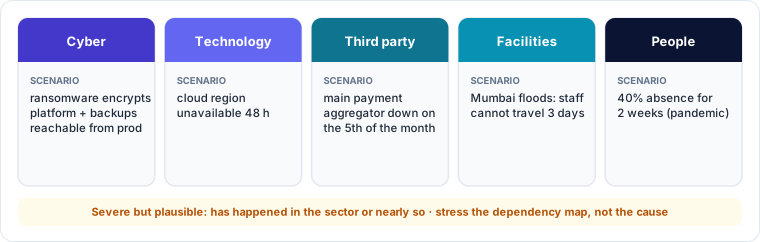
A scenario is severe if it would seriously stress the operation, and plausible if it has happened in the sector, nearly happened, or threat intelligence shows it could. Good sources include public incidents (Lesson 1.1), regulators' and CERT-In advisories, ISAC reports, your own incident history and the dependency map's weak points.
A good scenario library:
- covers all resource families: technology, people, premises, information, suppliers;
- includes at least one cyber scenario that defeats normal failover, such as ransomware reaching backups or a compromised administrator;
- includes concentration scenarios, such as failure of a major cloud provider or TSP serving many firms;
- varies timing, for example peak days and month-end;
- includes combinations, such as a flood plus a power outage, or an outage during a key-person absence;
- is reviewed at least yearly and after major sector incidents.
Describe each scenario precisely: what fails, for how long, what remains available, and when it happens.
5. Testing against tolerance
For each critical operation and scenario, estimate (and later exercise) how long the operation would be outside normal service using current capabilities, and compare with tolerance.
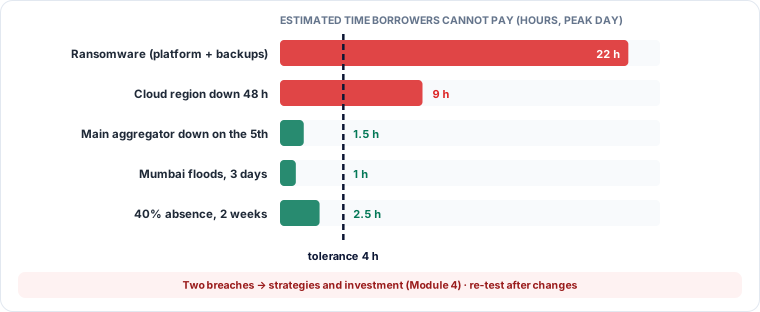
For each breach, record:
- why it breaches: which resource or step takes too long;
- what would fix it: a strategy option, investment or process change;
- the decision: treat (with plan and date) or, exceptionally, accept with board approval and a remediation timeline.
The UK and Basel approaches recognise that institutions may not be able to stay within tolerance under every scenario. What matters is that they know where they would breach, act on it, and report it to the board.
Regulator lens
Inspectors will ask for the scenario library, the analysis for each critical operation and the actions arising. A library containing only "fire at head office" and "power failure" is a red flag. They expect cyber, third-party and concentration scenarios, and they look for evidence that results changed investment decisions.
6. From risk to treatment
Risks requiring treatment feed into:
- preventive measures that reduce likelihood (patching, redundancy, supplier diversification), usually through the ISMS or IT risk processes;
- continuity strategies and solutions that reduce impact duration (Module 4);
- plans and exercises that make recovery faster and more reliable (Modules 6 and 7).
Keep a single register that links each risk and each scenario breach to its treatment, owner and due date, and report progress to the steering group.
Case study — Sahyadri and Tarang: scenario analysis
Sahyadri tests CO-02 (collections) against its five scenarios using current capabilities (Figure 3.9):
| Scenario | Estimated outage | Within 4 h? | Driver |
|---|---|---|---|
| S-01 Ransomware reaches Tarang's platform and backups reachable from production | ~22 h | No | Clean rebuild and restore from isolated backup |
| S-02 Tarang's cloud region unavailable 48 h | ~9 h | No | No second region; rebuild in another region from backups |
| S-03 PA-1 aggregator down on the 5th | ~1.5 h | Yes | Switch routing to PA-2 (now tested) |
| S-04 Mumbai floods, staff cannot travel for 3 days | ~1 h | Yes | Remote working; cloud-hosted systems |
| S-05 40% absence for 2 weeks | ~2.5 h on peak days | Yes | Cross-training; deferred non-critical work |
Both breaches trace to Tarang. Sahyadri raises them formally under its outsourcing governance. Tarang adds them to its own risk register with treatment decisions due from the strategy work: a warm standby in a second region for S-02 and an isolated recovery environment with immutable backups for S-01. Sahyadri also adds a manual fallback: borrowers directed to pay through a bank-hosted payment page during a Tarang outage, with Sahyadri reconciling manually.
Key takeaways
- 8.2.3: identify risks of disruption to prioritised activities and resources, analyse, evaluate and decide which need treatment.
- Combine a risk register (prevention) with severe-but-plausible scenarios (response and recovery).
- Scenario libraries must include cyber scenarios that defeat failover, third-party and concentration scenarios, peak timing and combinations.
- Compare outcomes with tolerance; record breaches, causes, fixes and board-level decisions.
Self-check
- What three things must the ISO 22301 risk assessment process do?
- Why do regulators favour scenario testing over likelihood-based assessment for extreme events?
- Give an example of a cyber scenario that would defeat a traditional DR failover.