
Third-party, nth-party and concentration risk
In this lesson you will:
- Tier suppliers by their importance to prioritised activities
- Assess a critical supplier's continuity capability using ISO/TS 22318 and regulatory expectations
- Identify nth-party and concentration risk, including sector-wide concentration
- Assess substitutability and plan for exit
Most BFSI critical operations now run on someone else's technology: cloud providers, core-banking vendors, TSPs, payment aggregators, telecom carriers and card networks. The July 2024 ransomware incident at a banking TSP showed what happens when many institutions share one provider. Regulators are clear that outsourcing a service does not outsource accountability.
1. Why third parties need their own analysis
ISO 22301 requires the BIA to determine dependencies, including partners and suppliers. Clause 8.1 requires outsourced processes to be controlled. ISO/TS 22318 gives a full method for supply chain continuity. The regulatory overlay is substantial:
- RBI IT outsourcing Directions: due diligence, BCP/DR capability of the provider, testing, audit and regulatory access, concentration risk and exit strategy for material outsourcing.
- RBI operational resilience guidance: map third and nth-party dependencies of critical operations; consider substitutability.
- SEBI CSCRF: third-party and supply chain controls, including requirements for vendors supporting critical systems.
- DORA (for EU-linked entities): register of ICT arrangements, mandatory contract terms, exit strategies and concentration assessment.
2. Tiering suppliers
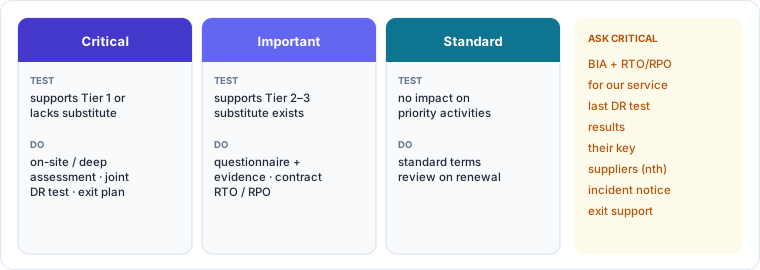
Tier suppliers by what they support and how replaceable they are:
| Tier | Criteria | Continuity actions |
|---|---|---|
| Critical | Supports a Tier 1 activity or critical operation, or has no practical substitute within tolerance | Deep assessment; contractual RTO/RPO; joint DR testing; incident notification; exit plan; annual review |
| Important | Supports Tier 2–3 activities; substitutes exist but take time | Questionnaire with evidence; contract terms; review on renewal |
| Standard | No effect on prioritised activities | Standard terms |
Tiering for continuity is not the same as tiering by spend. A cheap SMS gateway can be critical, and an expensive consulting firm may be standard.
3. Assessing a critical supplier
Ask for evidence, not assurances:
| Area | What to ask | Good evidence |
|---|---|---|
| BCMS | Do they run a BCMS? Certified? | ISO 22301 certificate with relevant scope; BC policy |
| BIA | What RTO and RPO apply to our service? | Extract of their BIA; contract schedule |
| DR capability | How do they recover? Where? | Architecture summary; DR test reports with actual times |
| Cyber resilience | How would they recover from ransomware? | Immutable backup design; isolated recovery test |
| Their suppliers | Who do they depend on (nth parties)? | List of critical sub-processors and hosting locations |
| Incident notification | How fast will they tell us? | Contract clause (often 2–4 hours for suspected cyber incidents) |
| Testing | Can we join or observe tests? | Test calendar; joint test history |
| Exit | Can they support transition? | Data export formats; exit assistance terms |
For the most critical suppliers, consider on-site or virtual assessments, joint exercises and shared dependency maps, as Sahyadri and Tarang did. Pooled audits, where several customers jointly audit a common supplier, reduce effort on both sides and are accepted by regulators.
4. Nth-party and concentration risk
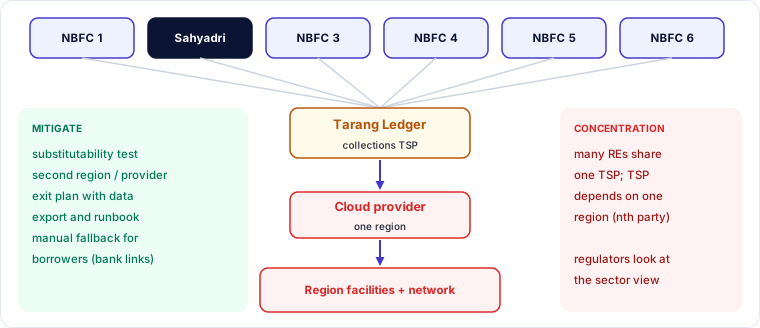
Nth-party risk is the risk in your supplier's suppliers: the TSP's cloud provider, the aggregator's sponsor bank, the core-banking vendor's hosting partner. You usually cannot contract with them, but you can:
- require the supplier to disclose its critical sub-contractors and notify changes;
- require the supplier to manage them with equivalent continuity expectations;
- map them in your dependency maps and include them in scenarios.
Concentration risk has two forms:
- Firm-level: you rely heavily on one provider for several critical operations, or one provider carries most of a service's volume (like PA-1's 85%).
- Sector-level: many institutions rely on the same provider. Regulators watch this closely: RBI and SEBI through supervisory data, DORA through CTPP oversight, the UK through its critical third parties regime. You may not be able to fix sector concentration alone, but you must recognise it and plan for its failure.
5. Substitutability and exit
Substitutability asks: if this supplier failed or had to be replaced, could we move to an alternative within tolerance? Options include:
- Active alternatives already running (dual aggregators, multi-region or multi-cloud);
- Warm alternatives, contracted and integrated but rarely used;
- Manual or degraded workarounds that meet the MBCO;
- Exit to another provider over months, through a planned transition.
An exit plan for each critical supplier covers: triggers for exit (failure, insolvency, regulatory direction, persistent poor performance); data retrieval in usable formats; transition steps and timelines; who does what; how service continues during transition; and costs. RBI's outsourcing Directions and DORA both expect exit strategies to be documented and feasible. Test them at least as a tabletop.
Auditor lens
Auditors ask: "Which of your suppliers are critical to prioritised activities? Show me the continuity assessment for one, the contractual RTO, the last DR test result you received, and the exit plan." A supplier register without continuity tiering, or exit plans that say only "terminate and re-tender", are common findings.
Case study — Tarang Ledger: suppliers seen from both sides
Tarang's critical suppliers:
| Supplier | Supports | Substitutable within tolerance? | Action |
|---|---|---|---|
| Cloud provider (Mumbai region) | All tiers | No (single region today) | Second region in same provider (Module 4); multi-cloud rejected as too costly for now, revisit yearly |
| PA-1 aggregator | Tier 1 collections | Yes, via PA-2 (switch tested) | Rebalance to 60/40; contract 2-hour incident notice |
| SMS gateway | Tier 1 confirmations | Yes, after second provider added | Dual-provider routing |
| Identity provider (SSO) | Administration of all systems | No, for admin access | Break-glass accounts; offline admin procedure |
Sahyadri's view of Tarang: Tarang is a critical supplier and a material outsourcing arrangement. Sahyadri's assessment now includes Tarang's BIA extract (collections RTO 3 h, RPO 0 for confirmations), the gaps and treatment plan from Lesson 3.4, a 2-hour cyber-incident notice clause, joint participation in Tarang's half-yearly DR drill, and an exit plan. Under that plan Sahyadri could move collections to a bank-hosted payment page within 4 hours as a degraded fallback, and to an alternative TSP within 6 months.
Sahyadri also notes sector concentration: Tarang serves about 60 lenders, so a Tarang failure would hit several NBFCs at once. It shares this with its operational risk committee as context for its own tolerance.
Key takeaways
- Outsourcing does not outsource accountability; RBI, SEBI and DORA all require third-party continuity management and exit.
- Tier suppliers by what they support and how replaceable they are, not by spend.
- Assess critical suppliers with evidence: BIA extract, DR test results, cyber recovery design, nth parties, notification, testing and exit.
- Manage nth-party and concentration risk, both firm-level and sector-level.
- Plan substitutability and a feasible, tested exit.
Self-check
- Why can a low-cost supplier be classed as critical for continuity?
- What is the difference between firm-level and sector-level concentration risk?
- List four elements of a credible exit plan.