
Impact over time: MTPD, RTO, MBCO, RPO and impact tolerances
In this lesson you will:
- Turn impact-over-time ratings into MTPD, RTO, MBCO and RPO
- Set tolerances for disruption using time, volume, service-level and data metrics
- Group services into recovery tiers without losing BIA-specific values
- Reconcile BIA values with regulatory numbers such as SEBI's 2-hour RTO
Lesson 3.1 produced impact ratings over time. This lesson turns them into the numbers that drive recovery design, and into the tolerances that regulators expect boards to approve.
1. Reading the impact grid
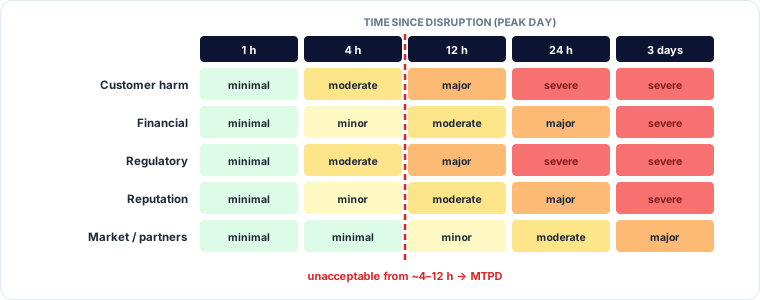
For each activity or service, rate each impact category at each time bucket. Then ask: at what point does any category reach the level top management has defined as unacceptable? That point is the MTPD. In Figure 3.3, customer harm and regulatory impact reach "major" by 12 hours and "severe" by 24, so the MTPD is set at 12 hours on peak days.
The RTO is then set inside the MTPD, with a margin for:
- detection and the decision to invoke recovery;
- recovery steps that take longer than planned;
- work recovery: verifying data, reconciling and processing the backlog.
A common rule of thumb is RTO at no more than half to two-thirds of MTPD for critical activities. The choice must be justified, not formulaic.
2. MBCO: how much is enough?
The minimum business continuity objective is the level of service acceptable while recovering. For collections, MBCO might be: "Borrowers can pay through at least one digital channel and get a confirmation; posting to loan accounts may be delayed up to 24 hours." MBCO matters because it shapes cheaper strategies. You may not need the whole platform back in 4 hours, only payment acceptance and confirmation.
3. RPO: data loss from the business view
Ask process owners: "If we had to restore to a point before the disruption, what work would be lost, and can it be recreated?" For each information set:
| Information | Can it be recreated? | RPO |
|---|---|---|
| Payment confirmations sent to borrowers | No; borrowers hold receipts, and loss breaks trust and creates disputes | Zero (or near-zero) |
| Reconciliation workpapers | Yes, from bank files, within hours | 1 hour |
| Invoices generated | Yes, from source data | 4 hours |
| Analytics datasets | Yes, rebuilt overnight | 24 hours |
RPO drives replication and backup design. Zero or near-zero RPO typically needs synchronous replication or transaction journaling to a second location. Remember that synchronous replication also copies corruption, which is why Module 4 adds immutable backups.
4. Tolerance for disruption
Basel, RBI and the UK expect a tolerance for each critical operation, set from the end user's point of view and approved by the board. RBI's guidance allows time-based metrics plus quantity and service-level metrics where they express harm better.
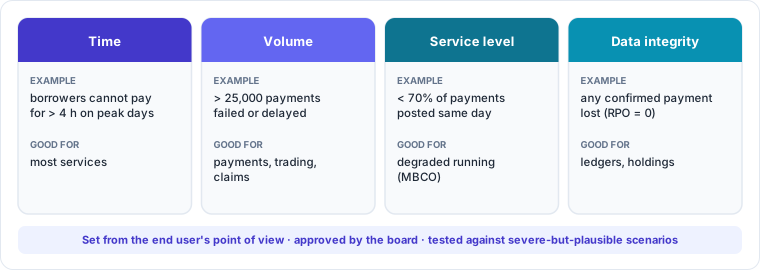
How tolerance relates to MTPD and RTO:
- Tolerance is set for the critical operation as a whole, often a single combined statement, and it describes the point of intolerable harm. It is close to MTPD but focused on external harm.
- RTOs are set for the activities and resources that support it, and must allow the operation to stay within tolerance.
- Tolerance is tested by asking: under severe but plausible scenarios, would we stay within it? (Lesson 3.4).
A good tolerance statement for Sahyadri's collections might read: "Borrowers must not be unable to make EMI payments for more than 4 hours on peak days (5th–7th) or 12 hours on other days. No payment confirmed to a borrower may be lost. The backlog must be cleared within 24 hours of restoration."
Note that the tolerance here (4 hours on peak days) is shorter than the MTPD from the impact grid (12 hours). The board chose a stricter tolerance after considering reputation and regulatory expectations. Boards may set tolerances stricter than the bare analysis, and the reason should be recorded.
5. Recovery tiers
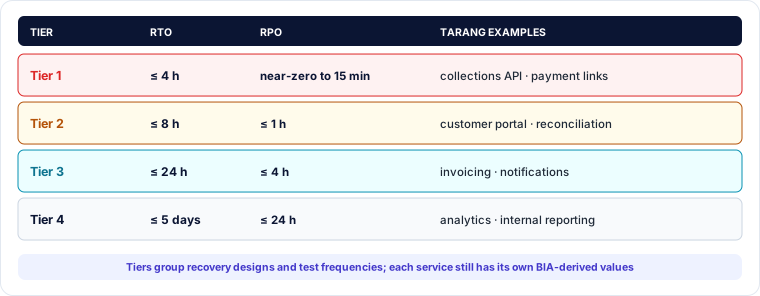
Tiers simplify design and testing: each tier gets a standard DR pattern, test frequency and monitoring. Keep the BIA's specific values for each service, though. A Tier 1 service with a 3-hour RTO and one with a 1-hour RTO may need different designs.
6. Reconciling with regulatory numbers
Regulators sometimes state recovery numbers directly. Examples are SEBI CSCRF's RTO of 2 hours and RPO of 15 minutes for critical systems and the MII rule of restoration within 45 minutes. Treat these as minimum constraints:
- if your BIA gives a longer RTO for a system the regulator calls critical, the regulatory figure applies, so record it as the requirement;
- if your BIA gives a shorter RTO, keep the BIA figure;
- if you believe a system is not critical in the regulator's sense, document the reasoning and the classification decision, since inspectors will test it.
Regulator lens
Inspectors compare three numbers for a critical operation: the board-approved tolerance, the RTOs of supporting systems and the recovery times actually achieved in the last drill. All three must be consistent. A tolerance of 4 hours supported by systems whose drills took 9 hours is a finding, however good the plans look.
Case study — Tarang Ledger: from Sahyadri's tolerance to Tarang's RTOs
Sahyadri's board approves the collections tolerance above. Tarang works backwards:
| Element | Value | Reasoning |
|---|---|---|
| Sahyadri tolerance (peak) | 4 h borrowers unable to pay | Board decision |
| Sahyadri's own work recovery | 1 h | Switch channels, inform branches |
| Tarang collections API and payment links RTO | 3 h | Must be back before Sahyadri's tolerance is breached |
| RPO for payment confirmations | 0 | No confirmed payment may be lost |
| RPO for other collections data | 5 min | Reconstructable from aggregator files |
| MBCO | Payment acceptance + confirmation via at least one aggregator; posting files may lag up to 12 h | Reduces what must recover in 3 h |
The rest of Tarang's BIA places the customer portal and reconciliation in Tier 2 (RTO 8 h, RPO 1 h), invoicing in Tier 3 (RTO 24 h, RPO 4 h, MTPD 72 h) and analytics in Tier 4 (5 days).
Comparison with capability: Tarang's demonstrated database restore is 6 h 20 min, and full service would take 8–10 hours in a region failure. That is well beyond the 3-hour RTO. The gap goes to the strategy work in Module 4 and onto the risk register.
Key takeaways
- MTPD = point where impact becomes unacceptable; RTO inside it, with margin for detection, problems and work recovery.
- MBCO defines the minimum service; it often allows cheaper strategies.
- RPO comes from what data the business can recreate; zero RPO needs replication plus protection against replicated corruption.
- Tolerances are set per critical operation from the end-user view, using time, volume, service-level or data metrics, and are approved by the board, which may set them stricter than the analysis.
- Treat regulatory recovery numbers as minimum constraints.
Self-check
- In an impact grid, how do you identify the MTPD?
- Why might a board set a tolerance shorter than the MTPD from the analysis?
- A system SEBI treats as critical has a BIA RTO of 6 hours. What RTO applies, and what should be documented?