
Planning and running a business impact analysis (8.2.1, 8.2.2)
In this lesson you will:
- Explain what ISO 22301 requires of the BIA and how ISO/TS 22317 structures it
- Plan a BIA, choosing levels, impact categories, time buckets and methods
- Run BIA interviews and workshops that produce defensible results
- Validate and approve BIA outputs
The BIA is the foundation of everything else in the BCMS. Strategies, plans, DR designs and exercise scenarios all depend on what it says is urgent. A weak BIA produces either gold-plated recovery for things that do not matter or, worse, slow recovery for things that do.
1. What ISO 22301 requires
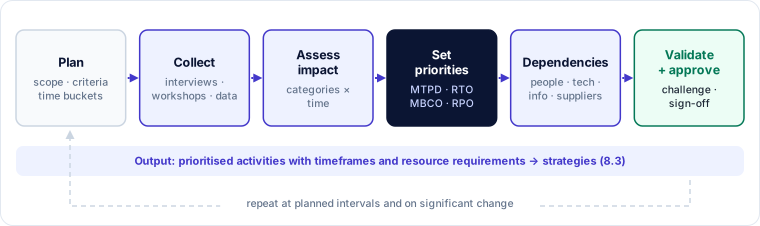
Clause 8.2.1 requires the organisation to implement and maintain systematic processes for analysing business impact and assessing risks of disruption, and to review them at planned intervals and when significant changes occur.
Clause 8.2.2 requires the BIA process to:
- define impact types and criteria relevant to the organisation's context;
- identify the activities that support the provision of products and services;
- use the impact types and criteria to assess impacts over time from disruption of those activities;
- identify the timeframe within which impacts become unacceptable (the maximum tolerable period of disruption, by whatever name);
- set prioritised timeframes for resuming disrupted activities at a specified minimum acceptable capacity. These timeframes must sit within the time when impacts become unacceptable (that is, RTO within MTPD, with MBCO as the capacity);
- use the BIA to determine prioritised activities;
- determine the resources needed to support prioritised activities;
- determine the dependencies, including partners and suppliers, and interdependencies of prioritised activities.
The standard does not prescribe a method. ISO/TS 22317 provides one, and auditors recognise it.
2. Planning the BIA
Levels. ISO/TS 22317 describes BIA at three levels:
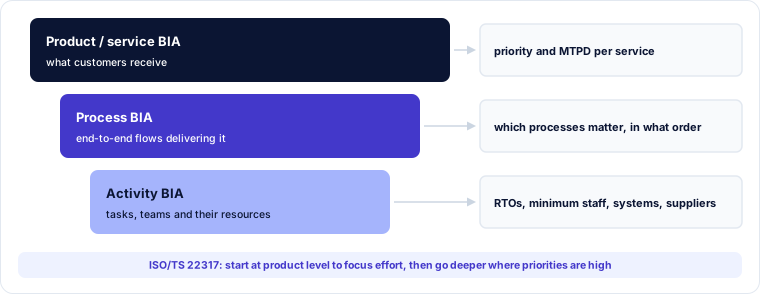
Start at product or service level with senior management to agree which services matter most and their tolerances. Then go to process level and finally activity level only for the high-priority services. This saves effort and avoids the classic mistake of sending a 30-tab questionnaire to every department.
Impact categories. Define them once and use them everywhere. They are usually reused from the enterprise or operational risk framework so that ratings are consistent:
| Category | Example criteria for "severe" (an NBFC) |
|---|---|
| Customer harm | More than 10,000 customers unable to pay or access funds; vulnerable customers affected |
| Financial | Loss over ₹5 crore, or cash-flow impact threatening funding lines |
| Regulatory and legal | Breach of an RBI direction or tolerance; reportable incident; penalty likely |
| Reputation | Sustained national media coverage; social media trending |
| Market or partners | Payment-system participant obligations breached; co-lending partners affected |
| Operational backlog | Backlog that cannot be cleared within a week |
Time buckets. Choose intervals that match how fast impact develops in your business, for example 1 h, 4 h, 12 h, 24 h, 3 days and 1 week. A trading firm might use 15 min, 30 min, 1 h and 2 h. An insurer's claims operation might start at 1 day.
Scenarios of time. Ask about the worst credible time for disruption: month-end, salary day, EMI dates, quarter-end reporting, market expiry days, festival peaks. A BIA that assumes an average Tuesday underestimates impact.
3. Collecting information
| Method | Strength | Weakness |
|---|---|---|
| Questionnaire | Scales to many teams | Low-quality answers without guidance; overstated urgency |
| Interview | Depth; challenge in real time | Time-consuming; depends on interviewer skill |
| Workshop | Shared view across a process; resolves conflicts | Hard to schedule; dominated by senior voices |
| Data | Objective: volumes, peaks, incident history, finance figures | Not available for every question |
A practical combination: pre-populate a template with known data (volumes, systems, suppliers from the CMDB and contract register), then hold a 60–90 minute interview or workshop per process with the process owner and one or two people who actually do the work.
Good BIA questions are concrete: "If payment links stopped working at 10 am on the 5th, what happens at 11 am? At 2 pm? Tomorrow?" "What is the minimum you could run with?" "Who outside the team would notice first?" "What workaround exists, and how long can it last?"
4. Avoiding common BIA errors
- Everything is critical. Calibrate with impact criteria and senior challenge. If every activity has a 1-hour RTO, the BIA has failed.
- RTO from IT capability. The BIA asks what the business needs; IT capability is compared afterwards. Do not let "the backup takes 8 hours" become the RTO.
- Ignoring peaks. Use worst-credible timing.
- Missing upstream and downstream dependencies, such as a reconciliation team that depends on a bank file at 7 am.
- Stale results. Re-run on significant change and review at least annually.
5. Validation and approval
Before results are used, validate them:
- compare RTOs and MTPDs across related processes for consistency, since a downstream process cannot need recovery before its upstream input exists;
- challenge outliers with process owners and senior management;
- reconcile with regulatory requirements (an RTO longer than a regulator's stated limit for that system needs explanation);
- obtain sign-off from process owners and approval from top management. In BFSI, tolerances for critical operations go to the board.
Auditor lens
Auditors pick a prioritised activity and ask how its RTO was set. "The team told us" is weak. "Impact criteria reached 'severe' at 12 hours on peak days; RTO set at 4 hours to allow for recovery problems; approved by the steering group on [date]" is strong. They also check the date of the last BIA review against major changes since.
Case study — Tarang Ledger: planning the BIA
Anil plans a two-month BIA:
| Decision | Choice |
|---|---|
| Levels | Product level for all 6 services (steering workshop); process and activity level for collections and reconciliation |
| Impact categories | Reused ISMS risk-scale categories plus "customer's regulatory impact", because Tarang's customers carry regulatory duties |
| Time buckets | 1 h, 4 h, 12 h, 24 h, 3 days, 1 week |
| Worst credible time | 5th–7th of the month, when collections volume is three times average |
| Methods | Pre-filled templates from the CMDB and supplier register; 12 interviews; 2 workshops |
| Customer input | Sahyadri and two other NBFC customers share their own BIA results for collections |
| Approval | Steering group; board audit and risk committee for service tolerances |
In the first interview the support lead says "everything we do is critical in the first hour". Anil asks what happens at 1 hour if customer-portal reports are unavailable. Answer: "Some customers email us; nothing breaks." The portal moves to Tier 2.
Key takeaways
- 8.2.2 requires impact criteria, activities, impact over time, the point of unacceptable impact, prioritised timeframes at minimum capacity, prioritised activities, resources and dependencies.
- Use ISO/TS 22317: start at product/service level, go deeper only where priority is high.
- Use consistent impact categories, sensible time buckets and worst-credible timing.
- Avoid "everything is critical" and RTOs derived from IT capability; validate and get approval, from the board for critical operations.
Self-check
- List four things ISO 22301 clause 8.2.2 requires the BIA to determine.
- Why should BIA interviews ask about the worst credible time rather than a typical day?
- What is wrong with setting an RTO equal to the current backup restore time?