
Scope, critical operations and the BCMS (4.3, 4.4)
In this lesson you will:
- Define a BCMS scope that is meaningful to customers and regulators, with justified exclusions
- Identify critical operations using customer, market, viability and regulatory criteria
- Relate ISO 22301 scope to RBI critical operations, SEBI critical systems and DORA critical functions
- Write a scope statement and a critical operations register
Scope answers "what does this BCMS protect?". In regulated finance there is a second question that matters just as much: "which of those things are critical?" This lesson handles both: the ISO 22301 scope, and the critical operations list that regulators expect the board to approve.
1. Determining the scope (4.3)
ISO 22301 asks the organisation to determine the boundaries and applicability of the BCMS, considering the issues (4.1), the requirements of interested parties (4.2), its mission, goals and obligations, and its internal and external dependencies. The scope must identify the products and services and the parts of the organisation included, and it must be available as documented information. Any exclusions must not affect the organisation's ability to provide continuity, and they must be explained.
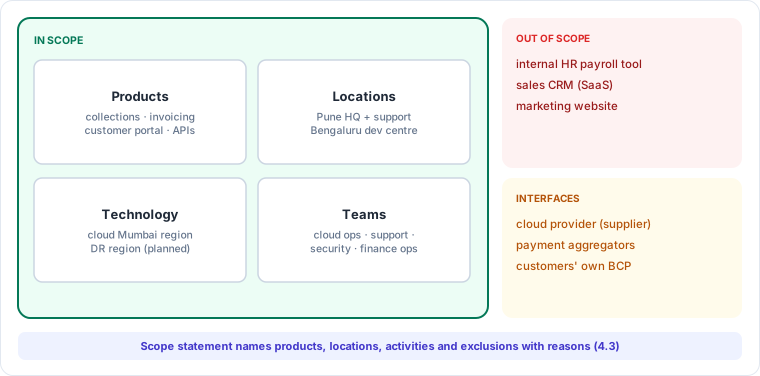
A practical scope statement has five parts:
- Products and services covered, named as customers know them.
- Locations: offices, operations centres, data centres and cloud regions.
- Activities and teams that deliver them, including support functions such as IT, security and finance operations.
- Exclusions, each with a reason that shows continuity of in-scope services is not affected.
- Interfaces and dependencies outside the scope: suppliers, group entities, customers' own arrangements.
Scope traps:
- Scoping only IT ("the data centre") leaves out the people and processes that make the service work.
- Excluding a function that critical services depend on, such as customer support for payment disputes or a treasury desk that funds settlement, makes the exclusion indefensible.
- A scope narrower than the ISO 27001 scope is fine. A scope that does not match what customers think they are buying causes trouble when they read the certificate.
2. Critical operations
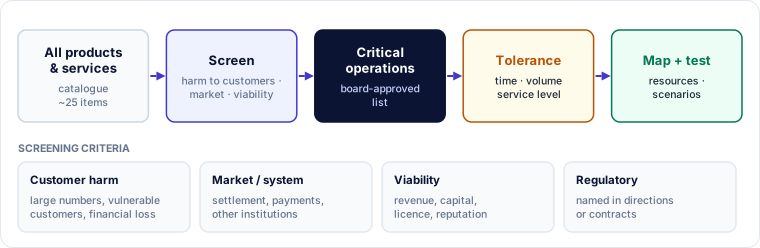
A critical operation (Basel and RBI terminology) is an activity, process or service whose disruption would cause material harm. The usual tests ask whether disruption would:
- harm customers, especially in large numbers or where they are vulnerable or suffer financial loss;
- harm the market or financial system, for example in payments, settlement, or other institutions that depend on you;
- threaten the institution's viability, through revenue, capital, licence or reputation;
- breach regulatory obligations that name the service, such as payment-system participation or an MII's trading and clearing.
Typical BFSI critical operations include payments (UPI, IMPS, NEFT and RTGS participation), cash and ATM services, deposit access, loan disbursement and repayment, trading and order routing, clearing and settlement, depository services, claims settlement and policy servicing.
Granularity matters. "Retail banking" is too broad to set a tolerance for. "A single report" is too narrow to matter. A good critical operation is something an external user experiences and that can be given a meaningful time limit, such as "borrowers can make EMI payments and see them reflected".
Related terms. SEBI's CSCRF asks REs to identify critical systems, the IT systems supporting core business. These map to the resources behind critical operations. DORA's critical or important functions and the UK's important business services are close equivalents. For a TSP, the question becomes: which customer critical operations depend on our services?
3. The critical operations register
| Field | Example (Sahyadri Finance) |
|---|---|
| ID and name | CO-02 EMI collection and posting |
| Description and users | Borrowers pay via UPI, NACH, payment links or branch cash; payments post to loan accounts |
| Why critical | 4 lakh borrowers; missed payments cause late fees and bureau reporting; 60% of daily cash inflow |
| Owner | Head of collections |
| Tolerance for disruption | Set in Module 3 |
| Key dependencies (summary) | Tarang platform, NACH sponsor bank, payment aggregator, loan management system |
| Board approval | Date and minute reference |
| Review | Annual or on material change |
ISO 22301 does not require the word "critical operation", but making the list explicit, and approved, connects the BCMS to regulatory expectations. In the BIA (Module 3) every critical operation becomes a top-priority activity.
4. The BCMS itself (4.4)
Clause 4.4 is short: establish, implement, maintain and continually improve a BCMS, including the processes needed and their interactions. In practice, show it with a process map of the BCMS: context → BIA and risk → strategies → plans → exercises → evaluation → audit → review → improvement, with owners and inputs and outputs. Organisations with an ISMS can extend the existing management-system manual rather than writing a new one.
Regulator lens
Inspectors often ask for the board-approved list of critical operations and the date it was last reviewed. They then pick one and ask to see its tolerance, dependency map and most recent test. A list that has not changed in three years while the business launched new digital channels attracts questions.
Case study — Tarang Ledger: scope and Sahyadri's critical operations
Tarang's scope statement (extract): "The BCMS covers the provision of Tarang Ledger's collections, invoicing, customer portal and API services to customers. It covers the activities of cloud operations, product support, security operations, customer success and finance operations performed from Pune and Bengaluru and remotely, and the supporting infrastructure in the cloud provider's Mumbai region and the planned secondary region. Excluded: internal HR payroll, the sales CRM and the marketing website, which do not support customer services; their unavailability does not affect service delivery."
Sahyadri's critical operations (approved by its board):
| ID | Critical operation | Depends on Tarang? |
|---|---|---|
| CO-01 | Loan disbursement | No |
| CO-02 | EMI collection and posting | Yes: payment links, reconciliation, posting files |
| CO-03 | Customer service for payment disputes | Partly: Tarang portal used for payment status |
| CO-04 | Regulatory and bureau reporting | No |
This tells Tarang that its collections service supports a regulated entity's critical operation, which raises its own priority in Tarang's BIA.
Key takeaways
- The scope names products and services, locations, activities and teams, exclusions with reasons, and interfaces, and is documented (4.3).
- Exclusions must not undermine continuity of in-scope services.
- Regulators expect a board-approved list of critical operations, screened for customer, market, viability and regulatory impact, at the right granularity.
- A TSP should identify which customer critical operations depend on it.
Self-check
- Why is "retail banking" a poor choice of critical operation?
- Under what condition can a function be excluded from the BCMS scope?
- How does SEBI's "critical system" relate to a critical operation?