
Leadership, policy, roles and board oversight (5.1–5.3)
In this lesson you will:
- Describe how top management demonstrates leadership of the BCMS
- Write a business continuity policy that meets ISO 22301 and regulatory expectations
- Design a governance structure with clear roles from board to recovery teams
- Align BCMS governance with RBI, SEBI and IRDAI committee requirements
Continuity fails at the top before it fails anywhere else. Without leadership, BIAs are filled in by junior staff, DR investment is deferred and exercises are cancelled when they clash with business priorities. Regulators know this, and that is why every Indian instrument puts the board at the centre.
1. Leadership and commitment (5.1)
Top management must demonstrate leadership of the BCMS. In practice that means it:
- makes sure the policy and objectives are set and compatible with strategy;
- integrates BCMS requirements into business processes (budgeting, change, procurement, product launch);
- provides resources;
- communicates why continuity matters;
- makes sure the BCMS achieves its outcomes;
- directs and supports people, promotes improvement, and supports other managers in their areas.
Evidence is not a signature on a policy. It is minutes of steering meetings where decisions were made, budgets approved for recovery capabilities, executives taking part in crisis exercises, and continuity considered in new product approvals.
2. The business continuity policy (5.2)
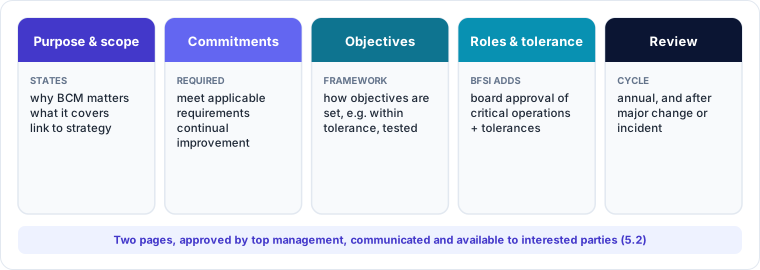
ISO 22301 requires a policy that is appropriate to the purpose of the organisation, provides a framework for setting objectives, includes a commitment to satisfy applicable requirements and a commitment to continual improvement. It must be documented, communicated within the organisation, and available to interested parties as appropriate.
In BFSI, regulators also expect the policy, or a linked board document, to cover:
- board approval of critical operations and tolerances for disruption;
- roles of the board, its committees and senior management;
- the expectation of regular testing, including DR drills at defined frequencies;
- how third-party continuity is managed;
- links to the cyber crisis management plan and incident reporting.
Keep the policy short, usually two to three pages. Put methods in procedures and details in plans. A policy that runs to 40 pages will not be read by the board that approves it.
3. Governance structure and roles (5.3)
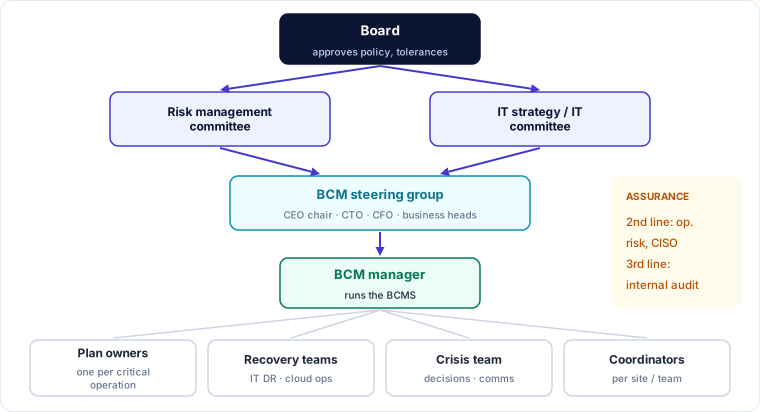
Top management must assign responsibility and authority for making sure the BCMS conforms to ISO 22301 and for reporting on its performance. Typical roles are:
| Role | Responsibilities |
|---|---|
| Board | Approves policy, critical operations and tolerances; receives reports on testing, incidents and gaps; holds management accountable |
| Board committees | Risk management committee oversees operational resilience; IT strategy or IT committee oversees technology risk and DR; in insurers, the ISRMC receives BCP/DR test results |
| Steering group | Senior executives who make cross-functional decisions, approve strategies and track the programme |
| Executive owner | A named senior executive accountable for the BCMS (often CRO, COO or CTO) |
| BCM manager | Runs the BCMS: methods, BIA coordination, plans, exercise programme, reporting |
| Critical operation and plan owners | Business heads who own BIA results and BC plans for their operations |
| Crisis management team | Senior decision-makers who lead the response to a major disruption |
| Recovery teams | IT DR, cloud operations, facilities, HR, communications |
| Coordinators | Contacts in each site or team who keep contact lists current and help in exercises |
Three lines. The BCMS is a first-line activity run by the business with BCM support. Operational risk and the CISO provide second-line challenge, and internal audit gives independent assurance. Do not let the BCM manager also be the only person who audits the BCMS.
Regulatory alignment:
- RBI expects board oversight through its committees, an IT strategy committee for technology and DR matters, and senior management accountability for operational resilience.
- SEBI CSCRF expects a board-approved cyber resilience policy, an IT committee and a designated CISO. MIIs have additional governance requirements for BCP-DR.
- IRDAI routes BCP/DR test results to the ISRMC.
Map each committee's terms of reference to the BCMS reporting calendar so that nothing falls between them.
Auditor lens
Auditors interview the executive owner, not just the BCM manager. Typical questions: "What are our critical operations and their tolerances?", "When did you last take part in an exercise?" and "What did the last management review decide?" An executive who cannot answer suggests leadership exists on paper only.
Case study — Tarang Ledger: policy and roles
Tarang's two-page Business Continuity and Resilience Policy, approved by the board, states:
- Purpose: keep customer collections and invoicing services within agreed tolerances during disruption, so that customers, including regulated lenders and intermediaries, can meet their own obligations.
- Commitments: meet applicable legal, regulatory and contractual requirements, including those flowed down by regulated customers; continually improve the BCMS.
- Objectives framework: objectives are set yearly for tolerance coverage, demonstrated recovery, notification speed and exercise follow-up.
- Tolerances: service tolerances are approved by the board and reviewed annually.
- Roles: CEO chairs the steering group; CTO is executive owner; Anil is BCM manager; product heads own BC plans; Meera leads the cyber crisis annex.
- Review: annually, after major incidents and on significant change.
Because Tarang has no IT strategy committee, the board's audit and risk committee takes on technology resilience oversight. Its terms of reference are amended to receive a quarterly resilience report.
Key takeaways
- 5.1 leadership is shown through decisions, budgets and participation, not just signatures.
- 5.2 the policy is short, fits the purpose, frames objectives, commits to requirements and improvement, and in BFSI links to board-approved tolerances and testing.
- 5.3 assign roles from board to recovery teams, with independent second- and third-line assurance.
- Align with RBI, SEBI and IRDAI committee structures and reporting.
Self-check
- Give three kinds of evidence that top management leads the BCMS.
- Where should the details of DR procedures sit, if not in the policy?
- Why should the BCM manager not be the sole auditor of the BCMS?