
Context of the organisation and interested parties (4.1, 4.2)
In this lesson you will:
- Identify external and internal issues relevant to a BCMS, including climate change
- Determine interested parties and their continuity requirements
- Build and maintain a register of legal, regulatory and contractual requirements
- Use context outputs to drive scope, the BIA and objectives
A BCMS that ignores its context ends up protecting the wrong things. Clause 4 makes you look outward and inward before you decide what to protect: what is happening around the organisation, who depends on it, and what they and the law require.
1. Issues (4.1)
Clause 4.1 asks the organisation to determine the external and internal issues that are relevant to its purpose and that affect its ability to achieve the intended outcomes of the BCMS. Since Amendment 1:2024, it must also decide whether climate change is a relevant issue.
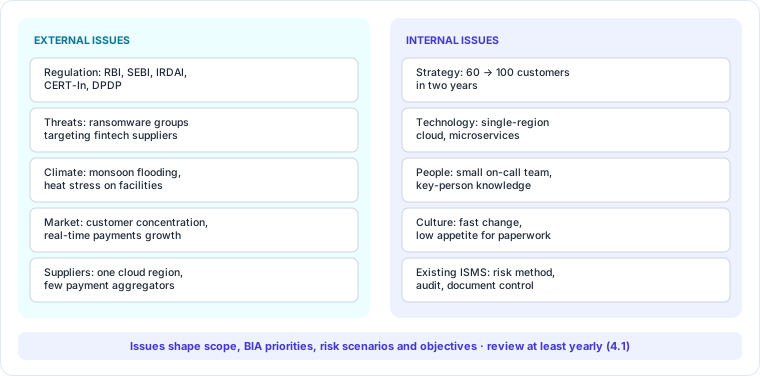
For a continuity programme, issues worth recording usually include:
| External | Internal |
|---|---|
| Regulatory direction (new RBI, SEBI or IRDAI instruments; flow-down from customers) | Strategy and growth plans that will change volumes or services |
| Threat landscape (ransomware against financial suppliers, DDoS campaigns) | Technology architecture, especially single points of failure |
| Climate and natural hazards at each site | People: key-person dependencies, remote working, attrition |
| Concentration in the supply chain (few cloud providers, payment networks, aggregators) | Culture and appetite for formal process |
| Market structure: real-time payments, T+0 settlement, 24×7 expectations | Existing management systems that can be reused (ISMS, ORM, quality) |
An issue is a condition or trend, not yet a risk. "Single cloud region" is an issue. "Mumbai region outage stops collections for 24 hours" is a risk scenario that will be assessed in clause 8.2.3. Issues are recorded in a context register, reviewed at least yearly and whenever something significant changes.
Climate change. For most BFSI organisations the answer to the Amendment 1 question is "yes, relevant". Examples are flood risk to operations centres in coastal cities, heatwaves stressing cooling and power, and monsoon disruption to staff travel. Record the decision and its reasons either way.
2. Interested parties (4.2.1)
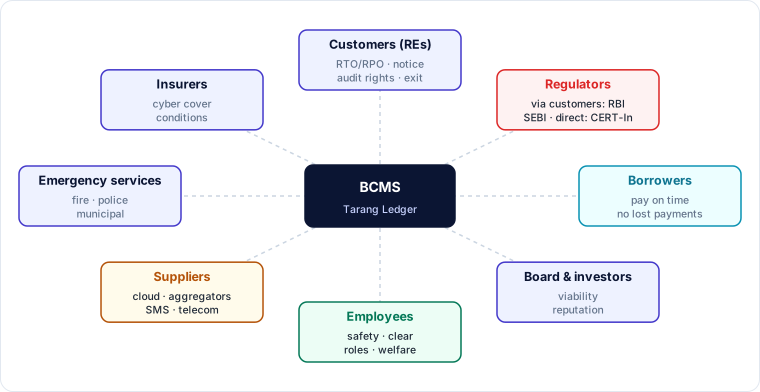
Determine the interested parties relevant to the BCMS, their requirements, and which of those requirements will be addressed through the BCMS. For a regulated entity, parties include customers, regulators, payment-system operators, the board, employees, suppliers, emergency services and insurers. For a TSP, the regulated customers and, through them, their regulators dominate.
Be specific about requirements. "Customers want availability" is not useful. "NBFC customers require RTO ≤ 4 hours for collections, notification of suspected cyber incidents within 2 hours, an annual DR test report and exit assistance for 6 months" is.
3. Legal and regulatory requirements (4.2.2)
ISO 22301 adds an explicit requirement to implement and maintain a process to identify, access and assess applicable legal and regulatory requirements related to continuity. These requirements must be taken into account in the BCMS, and the information must be documented and kept up to date.
A good register has these columns:
| Column | Purpose |
|---|---|
| Source and version | For example, "RBI Cybersecurity Directions (NBFC), July 2026" |
| Why it applies | Direct regulation, flow-down through a contract, or voluntary |
| Requirement (paraphrased) | Specific obligation, such as a 6-hour reporting window |
| BCMS element affected | BIA, strategy, plan, exercise, reporting procedure |
| Owner | Who keeps it current and ensures compliance |
| Evidence | Where compliance is shown |
| Last checked | Date someone verified the source is current |
Indian instruments change often, as the 2026 consolidation of RBI's technology circulars showed. Assign someone, usually compliance or legal, to watch regulator websites and circulars, and review the register at least quarterly in BFSI.
Auditor lens
Auditors test 4.2.2 by picking a recent regulatory change and asking when the organisation learned of it, who assessed it and what changed in the BCMS. A register whose "last checked" dates are older than the latest relevant circular is an easy nonconformity.
4. From context to action
Context is useful only if it changes decisions. Trace each significant issue or requirement to one of:
- scope (4.3): what must be inside the BCMS;
- BIA and risk assessment (8.2): priorities, impact categories, scenarios;
- strategies (8.3): for example, a second region or a second payment aggregator;
- objectives (6.2): measurable targets such as notification within 2 hours;
- exercises (8.5): regulatory drill frequencies.
Case study — Tarang Ledger: context and parties
Anil runs a half-day workshop with the steering group and reuses the ISMS context register as a starting point. New continuity-specific entries (extract):
| ID | Issue or requirement | Type | Leads to |
|---|---|---|---|
| BC-C03 | Platform runs in one cloud region | Internal issue | Risk scenario S-02; strategy decision on DR region |
| BC-C05 | Mumbai flood risk to the region's facilities and to staff travel | External, climate | Scenario S-04; remote-work strategy |
| BC-C07 | Monthly collection peak on the 5th–7th, three times average volume | Internal issue | BIA impact-over-time for peak days |
| BC-P02 | Sahyadri: RTO ≤ 4 h for collections; 2-hour cyber incident notice | Customer requirement | BIA validation; objective O-3 |
| BC-P05 | Kaveri Securities: CSCRF third-party clauses | Customer requirement | Assess whether Tarang supports a Kaveri critical system |
| BC-L01 | CERT-In 6-hour reporting; 180-day logs | Legal | Incident procedure; log retention |
| BC-L04 | RBI IT outsourcing Directions via NBFC customers | Regulatory flow-down | DR test sharing; exit support |
On climate, the register records "relevant" with reasons, and a note that the cloud provider's own climate resilience will be reviewed under supplier management.
Sahyadri does the same exercise from the regulated side. Its register includes RBI's operational resilience guidance and the cyber Directions directly, and lists Tarang as a material outsourcing arrangement.
Key takeaways
- 4.1: record external and internal issues, including whether climate change is relevant; issues are not yet risks.
- 4.2.1: identify interested parties and their specific continuity requirements.
- 4.2.2: keep a process and a documented register of legal and regulatory requirements, with owners, evidence and "last checked" dates.
- Every significant context item should lead somewhere: scope, BIA, strategy, objectives or exercises.
Self-check
- Is "we use one cloud region" an issue or a risk? What would the related risk scenario be?
- What extra requirement does ISO 22301 clause 4.2.2 add beyond listing interested parties?
- How should an organisation show that it has assessed climate change under Amendment 1:2024?