
Planning: risks, opportunities, objectives and changes (6.1–6.3, 8.1)
In this lesson you will:
- Distinguish risks and opportunities to the BCMS (6.1) from risks of disruption (8.2.3)
- Set measurable business continuity objectives with plans to achieve them
- Plan changes to the BCMS in a controlled way
- Apply operational planning and control, including over outsourced processes
Clause 6 of ISO 22301 looks like the risk clause of ISO 27001, but its job is different. It is about planning the management system: what could stop the BCMS from working, what objectives it will pursue and how changes are made. The risks that could disrupt your operations are assessed later, in clause 8.2.
1. Two kinds of risk
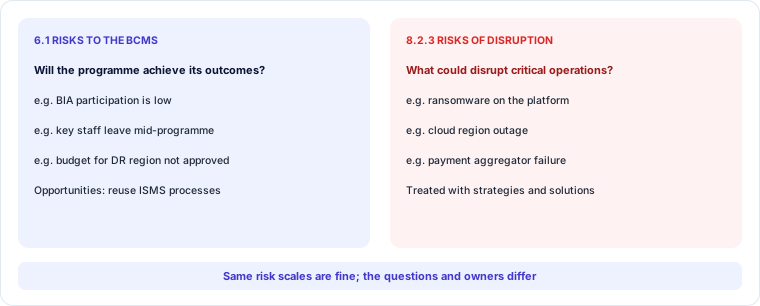
6.1 Risks and opportunities. Considering the issues (4.1) and requirements (4.2), determine the risks and opportunities that need to be addressed to make sure the BCMS can achieve its outcomes, prevent or reduce undesired effects, and achieve continual improvement. Plan actions to address them, integrate the actions into BCMS processes and evaluate their effectiveness.
Examples:
| Risk or opportunity to the BCMS | Action |
|---|---|
| Business heads do not prioritise BIA interviews | CEO mandate; BIA completion as a steering metric |
| The BCM manager is a single point of knowledge | Deputy named; methods documented |
| DR budget may be deferred | Business case linked to customer contracts and regulatory findings |
| New regulator instruments arrive mid-programme | Monthly regulatory watch; register owner |
| Opportunity: reuse ISMS risk scales, audit and document control | Integrated management system manual |
| Opportunity: customers will fund shared DR testing | Joint test agreement with major customers |
8.2.3 Risk assessment for disruption covers threats to the critical operations themselves: ransomware, region outage, supplier failure. It is part of the BIA and risk assessment process (Module 3). Organisations can use the same risk scales for both, but the registers, owners and treatments differ.
2. Business continuity objectives (6.2)
Objectives must be consistent with the policy, measurable where practicable, take account of applicable requirements, be monitored, communicated and updated. When planning how to achieve them, decide what will be done, what resources, who is responsible, when it will be completed and how results will be evaluated.
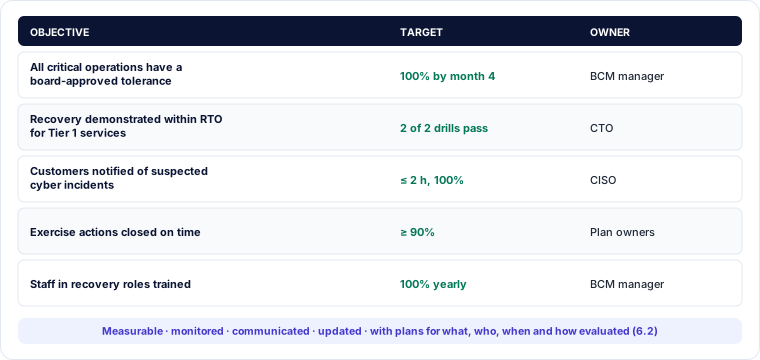
Good objectives focus on outcomes and capability, not on activity:
| Weak | Better |
|---|---|
| "Improve continuity" | "All Tier 1 services recovered within RTO in the half-yearly DR drill" |
| "Run exercises" | "Every critical operation exercised at least once a year; 90% of actions closed on time" |
| "Update plans" | "All BC plans reviewed within 12 months and after every major change" |
| "Comply with RBI" | "Cyber incidents reported to customers within 2 hours in 100% of cases" |
Link objectives to the board's risk appetite and to tolerances. Where a regulator sets a number (SEBI's RTO of 2 hours, for example), make the objective "demonstrated" rather than "documented".
3. Planning changes to the BCMS (6.3)
When the BCMS needs to change, for instance a new site, a new critical operation, a merger or a major restructure, plan it with attention to the purpose of the change and its consequences, the integrity of the BCMS, resources, and allocation of responsibilities. In practice:
- add a "continuity impact" question to the organisation's change-management and new-product approval processes;
- re-run the relevant part of the BIA when a service, supplier or architecture changes materially;
- update plans and contact lists before go-live, not after the first incident.
4. Operational planning and control (8.1)
Clause 8.1 requires the organisation to plan, implement and control the processes needed to meet requirements and carry out the actions from clause 6. This means setting criteria for processes, controlling them to those criteria and keeping enough documented information to be confident they were carried out as planned. Planned changes must be controlled and unintended changes reviewed. Outsourced processes and the supply chain must be controlled.
For BFSI, the outsourcing point carries weight. If a TSP runs your DR site, operates your backups or provides your contact-centre, the processes are still yours to control. That control comes through contract terms, test participation, reports and audits, as RBI's outsourcing Directions require.
Auditor lens
Auditors check that 6.1 actions exist and were evaluated, for example by asking, "You identified low BIA participation as a risk. What happened?" For 6.2 they sample an objective and ask for the latest measurement. Objectives without measurements, or measurements that are never reported, are common nonconformities.
Case study — Tarang Ledger: BCMS planning
Risks and opportunities (6.1), extract:
| ID | Risk or opportunity | Action | Owner |
|---|---|---|---|
| RO-1 | Product teams treat BIA as paperwork | CEO sets BIA completion by month 3 as a leadership objective | CEO |
| RO-2 | Anil is the only BCM-trained person | Meera's deputy trained in BIA method; procedures documented | Meera |
| RO-3 | Second-region DR cost not approved | Business case after BIA with customer contract value at risk | CTO |
| RO-4 | Opportunity: Sahyadri willing to join DR test | Joint test plan for the half-yearly drill | Anil |
Objectives for year 1 (6.2):
| Objective | Target | Measured | Owner |
|---|---|---|---|
| O-1 Tolerances approved for all services supporting customer critical operations | 100% by month 4 | Steering report | Anil |
| O-2 Collections service recovered within RTO in DR drill | 2 of 2 drills | Drill report | CTO |
| O-3 Customers notified of suspected cyber incidents | ≤ 2 hours, 100% | Incident log | Meera |
| O-4 Exercise actions closed on time | ≥ 90% | Action log | Plan owners |
| O-5 People in recovery roles trained and exercised | 100% yearly | Training records | Anil |
Tarang adds a continuity question to its change-approval form: "Does this change affect an RTO, RPO, supplier or recovery procedure?" A "yes" triggers BCM review.
Key takeaways
- 6.1 addresses risks and opportunities to the BCMS; 8.2.3 addresses risks of disruption to operations.
- 6.2 objectives are measurable and outcome-focused, with plans for what, resources, who, when, how evaluated.
- 6.3 plan BCMS changes; build continuity checks into change and product approval.
- 8.1 control processes, including outsourced ones, through criteria and evidence.
Self-check
- Is "a cloud region outage" a 6.1 risk or an 8.2.3 risk? Give an example of the other kind.
- Rewrite "test DR regularly" as a measurable objective.
- How does clause 8.1 apply to a DR service run by a third party?