
Support: resources, competence, awareness, communication and documents (7.1–7.5)
In this lesson you will:
- Determine resources and competence needed for each BCMS role
- Build awareness so that staff know what to do in a disruption
- Plan BCMS communication and keep it separate from incident communication
- Control documented information, including plans that must be usable offline in a crisis
Clause 7 is where a BCMS gets the people, skills and documents it needs to work. The requirements match other management-system standards, but continuity adds a twist: everything has to work during a disruption, when systems, offices and key people may be unavailable.
1. Resources (7.1)
Determine and provide the resources needed for the BCMS. These include the people who run it, budget for recovery capabilities, tools (a BCM platform, a mass notification system, an offline plan repository) and time for staff to take part in BIAs and exercises. The most common resource failure is not budget. It is time: business heads who never have an afternoon free for an exercise.
2. Competence (7.2)
Determine the competence needed by people doing work that affects BC performance, make sure they are competent through education, training or experience, take action to close gaps and evaluate the effectiveness of that action, and keep evidence.
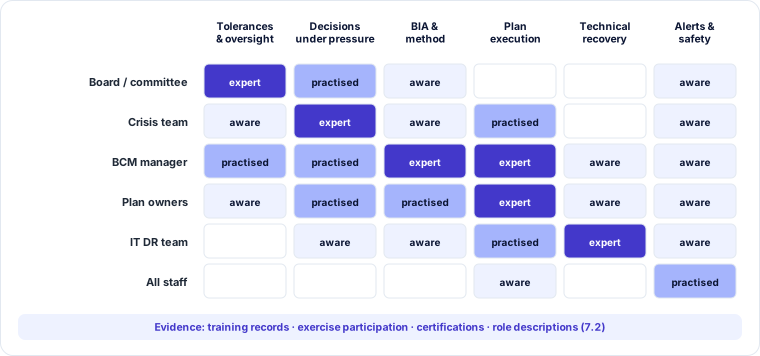
| Role | Competence that matters | How to build it |
|---|---|---|
| Board and committees | Understanding tolerances, reading resilience reports, challenging management | Annual briefing; participation in a crisis exercise |
| Crisis management team | Decision-making with incomplete information, communication, regulatory reporting | Scenario exercises; ISO 22361-based training |
| BCM manager | BIA method, strategy design, plan writing, exercise design, ISO 22301 | Professional certification and a course such as this one; mentoring |
| Plan owners | Executing their plan, leading their team in a disruption | Walkthroughs and tabletop exercises |
| IT DR and cloud teams | Failover, restore, clean recovery, runbook execution | DR drills; restore tests; vendor training |
| All staff | How alerts arrive, where to go, how to work remotely, how to report incidents | Induction, annual awareness, alert tests |
Exercises double as competence evidence. Record who took part and in what role.
3. Awareness (7.3)
Everyone working under the organisation's control must be aware of the BC policy, their contribution to the BCMS and the implications of not conforming, and their own role before, during and after a disruption. That last point is specific to ISO 22301 and is the one people forget. Practical tests:
- Does a support agent know what to tell customers if the platform is down?
- Does a new joiner know how emergency alerts arrive and how to confirm they are safe?
- Do on-call engineers know who can declare a disaster?
Short, scenario-based content works better than policy summaries: "If the Pune office floods tonight, here is what happens tomorrow morning."
4. Communication (7.4)
Determine the internal and external communications relevant to the BCMS: what, when, with whom and how. ISO 22301 places communication during a disruption, such as warnings and communication with interested parties and authorities, in clause 8.4.3 (Module 6). Clause 7.4 is about routine BCMS communication:
| What | With whom | When |
|---|---|---|
| Resilience report | Board or committee | Quarterly |
| Programme status | Steering group | Monthly |
| DR test summary | Key customers (TSPs) or regulator on request | After each drill |
| Awareness | All staff | Induction and yearly |
| Requirement changes | Plan owners | When the regulatory register changes |
5. Documented information (7.5)
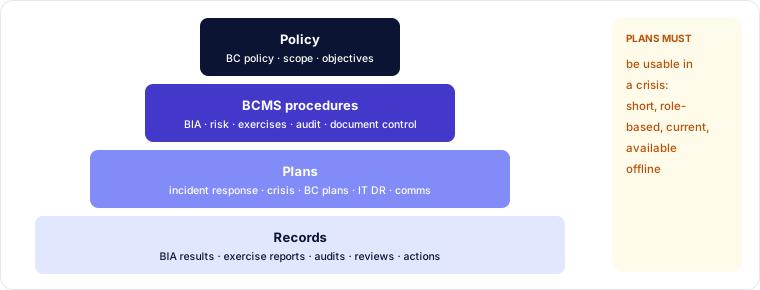
The BCMS must include the documented information ISO 22301 requires and whatever else the organisation decides is needed. Documents must be identified, reviewed and approved, and controlled for distribution, access, storage, changes and retention. Documented information required by the standard typically includes:
- the scope (4.3) and the legal and regulatory requirements (4.2.2);
- the BC policy (5.2) and objectives (6.2);
- evidence of competence (7.2);
- documented information on the BIA and risk assessment process and results (8.2);
- BC plans and procedures (8.4);
- exercise and evaluation results (8.5, 8.6);
- monitoring and measurement results, the audit programme and results, and management review results (9.1–9.3);
- nonconformities and corrective actions (10.1).
Continuity-specific document control. Plans are useless if they are stored only on the system that has failed. Requirements for plan documents:
- Available offline and off-site: printed packs for crisis team members, encrypted copies on phones, a plan repository hosted outside the primary environment.
- Current: contact lists updated at least quarterly and automatically from HR where possible.
- Protected: plans contain sensitive information such as network diagrams, credentials processes and contacts, so classify and control them under the ISMS.
- Usable: checklists and decision trees, not prose. Version and date on every page.
Auditor lens
A favourite test: "Show me the BC plan for collections as you would access it if your email and file server were down." Then: "Call the second person on the crisis team contact list." Out-of-date numbers and plans that live only on the corporate intranet are frequent findings.
Case study — Tarang Ledger: making support work in a crisis
Anil finds four gaps against clause 7 and fixes them:
| Gap | Action |
|---|---|
| Plans stored only in the company wiki, hosted in the same cloud account as production | Plan repository moved to a separate SaaS tenant; crisis team gets encrypted offline copies; printed packs in Pune and Bengaluru |
| Contact lists maintained by hand | Nightly export from HR system into the notification tool; quarterly call-tree test |
| Support agents unsure what to tell customers during outages | Three-minute scenario video and status-page scripts |
| No evidence of crisis team competence | Two-hour ISO 22361-based workshop followed by a tabletop exercise; attendance recorded |
Documentation reuses the ISMS document-control procedure with one addition: every plan must be accessible without corporate SSO.
Key takeaways
- 7.1 the scarcest resource is often time for BIA and exercises.
- 7.2 build role-specific competence; exercises are evidence.
- 7.3 everyone must know their role before, during and after a disruption.
- 7.4 covers routine BCMS communication; crisis communication sits in 8.4.3.
- 7.5 plans must be available offline, current, protected and usable.
Self-check
- What awareness requirement does ISO 22301 add that ISO 27001 does not have?
- Name three places a crisis team member could access the BC plan if corporate systems are down.
- Which clause covers warning and communication during a disruption?