
The vocabulary of continuity and resilience
In this lesson you will:
- Define BCM, BCMS, operational resilience, cyber resilience and disaster recovery and explain how they relate
- Distinguish MTPD, RTO, RPO and MBCO and set them in a consistent order
- Relate ISO 22301 terms to the regulatory terms used by RBI, SEBI, the Basel Committee and DORA
- Avoid common mistakes in how these terms are used
Resilience work fails surprisingly often because people use the same words to mean different things. An IT team's "RTO of 4 hours" may mean "servers are up", while the business means "customers can transact". A regulator's "critical operation" may not match the "critical processes" list in your BIA. This lesson fixes the vocabulary for the rest of the course.
1. The big concepts
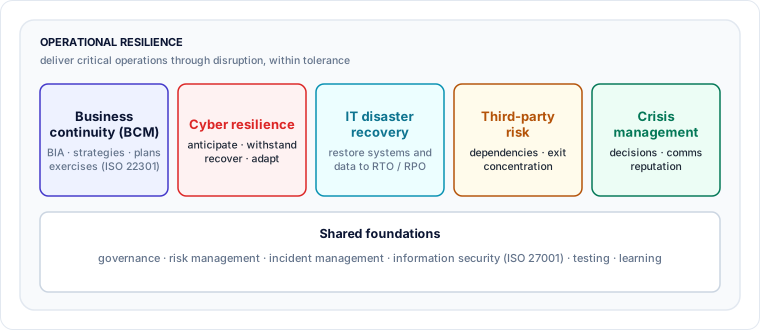
| Term | Meaning in this course |
|---|---|
| Business continuity | Being able to keep delivering products and services at an agreed level, and within an acceptable time, when something disrupts the organisation |
| Business continuity management (BCM) | The ongoing work of understanding what could disrupt the organisation and what that would do to it, and building the capability to respond |
| Business continuity management system (BCMS) | The set of policies, roles, processes and records through which an organisation plans, runs, checks and improves business continuity. ISO 22301 specifies its requirements |
| Operational resilience | The ability to deliver critical operations through disruption: to anticipate, prepare for, respond to and adapt to disruptions, staying within tolerance. This is the regulatory umbrella term used by the Basel Committee, RBI and others |
| Cyber resilience | The ability to anticipate, withstand, recover from and adapt to adverse conditions, stresses, attacks or compromises on systems that use or are enabled by cyber resources (the NIST SP 800-160 Vol. 2 framing) |
| Disaster recovery (DR) / ICT continuity | Restoring technology, systems and data after a disruption so that business continuity objectives can be met |
| Crisis management | Leading the organisation through an event that threatens its strategy, reputation or viability, including decisions and communication |
| Organisational resilience | The broadest idea: the ability to absorb and adapt in a changing environment (ISO 22316) |
The terms overlap on purpose. A practical way to hold them together: operational resilience is the outcome, and the BCMS is the management system that keeps the outcome under control. Cyber resilience and DR are capabilities inside it.
2. Products, services, activities and resources
ISO 22301 builds the BIA from the outside in:
- Products and services are what the organisation delivers to customers and other interested parties, such as EMI collection or equity trading.
- Activities (or processes) are what people and systems do to deliver them, such as receiving payment files, reconciling receipts and updating loan accounts.
- Resources are what activities need: people, information and data, technology, facilities, equipment, supplies, finance and partners or suppliers.
Regulators use similar ideas under different names. The Basel principles and RBI's guidance speak of critical operations. The UK regime uses important business services. DORA speaks of critical or important functions. When you map requirements, record each regulator's term and the BIA item it corresponds to.
3. The time and data objectives
| Term | Question it answers | Set by |
|---|---|---|
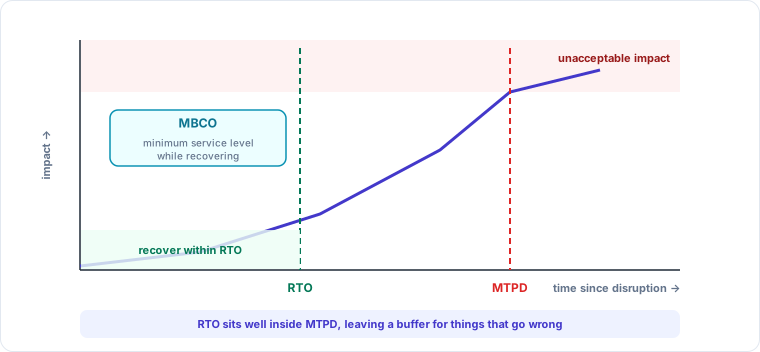
| MTPD — maximum tolerable period of disruption | After how long would the impact of not resuming become unacceptable? | Top management, from the BIA |
| RTO — recovery time objective | By when must the product, service or activity be resumed (or resources recovered)? Must be less than MTPD | BIA, approved by management |
| MBCO — minimum business continuity objective | What minimum level of service is acceptable while recovering? | BIA |
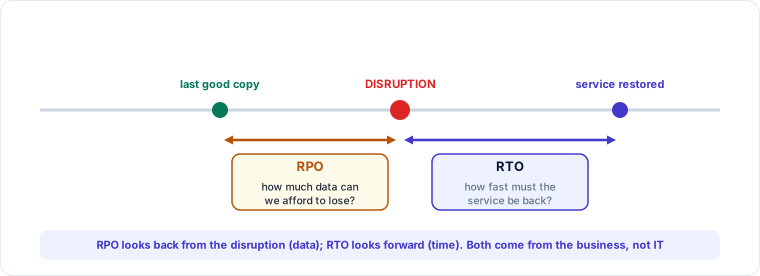
| RPO — recovery point objective | To what point must information be restorable so that the activity can resume? That is, how much data loss is tolerable? | BIA, with process and data owners |
Impact tolerance (UK) and tolerance for disruption (Basel, RBI) are close cousins of MTPD. They are usually set for a critical operation as a whole, from the customer's or the market's point of view. They may be expressed not only in time but also in volume (for example, number of failed payments) or service level. Module 3 shows how to set them alongside MTPD and RTO.
Some useful related terms:
- Recovery time capability (RTC): what you have demonstrated in a test. If RTC is longer than RTO, there is a gap.
- Work recovery time: time after systems are back to verify data, process backlogs and return to normal. This is often forgotten and must fit inside the RTO.
- Backlog: transactions that queued during the disruption and must be processed after it.
4. Getting the order right
A consistent set of objectives always follows: RTO < MTPD, and the RTO of supporting technology ≤ the RTO of the activity it supports, minus the time needed for work recovery.
For example, suppose EMI collection has an MTPD of 24 hours and an RTO of 8 hours. The collections platform must then be technically back in, say, 6 hours, leaving 2 hours to reconcile and clear the backlog. If the platform's DR design can only achieve 12 hours, no amount of planning in the business unit will meet the RTO.
Auditor lens
A classic finding is an IT DR plan with RTOs that do not trace to the BIA, or a BIA RTO that is shorter than any demonstrated recovery time. Auditors pick one critical activity and follow its MTPD, RTO and RPO from the BIA, to the IT DR plan, to the last DR test report.
5. Words that cause trouble
| Mistake | Better practice |
|---|---|
| "Our RTO is 4 hours" with no object | Always say what must be recovered: the service, the activity or a system |
| Using RTO for data | RPO is for data; RTO is for time to resume |
| Treating "high availability" as DR | Redundancy within one site or region keeps things running through component failure; it does not protect against corruption, ransomware or regional loss |
| "Incident" meaning everything | ISO 22301 uses disruption for an event that interrupts delivery. A security incident may or may not cause one |
| "BCP" for the whole programme | A plan is a document. The programme or BCMS includes BIA, strategies, exercises, audits and review |
Case study — Tarang Ledger and Sahyadri: agreeing the words
In the first joint workshop, Anil, Tarang's new BCM manager, finds that Sahyadri's "collections RTO of 4 hours" and Tarang's "platform RTO of 8 hours" are not comparable:
| Term | Sahyadri meant | Tarang meant |
|---|---|---|
| Service | Borrowers can pay by any channel and payments post to loan accounts | Tarang's web application and API respond |
| Clock starts | When borrowers start failing to pay | When Tarang declares a disaster |
| RPO | No payment confirmed to a borrower may be lost | Database restorable to within 1 hour |
They agree a shared glossary based on ISO 22301 terms with the RBI equivalents beside them. Sahyadri's "collections" becomes a critical operation with a tolerance for disruption. Tarang's platform becomes a resource supporting it, with its own RTO and RPO. The RPO for confirmed payments is set at zero: anything confirmed to a borrower must survive. This drives a design change in Module 4.
Key takeaways
- Operational resilience is the outcome; the BCMS manages it; cyber resilience and DR are capabilities within it.
- MTPD marks unacceptable impact; RTO is set inside it; MBCO is the minimum service while recovering; RPO limits data loss.
- Technology RTOs must fit inside activity RTOs, leaving time for work recovery and backlog.
- Regulators use their own words (critical operations, important business services, critical or important functions, tolerance for disruption). Map them to your BIA terms.
Self-check
- A payments service has an MTPD of 12 hours. Can its RTO be 12 hours? Why or why not?
- What is the difference between RTO and recovery time capability?
- Why does high availability within a single cloud region not by itself meet an RPO for ransomware scenarios?