
Why resilience matters in financial services
In this lesson you will:
- Describe the main sources of disruption that affect financial institutions and their technology providers
- Draw lessons from real outages and cyber attacks in the Indian and global financial sector
- Explain why regulators now treat disruption as inevitable and focus on recovery within tolerance
- Outline how this course and its case study are organised
Financial services run on trust that money will move, trades will settle and claims will be paid when promised. That trust depends on long chains of technology, people, premises and suppliers. When one link fails, customers do not care whose fault it was. They care how quickly service comes back and whether their money and data are safe.
For years, many organisations treated business continuity as a binder on a shelf and disaster recovery as an annual IT test. Regulators and boards have moved on. The working assumption today is that disruption will happen, so the questions are: which services must keep running, how much disruption can customers and markets bear, and can you prove you will recover in time?
1. Where disruption comes from
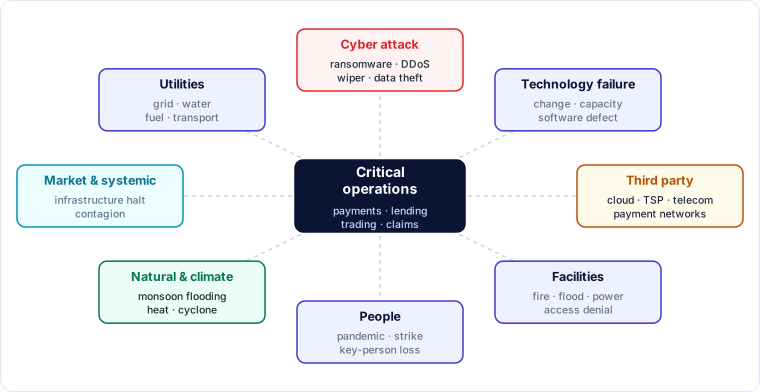
| Source | Typical BFSI examples |
|---|---|
| Cyber attack | Ransomware encrypting core systems; destructive wipers; DDoS on internet banking; data theft followed by extortion |
| Technology failure | Failed change or upgrade; capacity exhaustion on salary day; database corruption; expired certificates |
| Third parties | Cloud region outage; failure of a technology service provider (TSP), telecom carrier or payment network |
| Facilities | Data-centre power failure, fire, flooding of a branch or operations centre, denial of access |
| People | Pandemic, strikes, loss of key staff, mass absence in one city |
| Natural and climate | Monsoon flooding in Mumbai or Chennai, cyclones on the east coast, heatwaves stressing cooling and power |
| Market and systemic | Halt at an exchange, clearing corporation or depository; contagion from another firm's failure |
Two features stand out. First, many disruptions now start outside the organisation: at a cloud provider, a software vendor or a shared service. Second, cyber attacks behave differently from accidents. An attacker can corrupt backups, follow you to your DR site and strike again, which is why the course treats cyber resilience as a discipline of its own in Module 5.
2. Lessons from real disruptions
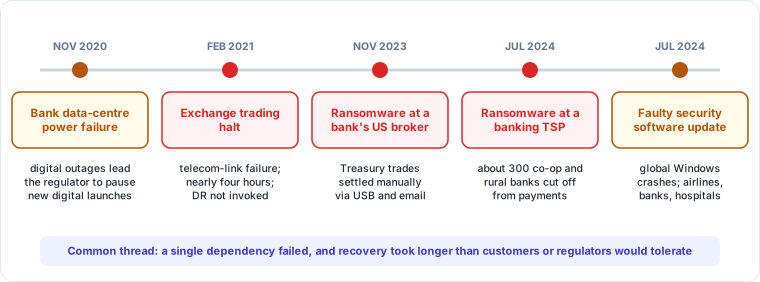
These cases are public and widely reported. They are summarised here for their lessons, not to judge the firms involved.
- Bank data-centre power failure (November 2020). A power failure at a large private bank's primary data centre interrupted internet banking, mobile banking and payments. It followed earlier outages. The Reserve Bank of India (RBI) directed the bank to pause new digital launches and new credit-card sourcing until it fixed the shortcomings. Lesson: repeated outages become a supervisory issue, and regulators can restrict growth until resilience improves.
- Exchange trading halt (February 2021). The National Stock Exchange halted trading for almost four hours after problems with telecom links from its service providers. Trading was not moved to the disaster recovery site. Lesson: the decision to invoke DR must be quick and pre-agreed. SEBI later tightened MII rules to require disaster declaration within 30 minutes and restoration within 45 minutes.
- Ransomware at a global bank's US broker-dealer (November 2023). A ransomware attack on the US financial-services arm of ICBC disrupted its Treasury market activity. Trades were reportedly settled by passing data on a USB drive. Lesson: a cyber attack can stop a business line even when the wider group is unaffected, and manual workarounds must be planned and safe.
- Ransomware at an Indian banking technology provider (July 2024). A ransomware attack on C-Edge Technologies, which provides core systems to many co-operative and regional rural banks, cut about 300 small banks off from payment systems while NPCI isolated them. Lesson: concentration risk. Many regulated entities depended on one provider, and the regulator's and the network's priority was to contain the threat even at the cost of service.
- Faulty security software update (July 2024). A defective update to CrowdStrike's endpoint security agent crashed millions of Windows machines worldwide, affecting airlines, hospitals and banks. Lesson: a trusted, well-controlled supplier can still be a single point of failure, and recovery may require hands-on work on every device.
Auditor lens
Inspectors and auditors increasingly ask: "Which public incidents did you analyse this year, and what did you change?" A short register of external incidents, each with an assessment of "could this happen to us?" and any actions, is strong evidence that the organisation learns from the sector.
3. Why regulators changed the question
Traditional business continuity asked, "Do you have a plan for losing this building or that data centre?" That question is still useful, but it is incomplete. Modern regulation, led by the Basel Committee's 2021 operational resilience principles and reflected in RBI's operational resilience guidance, SEBI's CSCRF and the EU's DORA, asks different questions:
- Which operations are critical, meaning their disruption would harm customers, market integrity or the institution's viability?
- How much disruption can each tolerate, expressed as time, volume or service level?
- What does each depend on: people, technology, data, premises and third parties?
- Can you stay within tolerance under severe but plausible scenarios, including cyber attacks?
- Is the board accountable and informed?
This is a shift from planning for causes ("fire at the Pune office") to protecting outcomes ("customers can make repayments"). It does not replace business continuity management. It frames it. Module 2 builds the management system and Module 3 shows how to set tolerances.
4. The cost of getting it wrong
Disruption costs show up in several places at once:
- Customers: failed payments, missed EMIs and late-payment charges, inability to trade at critical moments.
- Markets and the system: settlement delays, loss of confidence, knock-on effects on other institutions.
- Regulatory: reporting obligations within hours, inspections, directions that restrict business, penalties.
- Financial and reputational: compensation, lost revenue, higher insurance costs, and headlines that last longer than the outage.
A resilience programme is justified less by a precise return on investment than by the board's duty to keep critical services within tolerance and the regulator's expectation that it can prove this.
Case study — Tarang Ledger: the call from Sahyadri
Tarang Ledger certified to ISO 27001 last year. Its platform handles invoicing and collections for about 60 customers. The largest of these is Sahyadri Finance Ltd, a middle-layer NBFC with 4 lakh borrowers that collects most EMIs through Tarang.
After the July 2024 ransomware incident at a banking TSP, Sahyadri's board asks its operational risk team: "If Tarang goes down, how long before borrowers cannot pay us, and what do we do?" Sahyadri's head of operational risk calls Meera, Tarang's head of security:
| Sahyadri asks | Tarang's current answer |
|---|---|
| Your RTO and RPO for collections | RTO 8 hours, RPO 1 hour, from the ISO 27001 work (control 5.30) |
| Evidence that you can meet them | One full restore test in 6 h 20 min; no regional failover test |
| Plan if your cloud region fails | Draft only |
| How you would handle ransomware | Incident procedure and one tabletop exercise |
| Notice to us if you have a cyber incident | Contract says "promptly" |
Sahyadri's own collections tolerance turns out to be shorter than Tarang's RTO on peak days, which Module 3 explores. Tarang's CEO agrees to build an ISO 22301 business continuity management system within a year, with Meera leading and a new BCM manager, Anil, joining her. This course follows that programme, and shows Sahyadri's side where it differs.
Key takeaways
- Disruption comes from cyber attacks, technology, third parties, facilities, people, climate and the market, and increasingly from outside the organisation.
- Real incidents show recurring lessons: decide quickly to invoke DR, plan safe manual workarounds, manage concentration risk and treat trusted suppliers as possible single points of failure.
- Regulators now ask about critical operations, tolerance for disruption, dependencies, severe-but-plausible testing and board accountability.
- BCM remains the engine; operational and cyber resilience frame what it must protect and how well.
Self-check
- Why is a cyber attack harder to recover from than an accidental data-centre failure?
- What concentration lesson does the July 2024 ransomware attack on a banking TSP teach regulated entities?
- How does asking "can customers make repayments?" differ from asking "do we have a plan for losing the office?"