
The standards landscape: ISO 22301 and NIST
In this lesson you will:
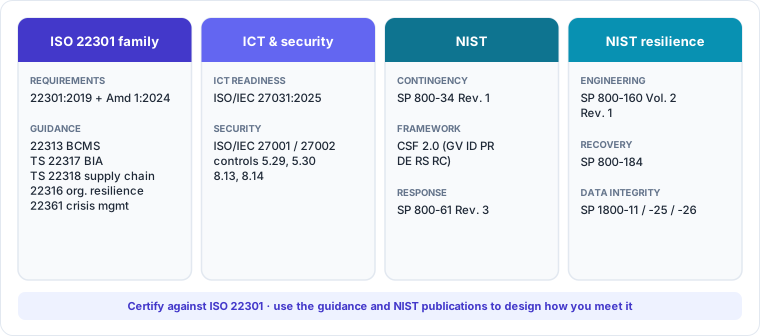
- Describe the structure of ISO 22301:2019 and what Amendment 1:2024 added
- Choose the right ISO guidance documents for BIA, supply chain, crisis management and ICT readiness
- Explain how NIST SP 800-34, CSF 2.0, SP 800-61r3, SP 800-160 Vol. 2 and SP 800-184 complement ISO 22301
- Decide which framework to certify against and which to use for design
Implementers do not need to read every resilience standard, but they do need to know which document answers which question. This lesson maps the ISO and NIST publications used throughout the course.
1. ISO 22301:2019 — the certifiable backbone
ISO 22301 specifies the requirements for a business continuity management system. It uses the same high-level (harmonized) structure as ISO/IEC 27001 and ISO 9001, so clauses 4 to 10 will feel familiar to anyone who has implemented an ISMS:
| Clause | Content | Course module |
|---|---|---|
| 4 Context | Issues, interested parties, legal and regulatory requirements, scope | 2 |
| 5 Leadership | Commitment, policy, roles | 2 |
| 6 Planning | Risks and opportunities, objectives, planning changes | 2 |
| 7 Support | Resources, competence, awareness, communication, documented information | 2 |
| 8 Operation | 8.1 operational planning; 8.2 BIA and risk assessment; 8.3 strategies and solutions; 8.4 plans and procedures; 8.5 exercise programme; 8.6 evaluation of BC documentation and capabilities | 3–7 |
| 9 Performance evaluation | Monitoring, internal audit, management review | 8 |
| 10 Improvement | Nonconformity, corrective action, continual improvement | 8 |
Clause 8 is the heart of the standard and the reason it differs from ISO 27001. Instead of a risk assessment leading to an Annex A of controls, ISO 22301 has a cycle of analysis, strategy, plans and exercises.
Compared with the 2012 edition, the 2019 revision streamlined the text. It removed some prescriptive detail about procedures, made the BIA and risk assessment clearer, introduced business continuity strategies and solutions as the term, and separated exercising (8.5) from evaluating documentation and capabilities (8.6).
Amendment 1:2024 added climate change to clause 4.1 (decide whether it is a relevant issue) and a note to 4.2 that interested parties may have climate-related requirements. This is the same amendment that was applied to ISO/IEC 27001 and other management-system standards. For BFSI, climate is directly relevant to continuity: flooding of operations centres, heat stress on data centres and disruption of staff travel.
2. ISO guidance documents
| Document | Use it for |
|---|---|
| ISO 22300 | Vocabulary for the security and resilience family |
| ISO 22313:2020 | Guidance on implementing each ISO 22301 requirement, with examples |
| ISO/TS 22317:2021 | Business impact analysis: planning, methods, impact categories, setting priorities and recovery times |
| ISO/TS 22318:2021 | Supply chain continuity: assessing and managing suppliers' continuity |
| ISO 22316:2017 | Organisational resilience principles and attributes; useful for board-level framing |
| ISO 22361:2022 | Crisis management: structure, leadership, decision-making and communication in a crisis |
| ISO 22320 | Emergency management and incident command structures |
| ISO/IEC 27031:2025 | ICT readiness for business continuity: how ICT services are prepared, tested and recovered to meet continuity objectives |
| ISO/IEC 27001 / 27002 | Security controls that support continuity, especially 5.29 (security during disruption), 5.30 (ICT readiness), 8.13 (backup) and 8.14 (redundancy) |
Only ISO 22301 contains certifiable requirements. The others help you meet those requirements well, and auditors often recognise their methods.
3. NIST publications
The US National Institute of Standards and Technology publishes free guidance that is widely used in Indian financial institutions, partly because SEBI's CSCRF and many global group policies are built on it.
| Publication | What it gives the implementer |
|---|---|
| SP 800-34 Rev. 1 — Contingency Planning Guide for Federal Information Systems | A seven-step contingency planning process: policy, BIA, preventive controls, recovery strategies, the plan, testing and training, and maintenance. It also describes the family of plans, including BCP, crisis communications, cyber incident response, DR, information system contingency plan (ISCP) and occupant emergency plan. Still the most practical guide to IT contingency plans |
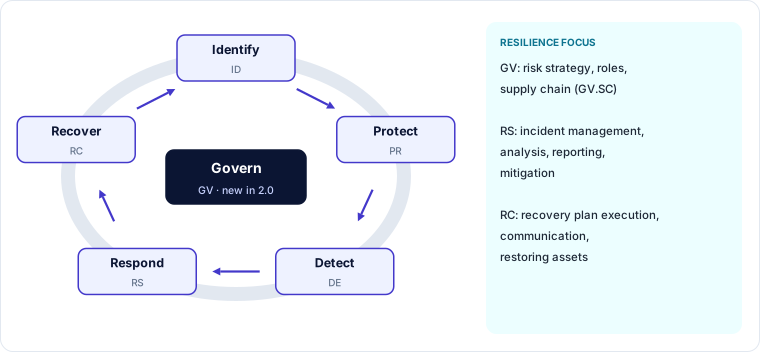
| Cybersecurity Framework (CSF) 2.0 (2024) | Six functions: Govern, Identify, Protect, Detect, Respond, Recover. Govern (new in 2.0) covers risk strategy, roles, policy and cybersecurity supply chain risk management. Respond and Recover cover incident management, communication and recovery plan execution |
| SP 800-61 Rev. 3 (2025) — Incident Response Recommendations | Reframes incident response around the CSF 2.0 functions instead of the old four-phase lifecycle. Response is continuous and integrated with governance, detection and recovery |
| SP 800-160 Vol. 2 Rev. 1 (2021) — Developing Cyber-Resilient Systems | Cyber resiliency goals (anticipate, withstand, recover, adapt), objectives and techniques such as redundancy, diversity, segmentation, non-persistence and deception |
| SP 800-184 (2016) — Guide for Cybersecurity Event Recovery | Planning and running recovery after a cyber event: playbooks, metrics, communication and building recovery into the organisation |
| SP 1800-11, -25, -26 | Practice guides on data integrity: identifying, protecting against, detecting and recovering from ransomware and destructive events |
4. How they fit together
A practical division of labour for a BFSI organisation:
- Certify (or align) the management system to ISO 22301. It provides governance, the BIA-strategy-plan-exercise cycle and improvement, and it is recognised by customers and auditors.
- Use ISO/TS 22317 and ISO/TS 22318 for the BIA and supplier continuity methods.
- Use NIST SP 800-34 and ISO/IEC 27031 to design IT contingency and DR plans.
- Use CSF 2.0, SP 800-61r3, SP 800-160 Vol. 2 and SP 800-184 for cyber resilience: detection, response, recovery and resilient design.
- Map regulatory requirements onto this single structure (Lesson 1.5), so that one BIA, one set of plans and one exercise programme satisfy ISO 22301, RBI, SEBI and IRDAI together.
Auditor lens
ISO 22301 auditors will not ask you to follow NIST, and regulators will not ask you to certify to ISO 22301. They will ask you to show that your method is defined, consistently applied and effective. Cite the guidance you used in your BCMS documentation; it strengthens the rationale for your choices.
Case study — Tarang Ledger: choosing the reference set
Meera and Anil agree the following for Tarang's BCMS:
| Need | Reference chosen | Reason |
|---|---|---|
| Certification | ISO 22301:2019 + Amd 1:2024 | Customers ask for it; it integrates with the ISO 27001 ISMS |
| BIA method | ISO/TS 22317 | Clear impact-over-time method that customers' auditors recognise |
| Supplier continuity | ISO/TS 22318 | Cloud provider, payment aggregators and SMS gateway are critical |
| DR plans | ISO/IEC 27031 + NIST SP 800-34 | Plan templates and test types |
| Cyber recovery | NIST CSF 2.0, SP 800-61r3, SP 800-184 | Matches SEBI CSCRF vocabulary used by intermediary customers |
| Crisis management | ISO 22361 | First formal crisis structure for the company |
Sahyadri, by contrast, aligns its programme to RBI's operational resilience guidance first. It uses ISO 22301 as its method but does not plan to certify.
Key takeaways
- ISO 22301 is the certifiable BCMS standard; clause 8 (BIA, strategies, plans, exercises, evaluation) is its core.
- Amd 1:2024 adds climate change to context and interested parties.
- ISO 22313, TS 22317, TS 22318, 22361 and ISO/IEC 27031 give the methods; only 22301 has requirements.
- NIST gives practical depth: SP 800-34 for contingency plans, CSF 2.0 with Govern, SP 800-61r3 for response, SP 800-160 Vol. 2 and SP 800-184 for cyber resilience and recovery.
Self-check
- Which ISO 22301 clause contains the BIA, and what follows it in the same clause?
- Which document would you use to design a BIA method, and which for supplier continuity?
- What changed in NIST's incident response guidance with SP 800-61 Rev. 3?