
Indian regulation: RBI, SEBI, IRDAI and CERT-In
In this lesson you will:
- Identify the main RBI, SEBI, IRDAI and cross-sector instruments that drive continuity and cyber resilience
- Summarise their key resilience expectations, including timelines for reporting, recovery and testing
- Explain how obligations flow down from regulated entities to technology service providers
- Build a regulatory requirements register for a BFSI organisation
Indian financial regulators have moved quickly since 2020. Each now expects board-owned resilience, defined recovery objectives, tested DR and fast incident reporting. The instruments are long, entity-specific and frequently revised. This lesson gives an implementer's map as of November 2026. Always read the version that applies to your entity type and size before you build controls.
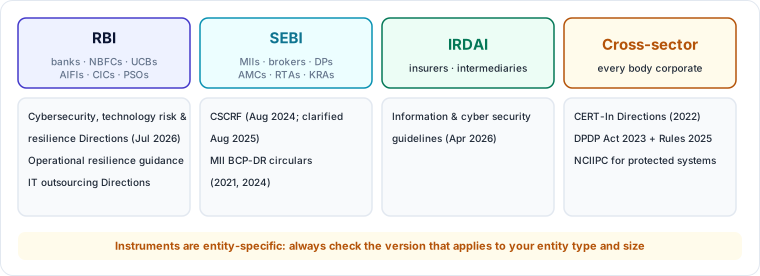
1. Reserve Bank of India
Cybersecurity, technology risk and resilience Directions (31 July 2026). RBI consolidated its technology instruments into entity-wise Directions. There are separate instruments for commercial banks, small finance banks, payments banks, urban co-operative banks, NBFCs, credit information companies and all-India financial institutions. They took effect on issue. They replace, among many older circulars, the 2016 Cyber Security Framework for banks and the 2023 Master Direction on IT governance, risk, controls and assurance. Proportionality is built in: NBFC chapters scale with the Scale Based Regulation layer and asset size, and UCBs are graded by digital depth.
Resilience-relevant themes include:
- board-level oversight through an IT Strategy Committee or its equivalent, a CISO with direct reporting to senior management and the board's risk committee, and board-approved IT, information security and continuity policies;
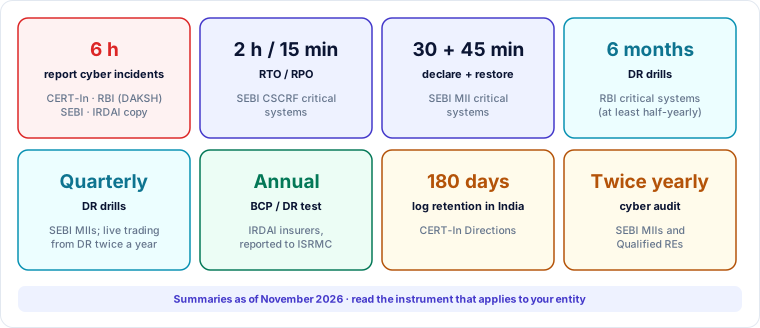
- BCP and DR for critical information systems, with DR drills at least half-yearly for critical systems and documented results;
- cyber incident reporting to RBI within six hours of detection through the DAKSH portal, alongside CERT-In reporting;
- security operations (a C-SOC for banks), vulnerability assessment and penetration testing at defined frequencies, and a cyber crisis management plan.
Guidance Note on Operational Risk Management and Operational Resilience (first issued April 2024). This aligns RBI with the Basel Committee principles. Its 17 principles sit under three pillars: prepare and protect; build resilience; and learn and adapt. For resilience, the key expectations are:
- identify critical operations and set a tolerance for disruption for each, using time-based and, where useful, volume or service-level metrics;
- map the people, technology, information, facilities and third parties that support each critical operation;
- test the ability to stay within tolerance under severe but plausible scenarios;
- manage third-party and nth-party dependencies, including substitutability;
- protect data with resilient backups, including immutable or offline copies;
- learn from incidents, near misses and tests.
It applies to commercial banks, co-operative banks, all-India financial institutions and NBFCs, proportionately.
Master Direction on Outsourcing of IT Services (2023). The regulated entity remains accountable for outsourced services. For material outsourcing it must: assess the provider's business continuity and DR capability; require the provider to test its BCP and share results; have audit and regulatory access rights; manage concentration risk; and maintain an exit strategy that can be executed without disrupting service. This is the main route by which RBI's expectations reach TSPs such as Tarang.
2. Securities and Exchange Board of India
Cybersecurity and Cyber Resilience Framework (CSCRF), August 2024, with technical clarifications in August 2025. CSCRF replaced SEBI's separate cyber circulars for different intermediaries with one framework, graded by category: MIIs, Qualified REs, mid-size, small-size and self-certification REs. It is built on cyber resiliency goals (anticipate, withstand, contain, recover, evolve) and functions aligned with NIST CSF. Resilience-relevant themes include:
- governance with board-approved policies, an IT committee and a CISO;
- identification of critical systems, with an RTO of 2 hours and RPO of 15 minutes set for critical systems in the framework's BCP and DR standard;
- reporting cyber incidents to SEBI within 6 hours of detection, in addition to CERT-In;
- a security operations centre, with a Market SOC option offered by exchanges for smaller REs;
- a Cyber Capability Index for MIIs and Qualified REs, and cyber audits twice a year for MIIs and Qualified REs (annually for others);
- ISO 27001 certification mandatory for MIIs and recommended for Qualified REs (since the 2025 clarifications).
BCP-DR for market infrastructure institutions. Exchanges, clearing corporations and depositories face the strictest rules:
- 2021 circular: defined critical systems; declare a disaster within 30 minutes and restore operations within 45 minutes; RPO of 15 minutes; quarterly DR drills; live trading or operation from the DR site at least twice a year.
- 2024 framework: a near site with near-zero RPO through synchronous replication from the primary data centre, and a DR site staffed and able to run independently.
3. Insurance Regulatory and Development Authority of India
Information and Cyber Security Guidelines (April 2026) replaced the 2023 guidelines. They are aligned with the DPDP Act. For continuity, insurers and covered intermediaries need a board-approved BCP and DR framework. They must test BCP and DR at least annually using realistic scenarios and report the results to the Information Security Risk Management Committee (ISRMC). They must report cyber incidents to CERT-In within six hours, with a copy to IRDAI.
4. Cross-sector requirements
| Instrument | Resilience relevance |
|---|---|
| CERT-In Directions (April 2022) under section 70B of the IT Act | Report specified cyber incidents within 6 hours of noticing them; keep ICT system logs for 180 days in India; synchronise clocks to specified NTP sources; designate a point of contact |
| Digital Personal Data Protection Act, 2023 and DPDP Rules, 2025 | Reasonable security safeguards, including measures for continued processing after a compromise; intimation of personal data breaches to the Data Protection Board and affected individuals. The Rules phase in obligations through 2027 |
| NCIIPC and section 70 of the IT Act | Systems declared protected systems or critical information infrastructure carry additional obligations and reporting |
| Other regulators | PFRDA, IFSCA and NPCI (for payment-system participants) issue their own cyber and continuity requirements |
5. Flow-down to technology service providers
Most TSPs are not regulated directly. Regulators reach them through the regulated entity, which must:
- assess and monitor the TSP's continuity and security;
- include contract clauses on RTO and RPO, incident notification (often 2–4 hours, so the RE can meet its own six-hour clock), testing, audit rights, regulatory access, sub-contracting and exit;
- participate in or review the TSP's DR tests.
For a TSP, the practical consequence is that its customers' regulations become its own requirements through clause 4.2 of ISO 22301.
Regulator lens
Inspection teams typically ask for the board-approved BCP/DR policy, the list of critical systems with their RTO and RPO, the last two DR drill reports with actual recovery times, the incident register with reporting timestamps, and evidence that material outsourcing arrangements were assessed for continuity and exit.
Case study — Tarang Ledger: building the regulatory register
Anil builds Tarang's register of legal, regulatory and contractual requirements for the BCMS (ISO 22301 clause 4.2.2). Extract:
| Source | Applies because | Requirement for Tarang |
|---|---|---|
| RBI IT outsourcing Directions | NBFC customers, including Sahyadri, outsource collections to Tarang | Tested BCP/DR shared with customers; audit access; support for exit |
| RBI cyber Directions (NBFC chapters) | Customers must report to RBI in 6 hours | Notify customers of suspected cyber incidents within 2 hours (new contract clause) |
| SEBI CSCRF via Kaveri Securities and distributors | Qualified RE customers flow down CSCRF to third parties | Support 2 h RTO / 15 min RPO for their critical feeds, or document why the service is not critical to them |
| CERT-In Directions | Applies to Tarang directly | 6-hour reporting; 180-day logs; NTP |
| DPDP Act and Rules | Tarang processes borrowers' personal data | Breach response; safeguards for continued processing |
| Customer contracts | 14 contracts include continuity clauses | Annual DR test report; 99.9% availability |
The register reveals a conflict. Sahyadri's draft contract asks for an RTO of 4 hours for collections, but Tarang's current design targets 8. Module 3 resolves it with a proper BIA.
Key takeaways
- RBI: entity-wise cyber and technology resilience Directions (July 2026) with half-yearly DR drills and 6-hour DAKSH reporting; operational resilience guidance on critical operations and tolerance; IT outsourcing Directions for third parties and exit.
- SEBI: CSCRF (graded by category, RTO 2 h / RPO 15 min, 6-hour reporting) and strict MII BCP-DR rules (30-minute declaration, 45-minute restoration, near site).
- IRDAI: 2026 guidelines with at least annual BCP/DR testing reported to the ISRMC.
- CERT-In 6-hour reporting and 180-day logs apply to everyone. Obligations flow down to TSPs through contracts.
Self-check
- What three expectations sit at the core of RBI's operational resilience guidance for critical operations?
- Why might a TSP's contract require incident notification within 2 hours when the regulation says 6?
- Name two BCP-DR requirements that apply to MIIs but not to most other SEBI-regulated entities.