
International comparators and an integrated requirements map
In this lesson you will:
- Summarise the Basel Committee principles, EU DORA and the UK operational resilience regime
- Explain why these international regimes matter to Indian institutions and their suppliers
- Build an integrated requirements map that satisfies several frameworks with one BCMS
- Plan the phases of a BCM and resilience programme
Indian regulation did not develop in isolation. RBI's operational resilience guidance follows the Basel Committee. SEBI's CSCRF borrows NIST's structure. Global banks with Indian operations, and Indian TSPs with European clients, meet DORA and UK requirements through group policies and contracts. Knowing the international regimes helps you read Indian rules and avoid building the same control three times.
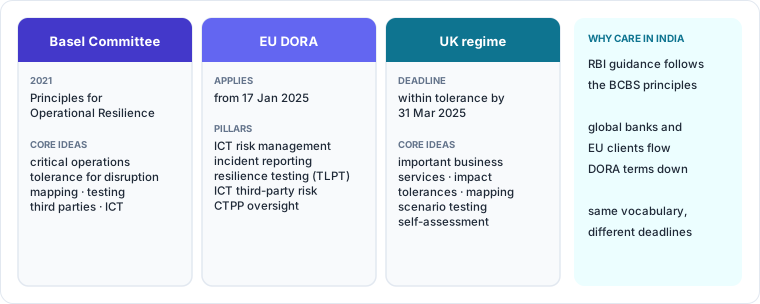
1. Basel Committee: Principles for Operational Resilience (2021)
The Basel Committee on Banking Supervision published seven principles in March 2021, alongside revised principles for operational risk management. In summary:
- Governance: the board approves the approach to operational resilience, including tolerance for disruption to critical operations.
- Operational risk management: identify and assess threats and vulnerabilities and use the operational risk framework to manage them.
- Business continuity planning and testing: forward-looking plans tested under severe but plausible scenarios.
- Mapping of interconnections and interdependencies of critical operations.
- Third-party dependency management, including intragroup arrangements.
- Incident management: response and recovery plans, root-cause analysis and learning.
- Resilient ICT, including cybersecurity: protected, tested and situationally aware.
RBI's 2024 guidance note is close to a national implementation of these principles.
2. EU Digital Operational Resilience Act (DORA)
DORA has applied since 17 January 2025 to almost all EU financial entities. It also reaches their ICT providers through contracts and, for the most important ones, direct oversight. Its five pillars are:
| Pillar | Key requirements |
|---|---|
| ICT risk management | Board-owned framework; identify, protect, detect, respond and recover; ICT business continuity policy with tested response and recovery plans; backup policies and restoration |
| Incident management and reporting | Classify ICT incidents; report major incidents with an initial notification within hours, then intermediate and final reports |
| Digital operational resilience testing | Annual testing programme; threat-led penetration testing (TLPT) at least every three years for significant entities |
| ICT third-party risk | A register of all ICT contractual arrangements; mandatory contract terms; exit strategies; concentration risk assessment |
| Oversight of critical ICT third-party providers (CTPPs) | EU supervisors designate and directly oversee the most systemic providers, such as large cloud providers |
Indian TSPs serving EU banks will see DORA's mandatory contract terms in their agreements: service levels, incident notification, audit and access rights, participation in testing, and exit support.
3. United Kingdom: operational resilience
UK rules (Bank of England, PRA and FCA) came into force on 31 March 2022. Firms had to:
- identify important business services (services to external end users whose disruption could cause intolerable harm);
- set an impact tolerance for each, the maximum tolerable disruption, mostly expressed as time;
- map the resources supporting each service and test against severe but plausible scenarios;
- write an annual self-assessment approved by the board;
- be able to stay within impact tolerance by 31 March 2025.
The UK also introduced a critical third parties regime for systemic providers. Other regulators in the region, such as Singapore's MAS (business continuity guidelines with service recovery time objectives for critical business services) and the HKMA, have similar expectations.
4. One BCMS, many requirements
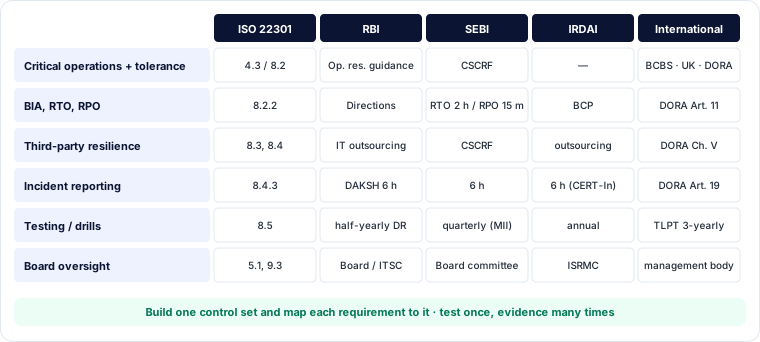
An integrated map lists themes as rows (critical operations, tolerance, BIA, dependencies, third parties, strategies, plans, incident reporting, testing, board oversight, audit) and sources as columns (ISO 22301 clauses, RBI, SEBI, IRDAI, CERT-In, DORA or others that apply). Each cell holds the specific requirement, and each row points to one process, owner and evidence set. The benefits are:
- one BIA that sets both ISO 22301 RTOs and RBI tolerances;
- one exercise programme whose calendar meets the strictest drill frequency;
- one incident procedure whose notification clock satisfies the shortest deadline;
- one audit programme that tests clauses and regulatory themes together.
Where requirements conflict, the strictest applicable requirement usually wins for the operations it covers. Record the decision, so an auditor can see why, for example, one service has a 2-hour RTO and another 8.
Auditor lens
A requirements map with owners and evidence references is one of the most useful documents in a regulated BCMS. Auditors and inspectors can trace any requirement to a process and a record in minutes. A map without evidence references is just a list.
5. Phasing the programme
A first-year BCMS and resilience programme in a mid-sized BFSI organisation or TSP typically runs as follows:
| Phase | Months | Main outputs |
|---|---|---|
| 1. Mobilise | 1–2 | Charter, sponsor, team, requirements map, policy |
| 2. Analyse | 2–4 | BIA, critical operations and tolerances, dependency maps, risk assessment |
| 3. Design | 4–7 | Strategies and solutions, budget decisions, DR and data-resilience changes, supplier actions |
| 4. Document | 5–8 | Response structure, BC plans, IT DR plans, crisis communication, cyber crisis annex |
| 5. Exercise | 7–11 | Tabletops, DR drill, cyber simulation, post-exercise reports |
| 6. Assure | 10–12 | Internal audit, management review, corrective actions, certification audit |
Case study — Tarang Ledger: the programme charter
Tarang's board approves a 12-month programme:
- Sponsor: CTO. Lead: Meera (head of security and ISMS manager). BCM manager: Anil (full time). Steering group: CEO (chair), CTO, CFO, head of customer success, head of support, legal counsel.
- Scope direction: the collections and invoicing platform and the teams that run and support it in Pune and Bengaluru.
- Drivers: RBI outsourcing flow-down from NBFC customers, CSCRF flow-down from intermediary customers, two EU prospects whose banks are subject to DORA, and ISO 22301 certification.
- Integration: reuse the ISMS's risk scales, document control, internal audit and management review. ISO 22301 Stage 2 to run alongside the second ISO 27001 surveillance audit.
- Budget: about ₹1.1 crore in year one, including a second-region DR capability (decision pending the BIA).
Sahyadri runs its own programme under its operational risk committee. It agrees to share BIA results for collections with Tarang so that the two programmes use the same tolerance.
Key takeaways
- Basel 2021 sets seven principles that RBI's guidance follows: governance, risk management, BCP and testing, mapping, third parties, incident management and resilient ICT.
- DORA (from January 2025) adds strict ICT risk, incident reporting, TLPT, third-party registers and CTPP oversight. Indian suppliers meet it through contracts.
- The UK regime uses important business services and impact tolerances, with the 2025 deadline to be within tolerance.
- Build an integrated requirements map so that one BCMS, one BIA, one exercise programme and one audit satisfy all of them.
Self-check
- Which Basel principle deals with understanding how critical operations depend on people, technology and third parties?
- How might DORA affect an Indian TSP that has no EU licence?
- When two frameworks set different drill frequencies for the same system, which should the programme follow, and what should be recorded?