
Responsible AI: fairness, transparency and explainability
In this lesson you will:
- Explain core responsible-AI principles and how they translate into controls
- Identify where bias enters the AI lifecycle and how to mitigate it
- Compare common fairness metrics and their trade-offs
- Distinguish transparency from explainability and choose suitable explanation methods
- Describe systemic, sustainability and societal considerations
Responsible AI turns values into requirements. Security professionals are often asked to help, because the same disciplines — clear requirements, testing, evidence, monitoring — apply.
1. Core principles
Most frameworks share a common set of principles, even when the wording differs.
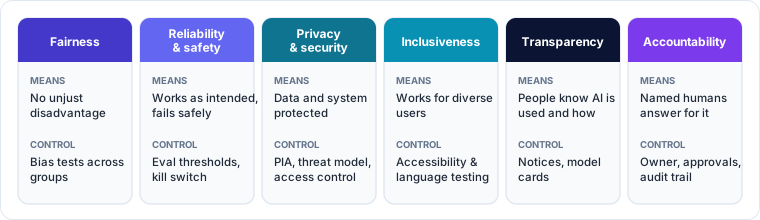
| Principle | Meaning | Example control |
|---|---|---|
| Fairness | Outcomes do not unjustly disadvantage groups | Bias testing across protected groups before release and in production |
| Reliability and safety | System performs as intended and fails safely | Evaluation thresholds, safe fallbacks, kill switch |
| Privacy and security | Personal data and the system are protected | Privacy impact assessment, threat model, access control |
| Inclusiveness | Works for diverse users, including people with disabilities and different languages | Accessibility and multilingual testing |
| Transparency | People know when AI is used and how it works at an appropriate level | AI disclosure notices, model cards |
| Accountability | Named humans answer for the system's outcomes | Owner in inventory, approval records, audit trail |
2. Where bias comes from
Algorithmic bias is systematic error that disadvantages some groups. It rarely comes from a single cause.
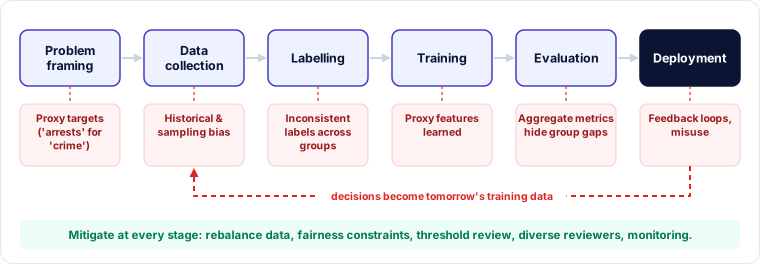
| Source | Example |
|---|---|
| Historical bias | Past hiring decisions favoured one group; a model trained on them learns the pattern |
| Representation / sampling bias | A speech model trained mostly on one accent performs poorly on others |
| Measurement bias | Using "arrests" as a proxy for "crime" reflects policing patterns |
| Label bias | Annotators apply labels inconsistently across groups |
| Proxy variables | Postcode or college name correlates with a protected attribute |
| Deployment / feedback bias | A system's decisions shape the next round of training data |
Mitigation across the lifecycle
- Pre-processing: rebalance or reweight training data, improve representation, remove or transform proxies.
- In-processing: add fairness constraints or penalties during training.
- Post-processing: adjust decision thresholds per group (where lawful) or calibrate outputs.
- Organisational: diverse review teams, documented fairness requirements, human review of adverse decisions, and ongoing monitoring.
Removing the protected attribute alone ("fairness through unawareness") rarely works, because proxies carry the same signal. Measuring fairness often requires the sensitive attribute, which raises privacy questions — one reason the EU's 2026 amendments allow limited processing of special-category data for bias detection under safeguards.
3. Measuring fairness
| Metric | Asks | Notes |
|---|---|---|
| Demographic parity | Do groups receive positive outcomes at similar rates? | Simple; ignores differences in qualification |
| Disparate impact ratio | Lowest group selection rate ÷ highest | The "four-fifths rule" flags ratios below 0.8 |
| Equal opportunity | Do qualified people in each group have similar true-positive rates? | Focuses on missed opportunities |
| Equalised odds | Are both true-positive and false-positive rates similar? | Stricter |
| Calibration | Does a score of 0.7 mean the same probability for each group? | Important for risk scores |
Different fairness metrics can conflict mathematically; you usually cannot satisfy all at once. Choosing a metric is a policy decision for the business owner with legal input, not a purely technical one. Document the choice and the reasoning.
Worked example — checking a loan-approval model
A lender tests its model on 2,000 recent applications.
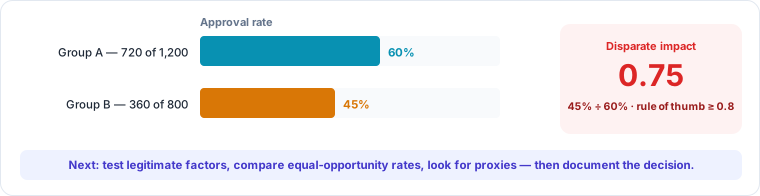
| Group | Applicants | Approved | Approval rate |
|---|---|---|---|
| Group A | 1,200 | 720 | 60% |
| Group B | 800 | 360 | 45% |
Disparate impact ratio = 45% ÷ 60% = 0.75, below the 0.8 rule of thumb.
Next steps: check whether the gap is explained by legitimate, job- or credit-relevant factors; compare equal-opportunity rates (approval rates among applicants who later repaid); look for proxies such as postcode; and decide — with the business owner and legal — whether to retrain, adjust, or add human review for borderline cases. Record the decision either way.
4. Transparency and explainability
These are related but different:
- Transparency is about openness: telling people AI is being used, what it is for, what data it uses, and its limitations. Tools include AI-use notices, model cards, system cards and datasheets for datasets.
- Explainability is about understanding a specific behaviour: why did the model produce this output?
- Interpretability is the degree to which a human can understand the model's internal mechanics. Simple models (linear, small decision trees) are interpretable by design; deep models are not.
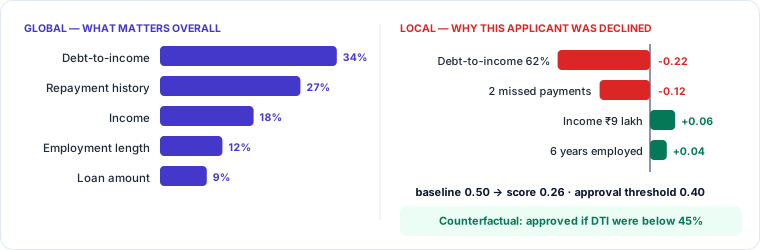
| Method | Scope | Use |
|---|---|---|
| Feature importance | Global | Which inputs matter most overall |
| SHAP / LIME | Local (and global by aggregation) | Contribution of each input to one prediction |
| Counterfactual explanations | Local | "Your application would be approved if income were ₹X higher" |
| Example-based | Local | Similar past cases |
| Citations / source attribution | GenAI | Which retrieved documents supported an answer |
Explanations must suit the audience: regulators and auditors need method and evidence; affected individuals need plain-language reasons and a route to contest.
Trade-off: more accurate models can be less explainable. For high-impact decisions, organisations sometimes choose a simpler, interpretable model on purpose — a case of the architectural trade-offs discussed in Module 6.
5. Systemic impacts, sustainability and societal trade-offs
Responsible AI also looks beyond the individual decision:
- Environmental footprint — training and serving large models consume significant energy and water. Choosing a smaller model, efficient hardware or batch inference can be a responsible choice as well as a cheaper one.
- Labour and skills — automation changes jobs; responsible deployment plans for reskilling.
- Information ecosystem — synthetic content at scale affects trust; labelling and provenance help.
- Concentration and dependency — reliance on a few model providers creates systemic risk.
- Dual use — capabilities built for good can be misused.
🔐 Security lens
Fairness and explainability tests use the same disciplines as security testing: defined requirements, repeatable test sets, evidence and retesting after change. Offer to put them in the same release gate.
Key takeaways
- Fairness, reliability and safety, privacy and security, inclusiveness, transparency and accountability are the common core principles.
- Bias enters through data, labels, proxies, design and feedback loops; removing the protected attribute is not enough.
- Fairness metrics can conflict — choosing one is a documented business and legal decision.
- Transparency is openness about AI use; explainability is understanding specific outputs; interpretability is understanding the mechanism.
- Responsible AI includes environmental, labour, information-ecosystem and concentration impacts.
Self-check
- Why can a model be biased even if gender is removed from its inputs?
- Calculate the disparate impact ratio if Group X is approved at 30% and Group Y at 50%.
- What is the difference between a model card and a local explanation?