
AI policies, standards, procedures and the use-case inventory
In this lesson you will:
- Distinguish AI policies, standards, procedures and guidelines
- Identify the topics an enterprise AI policy should cover
- Design a centralised AI use-case inventory and the fields it needs
- Describe an intake workflow that routes use cases by risk
Governance becomes real through documents people follow and records people keep. This lesson covers the AI policy framework and the single most useful governance artefact: the AI use-case inventory.
1. The document hierarchy
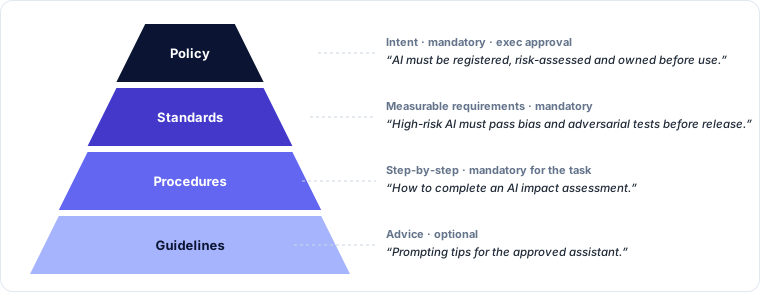
| Level | Purpose | Mandatory? | AI example |
|---|---|---|---|
| Policy | Management intent and principles | Yes | "AI systems must be registered, risk-assessed and owned before use" |
| Standard | Specific, measurable requirements that implement the policy | Yes | "High-risk AI must pass bias and adversarial testing before release" |
| Procedure | Step-by-step instructions | Yes, for those doing the task | "How to complete an AI impact assessment" |
| Guideline | Recommended practice and advice | No | "Prompting tips for staff using the approved assistant" |
2. What an enterprise AI policy should cover
A good AI policy is short — often two to four pages — and points to standards for detail. Typical sections:
- Scope and definitions — what counts as an AI system (include GenAI tools, embedded vendor AI and agents).
- Principles — the organisation's responsible-AI commitments.
- Roles and accountability — owners, committee, second-line oversight.
- Acceptable use — approved tools, prohibited uses (for example entering confidential data into unapproved public chatbots), and rules for AI-generated content.
- Lifecycle requirements — registration, risk tiering, impact assessment, testing, approval, monitoring, retirement.
- Data requirements — classification limits, privacy, IP and consent.
- Security requirements — reference to AI security standards.
- Third-party AI — procurement and due diligence.
- Transparency and human oversight — disclosure to users, override authority.
- Exceptions, enforcement and review — how exceptions are approved and recorded; review cycle.
Supporting standards typically include: AI security, AI data management, model development and validation, GenAI acceptable use, AI procurement, and agent/tool permissions.
3. The AI use-case inventory
You cannot govern what you cannot see. A centralised AI use-case inventory (sometimes called an AI register) records every AI system in use or in development, including AI bought from vendors and AI features switched on inside existing software.
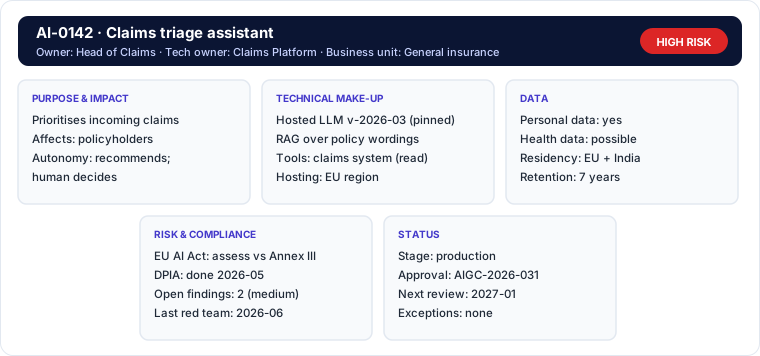
Core fields:
- Identity — ID, name, business owner, technical owner, business unit.
- Purpose and impact — intended use, users, affected people, decisions influenced, degree of autonomy.
- Technical make-up — model(s) and versions, provider, hosting, data sources, tools and integrations.
- Data — personal or sensitive data involved, data residency.
- Risk — risk tier, regulatory classification (e.g. EU AI Act tier), assessment dates, open findings.
- Status — lifecycle stage, approval reference, next review date, exceptions.
Why the inventory matters for security: it is your AI asset register. It tells you which systems an advisory about a model or library affects, which agents hold which tool permissions, and who to call during an incident.
4. Intake and triage
The inventory is populated through an intake workflow that starts as soon as someone proposes a use case.
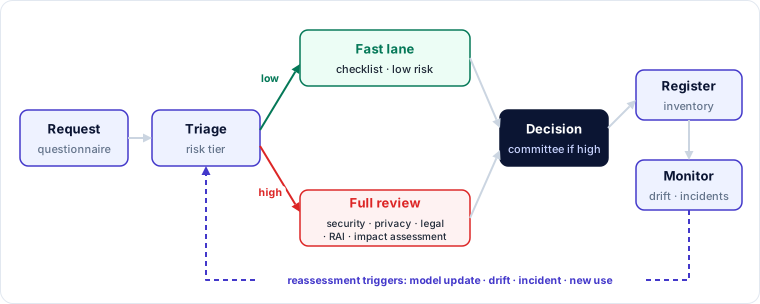
- Request — a short questionnaire: purpose, data, users, autonomy, vendor.
- Triage — answers drive an initial risk tier (for example low, medium, high, prohibited).
- Review — depth depends on tier: low-risk gets a checklist; high-risk gets security, privacy, legal and responsible-AI review plus an impact assessment.
- Decision — approve, approve with conditions, reject. High-risk decisions go to the committee.
- Register — the use case enters the inventory with its conditions and review date.
- Monitor — performance, drift, incidents and reassessment triggers.
Design for speed. If governance is slow for everything, people route around it and shadow AI grows. A fast lane for low-risk uses keeps the high-risk lane credible.
Worked example — triaging three requests in one week
| Request | Key answers | Tier and route |
|---|---|---|
| Marketing wants an approved GenAI tool to draft social posts | Public data only; human edits every post; no decisions about people | Low — fast lane, acceptable-use reminder, register |
| Operations wants an agent that can reorder stock automatically up to ₹5 lakh | Internal data; autonomous financial actions | Medium/high — security review of tool permissions, spend caps, HOTL monitoring |
| HR wants AI to rank job applicants | Personal data; significant effect on individuals; regulated as high-risk in the EU | High — full review, impact assessment, bias testing, HITL on every rejection, committee approval |
Takeaway: the questionnaire did the sorting. Only one of three requests needed the committee's time.
🔐 Security lens
Make inventory registration a precondition for things teams need — production credentials, API keys for model providers, budget codes. Controls attached to resources work better than policies people must remember.
Key takeaways
- Policy states intent; standards make it measurable; procedures say how; guidelines advise.
- A good AI policy covers scope, principles, roles, acceptable use, lifecycle, data, security, third parties, transparency and exceptions.
- The AI use-case inventory is the backbone of governance and doubles as the AI asset register for security.
- Intake questionnaires drive risk tiers; a fast lane for low-risk uses reduces shadow AI.
Self-check
- Which document would state "high-risk AI must pass adversarial testing before release": policy, standard or procedure?
- List four inventory fields that help during a security incident.
- Why can an over-cautious intake process increase risk?