
Accountability, oversight, auditing and awareness
In this lesson you will:
- Define intervention, override and sign-off authorities for AI systems
- Detect and manage shadow AI
- Identify the governance artefacts auditors expect
- Apply AI interaction labelling and synthetic-content disclosure
- Plan internal and external audits of AI systems
- Design role-based AI security training and measure its effectiveness
Principles and policies only matter if someone can stop a system, prove what it did, and find the AI nobody registered. This lesson covers the mechanisms that make accountability enforceable.
1. Human oversight with real authority
Module 1 introduced human-in-the-loop (HITL) and human-on-the-loop (HOTL) operation. Governance adds the question: who is allowed to do what?
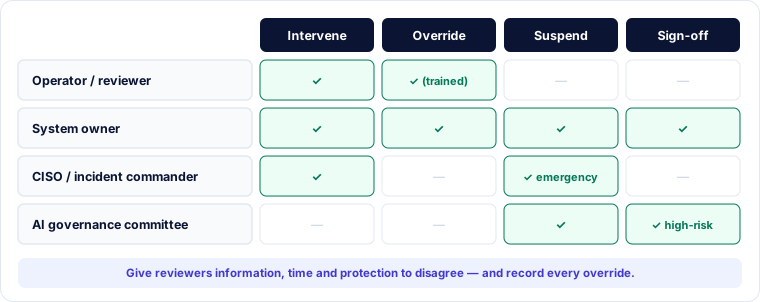
| Authority | Meaning | Typical holder |
|---|---|---|
| Intervene | Pause or correct an individual decision or action | Operator / reviewer on duty |
| Override | Replace the AI's decision with a human decision | Trained reviewer with domain authority |
| Suspend | Take the whole system out of service | System owner; CISO or incident commander in an emergency |
| Sign-off | Approve release, major change or risk acceptance | System owner plus committee for high-risk systems |
Good oversight design gives reviewers the information to judge (sources, confidence, reasons), the time to judge, the authority to disagree without penalty, and records of every override. Track the override rate: near zero can indicate automation bias, very high can indicate a poor model.
2. Shadow AI
Shadow AI is AI used without the organisation's knowledge or approval: staff pasting data into public chatbots, browser extensions with AI features, AI switched on inside a SaaS product, or teams calling model APIs with personal credit cards.
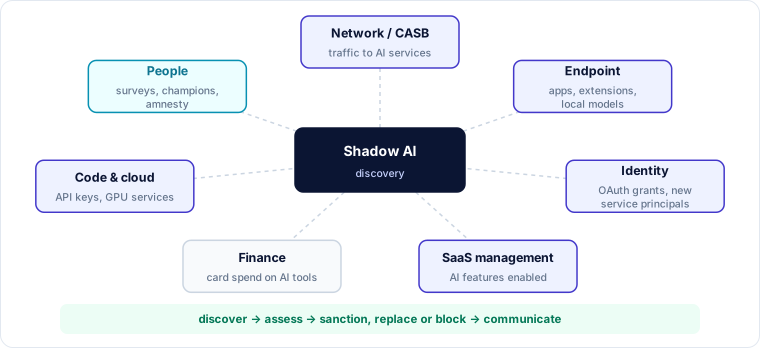
Detection sources
- Network / secure web gateway / CASB — traffic to known AI services and model APIs.
- Endpoint — installed AI apps, browser extensions, local model runtimes.
- Identity — OAuth grants to AI apps; new service principals calling model endpoints.
- SaaS management — AI features enabled in existing platforms.
- Finance — expense claims and card payments to AI vendors.
- Code and cloud — API keys for model providers in repositories; new GPU or AI services in cloud accounts.
- People — surveys, AI champions and amnesty programmes.
Management approach: discover → assess → decide (sanction, replace with an approved tool, or block) → communicate. Blocking alone pushes usage onto personal devices; providing an approved, safe alternative is the most effective control.
3. Governance artefacts
Auditors, regulators and incident responders all ask for evidence. Keep these artefacts for every material AI system:
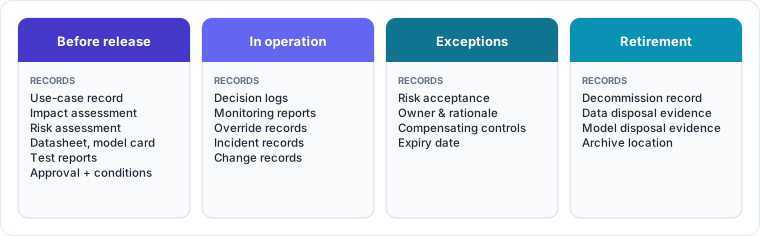
- Before release: use-case record, impact assessment, risk assessment, data documentation (datasheets), model card, test and evaluation reports, approval record with conditions.
- In operation: decision logs, monitoring reports, override records, incident records, change records.
- Exceptions: exception and risk-acceptance records with owner, rationale, compensating controls and expiry date.
- Retirement: decommissioning record, data and model disposal evidence.
4. AI interaction labelling and synthetic content
People should know when they are dealing with AI, and synthetic content should be identifiable.
- Interaction disclosure — tell users when they are talking to a chatbot or agent, unless obvious from context.
- Synthetic content labelling — mark AI-generated or manipulated images, audio, video and text, both visibly and in machine-readable form.
- Deepfake disclosure — disclose when realistic content depicting real people or events has been generated or altered.
- Provenance — content credentials standards (such as C2PA) attach signed metadata describing how content was created and edited; watermarking embeds signals in the content itself.
The EU AI Act imposes these transparency duties on providers and deployers, and they are good practice everywhere. Labels can be stripped and watermarks degraded, so treat them as one layer, not proof.
5. Auditing AI
| Audit type | Focus | Who |
|---|---|---|
| Compliance audit | Conformance with policy, law and standards (e.g. ISO/IEC 42001 certification) | Internal audit; certification bodies; regulators |
| Bias / fairness audit | Outcomes across groups; fairness metrics; mitigation evidence | Internal specialists or independent auditors |
| Drift and performance audit | Whether the system still meets its accuracy and reliability thresholds | Second line, model risk management |
| Security audit / assessment | Controls, configuration, testing results, red-team findings | Security assurance, external testers |
| Business outcome audit | Whether the system delivers the benefits claimed and at acceptable cost | Internal audit, finance |
Auditing AI depends on the artefacts above. If there are no decision logs, there is nothing to audit.
6. AI security education and awareness
Training should match role and risk.
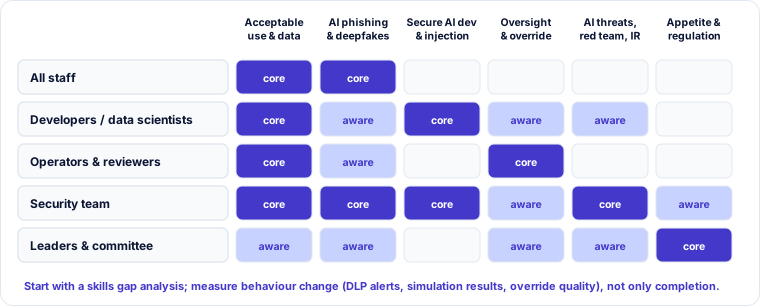
| Audience | Focus |
|---|---|
| All staff | Approved tools, what data not to share, recognising AI-enabled phishing and deepfakes, reporting concerns |
| Developers and data scientists | Secure AI development, prompt injection, data handling, supply chain, evaluation |
| Operators and reviewers | Oversight duties, automation bias, when and how to override, escalation |
| Security teams | AI threat modelling, red teaming, AI telemetry and incident response |
| Leaders and committee members | AI risk appetite, regulation, reading AI risk reports |
Start with a skills assessment and gap analysis: what does each role need to know, and what do they know today?
Measuring effectiveness — go beyond completion rates:
- Assessment scores before and after training.
- Behaviour: fewer DLP alerts for data pasted into unapproved AI tools; more shadow-AI self-reports.
- Simulation results: deepfake-voice or AI-phishing exercise outcomes.
- Oversight quality: override rates and review times in HITL processes.
- Culture: survey results on willingness to raise AI concerns.
Worked example — a shadow AI discovery sprint
A consulting firm runs a four-week shadow AI discovery.
| Signal | Finding |
|---|---|
| Web gateway logs | 1,400 staff used three public chatbots in a month |
| OAuth grants | 62 staff connected an AI meeting-notes app to their calendars and mailboxes |
| Expense claims | Four teams paid for AI coding assistants on cards |
| Survey and amnesty | Two client-facing teams built small GPT-based tools on personal accounts |
Response: an approved enterprise assistant (with data-protection terms and logging) was rolled out in two weeks; the meeting-notes app's OAuth grants were revoked and an approved alternative offered; coding assistants were moved to an enterprise licence; the two client tools were registered and reviewed. Public chatbots were then blocked for corporate data via DLP, with a link to the approved tool in the block message.
Takeaway: discovery plus a better approved option reduced risk faster than blocking alone would have.
🔐 Security lens
Your existing tooling — web gateway, CASB, DLP, identity governance, SIEM — already sees most shadow AI. Add AI-service categories and alerts to those tools before buying anything new.
Key takeaways
- Define intervene, override, suspend and sign-off authorities in advance; give reviewers information, time and protection.
- Find shadow AI through network, endpoint, identity, SaaS, finance, code and people signals — then offer a safe alternative.
- Keep governance artefacts across the lifecycle; without them, audits and investigations fail.
- Label AI interactions and synthetic content; use provenance and watermarking as layers, not proof.
- Train by role, start from a skills gap analysis, and measure behaviour, not just completion.
Self-check
- What does a near-zero override rate in a HITL process suggest?
- Name four signals that could reveal shadow AI.
- Give two measures of training effectiveness that are better than completion rates.