
The regulatory and standards landscape
In this lesson you will:
- Describe the EU AI Act's risk-based approach, roles and key dates
- Explain the NIST AI Risk Management Framework's four functions
- Describe ISO/IEC 42001 and how an AI management system fits with an ISMS
- Relate GDPR and India's DPDP Act to AI processing of personal data
- Summarise India's AI Governance Guidelines and their principles
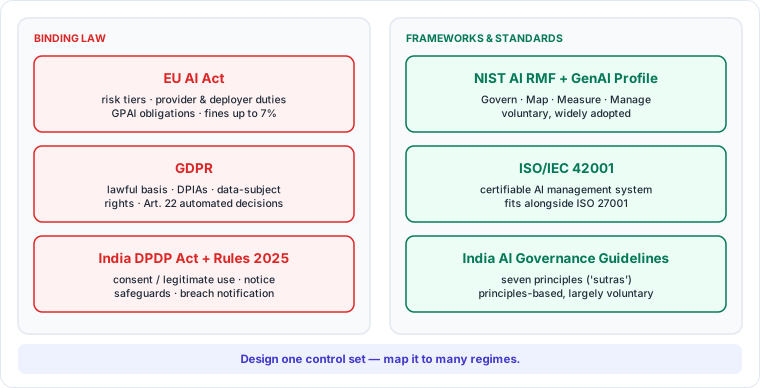
AI is regulated through a mix of AI-specific law, existing law that already applies (data protection, consumer protection, anti-discrimination, sector rules) and voluntary standards and frameworks. Security and risk professionals need to know what each one asks for, because many requirements become controls you will design or test.
Laws and their timelines change. The dates below reflect the position at the time of writing (late 2026). Always check official sources before relying on a specific date or threshold.
1. The EU AI Act
The EU Artificial Intelligence Act (Regulation (EU) 2024/1689) is the first comprehensive horizontal AI law. It entered into force on 1 August 2024 and applies in stages. It reaches beyond the EU: it applies to providers placing AI systems on the EU market and to deployers whose AI output is used in the EU, wherever they are based.
A risk-based approach
| Tier | Examples | Consequence |
|---|---|---|
| Unacceptable risk | Social scoring by public authorities, manipulative techniques causing harm, untargeted scraping of facial images, emotion recognition at work or school (with narrow exceptions), certain real-time remote biometric identification | Prohibited |
| High risk | AI as a safety component of regulated products (Annex I); AI used in areas listed in Annex III such as employment, education, credit scoring, essential services, law enforcement, migration, justice and critical infrastructure | Strict obligations before and after market entry |
| Transparency risk | Chatbots, emotion recognition, deepfakes and other synthetic content | Disclosure and labelling duties |
| Minimal risk | Spam filters, AI in video games, most internal productivity uses | No new obligations; voluntary codes encouraged |
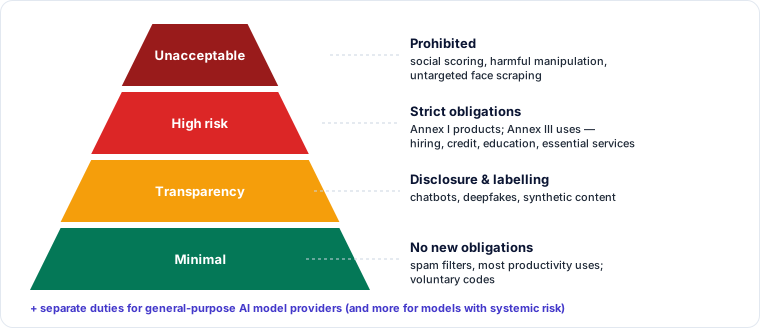
General-purpose AI (GPAI) models — large foundation models — have their own obligations for providers: technical documentation, information for downstream providers, a copyright policy and a summary of training content. Models with systemic risk (very high training compute or designated by the Commission) must also evaluate and mitigate systemic risks, report serious incidents and ensure adequate cybersecurity.
Roles
- Provider — develops an AI system or has one developed, and places it on the market under its own name.
- Deployer — uses an AI system under its authority in a professional context.
- Importer and distributor — bring systems into or make them available on the EU market.
A deployer that substantially modifies a high-risk system, or puts its own name on it, can become a provider and inherit provider obligations.
High-risk obligations (summary)
Providers must operate a risk management system across the lifecycle; apply data governance to training, validation and test data; maintain technical documentation and automatic logging; provide transparency and instructions for use; design for human oversight; achieve appropriate accuracy, robustness and cybersecurity; run a quality management system; complete a conformity assessment; and register the system. Deployers must use the system according to instructions, assign competent human oversight, monitor operation, keep logs, inform affected workers and, in some cases, perform a fundamental rights impact assessment.
The Act explicitly names AI-specific attacks the cybersecurity requirement must address: data poisoning, model poisoning, adversarial examples and model evasion, confidentiality attacks and model flaws.
Key dates
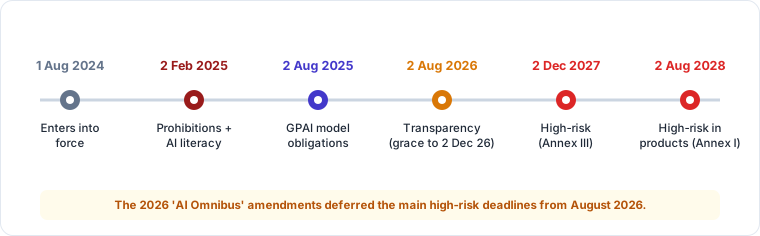
- 2 February 2025 — prohibitions and AI literacy provisions apply.
- 2 August 2025 — GPAI model obligations and governance/penalty provisions apply.
- 2 August 2026 — transparency obligations apply (with a grace period to 2 December 2026 for systems already on the market).
- 2 December 2027 — obligations for stand-alone high-risk systems (Annex III), as deferred by the 2026 amendments.
- 2 August 2028 — obligations for high-risk AI embedded in regulated products (Annex I).
The 2026 amendments also softened the AI literacy duty into an obligation to take measures to support staff literacy, permitted limited processing of special-category data for bias detection with safeguards, and added a prohibition on systems designed to generate non-consensual intimate imagery or child sexual abuse material.
Penalties
Fines are tiered: up to €35 million or 7% of worldwide annual turnover for prohibited practices; up to €15 million or 3% for most other breaches; up to €7.5 million or 1% for supplying incorrect information to authorities. Lower caps apply to SMEs.
2. NIST AI Risk Management Framework
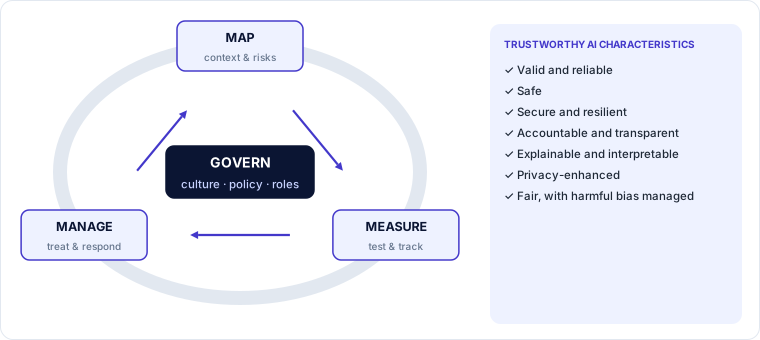
The NIST AI RMF 1.0 (January 2023) is a voluntary US framework, widely used internationally. It defines characteristics of trustworthy AI — valid and reliable; safe; secure and resilient; accountable and transparent; explainable and interpretable; privacy-enhanced; and fair with harmful bias managed — and organises activity into four functions:
| Function | Purpose | Typical outputs |
|---|---|---|
| Govern | Culture, policies, roles and accountability — applies across all other functions | AI policy, roles, risk tolerance, training |
| Map | Establish context and identify risks for a specific system | Intended use, stakeholders, impact, risk inventory |
| Measure | Analyse, assess and track risks with qualitative and quantitative methods | Test results, metrics, evaluations |
| Manage | Prioritise and act on risks; respond and recover | Risk treatment, monitoring, incident response |
NIST also publishes a Generative AI Profile (NIST AI 600-1, July 2024) that maps GenAI-specific risks — such as confabulation, information integrity, data privacy and information security — to suggested actions.
3. ISO/IEC 42001 — AI management systems
ISO/IEC 42001:2023 specifies requirements for an AI management system (AIMS). Like ISO/IEC 27001 for information security, it is certifiable and follows the familiar management-system structure: context, leadership, planning, support, operation, performance evaluation and improvement (Plan-Do-Check-Act). Annex A lists AI-specific controls, including AI policy, roles, resources, AI system impact assessment, data management, lifecycle processes, information for interested parties, use of AI systems and third-party relationships.
Related standards include ISO/IEC 23894 (AI risk management guidance), ISO/IEC 42005 (AI system impact assessment) and ISO/IEC 22989 (AI concepts and terminology).
Practical tip: if you already run an ISO 27001 ISMS, build the AIMS alongside it. The structure, internal audit, management review and document control can be shared; the AI-specific parts are the impact assessments, data and lifecycle controls.
4. Data protection law: GDPR and India's DPDP Act
Whenever AI processes personal data, data protection law applies — before, during and after training.
GDPR (EU) brings: lawful basis for each processing purpose; purpose limitation and data minimisation; transparency; data-subject rights including access, erasure and objection; data protection impact assessments (DPIAs) for high-risk processing; and Article 22 rights concerning decisions based solely on automated processing with legal or similarly significant effects, including the right to human intervention and to contest the decision.
India's Digital Personal Data Protection Act, 2023, with the DPDP Rules, 2025 (notified in November 2025 and phased in over about 18 months), requires: consent or a recognised legitimate use; clear notice; reasonable security safeguards; breach notification to the Data Protection Board and affected individuals; erasure when the purpose is served; and verifiable parental consent for children's data. Significant Data Fiduciaries carry extra duties, including periodic data protection impact assessments, audits and due diligence that algorithmic software does not pose a risk to the rights of Data Principals. Penalties can reach ₹250 crore per breach.
5. India's AI Governance Guidelines
In November 2025 India's Ministry of Electronics and IT (MeitY) published the India AI Governance Guidelines. They favour a principles-based, innovation-friendly approach over a new AI-specific law, relying on existing laws (IT Act, DPDP Act, consumer and sectoral rules) and voluntary measures. They set out seven guiding principles ("sutras"): trust; people first; innovation over restraint; fairness and equity; accountability; understandable by design; and safety, resilience and sustainability — and recommend institutions such as an AI Governance Group for coordinated oversight. Sector regulators (for example in finance) may still issue binding AI-specific expectations.
Worked example — mapping one system to several regimes
An Indian HR-tech company sells a CV-screening model to employers in India and the EU.
| Question | Answer |
|---|---|
| EU AI Act tier? | High risk — recruitment and selection is listed in Annex III |
| Its role? | Provider (it develops the system and sells it under its own name) |
| Its EU customers' role? | Deployers — they must ensure human oversight, monitor use and inform candidates |
| Data protection? | GDPR for EU candidates (lawful basis, DPIA, Article 22 safeguards); DPDP Act for Indian candidates (notice, consent or legitimate use, security safeguards) |
| Useful voluntary frameworks? | NIST AI RMF to structure risk work; ISO/IEC 42001 if customers want certified assurance |
Takeaway: one product, several overlapping obligations. A single control set — documented data governance, bias testing, logging, human review, security testing — can satisfy most of them if it is designed once and mapped many times.
🔐 Security lens
Several regimes demand "appropriate cybersecurity" for AI without saying what that is. Your threat models, adversarial tests and monitoring evidence are what turn that phrase into something an auditor or regulator can verify.
Key takeaways
- The EU AI Act is risk-based: prohibited, high-risk, transparency and minimal tiers, plus duties for general-purpose AI model providers.
- Provider and deployer obligations differ; modifying a high-risk system can make a deployer a provider.
- After the 2026 amendments, stand-alone high-risk obligations apply from 2 December 2027 and product-embedded ones from 2 August 2028.
- NIST AI RMF: Govern, Map, Measure, Manage. ISO/IEC 42001: a certifiable AI management system that fits alongside ISO 27001.
- GDPR and the DPDP Act apply whenever AI touches personal data; India's AI Governance Guidelines are principles-based and largely voluntary.
Self-check
- A bank in Pune uses a third-party credit-scoring model for EU customers. What is the bank's role under the EU AI Act, and what tier is the system?
- Which NIST AI RMF function covers setting the organisation's AI risk tolerance?
- Name two parts of an existing ISO 27001 ISMS you could reuse for an ISO/IEC 42001 AIMS.