
Why AI governance is different — and who owns it
In this lesson you will:
- Explain how AI governance differs from traditional IT governance
- Describe the main AI governance roles, including Chief AI Officer, AI ethics officer and AI champions
- Apply the three lines model to AI
- Choose a governance operating model that fits an organisation's size and maturity
Most organisations already have IT governance: change boards, architecture reviews, security sign-off, vendor management. It is tempting to push AI through the same gates. That catches some risks but misses the ones that make AI different. This lesson explains what changes and who should own it.
1. What makes AI governance different
Traditional IT governance assumes systems are deterministic: given the same input, the software does the same thing, and testing before release tells you how it will behave. AI breaks several of those assumptions.
| Dimension | Traditional IT | AI systems |
|---|---|---|
| Behaviour | Defined by code; predictable | Learned from data; probabilistic and sometimes surprising |
| Change | Changes when code is deployed | Changes when data, prompts, models or providers change — sometimes silently |
| Testing | Pass/fail against a specification | Statistical — measured across many inputs, never exhaustively |
| Failure mode | Crashes, errors, outages | Confident wrong answers, bias, manipulation, unsafe actions |
| Accountability | Clear owner of the code | Spread across data owners, model providers, deployers and users |
| Ethics & rights | Rarely central | Fairness, transparency and human rights often central |
| Regulation | Mostly sector and data law | Plus AI-specific law (e.g. EU AI Act) and standards |
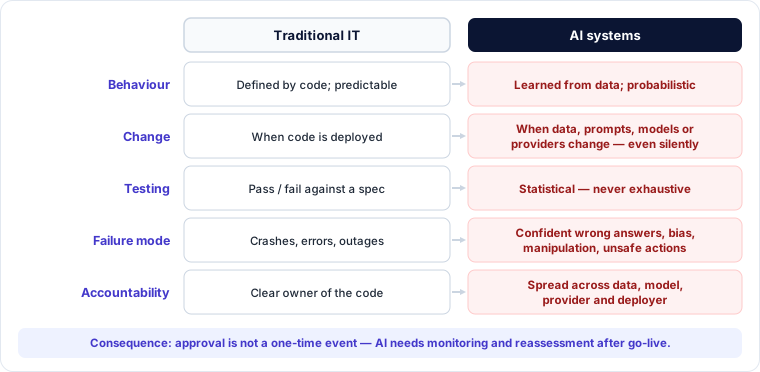
Three consequences follow:
- Approval is not a one-time event. An AI system needs ongoing monitoring and reassessment, because its behaviour can drift after go-live.
- The data is part of the system. Governance must cover training data, retrieval sources and prompts, not just code.
- Impact on people is a first-class risk. A model that is secure and available can still be unfair, opaque or harmful.
2. Roles in AI governance
There is no single standard organisation chart, but the same responsibilities recur.
| Role | Main responsibility |
|---|---|
| Board / executive committee | Sets AI risk appetite and strategy; receives reporting on significant AI risks |
| Chief AI Officer (CAIO) or equivalent | Owns the AI strategy and governance programme; chairs or sponsors the AI governance committee |
| AI governance committee / council | Cross-functional body that approves high-risk use cases, policies and exceptions |
| AI ethics officer / responsible AI lead | Champions responsible-AI principles; reviews fairness, transparency and societal impact |
| CISO / security team | AI security requirements, threat modelling, testing, monitoring and incident response |
| DPO / privacy office | Lawful basis, data minimisation, impact assessments, data-subject rights |
| Legal and compliance | Regulatory mapping, contracts, IP, liability |
| Model / system owner | Accountable for a specific AI system's performance and risk in production |
| Data owner / steward | Accountable for the data used to train, ground or evaluate the system |
| AI champions | Trained staff embedded in business units who spread good practice and spot shadow AI |
| Internal audit | Independent assurance that the governance framework works |
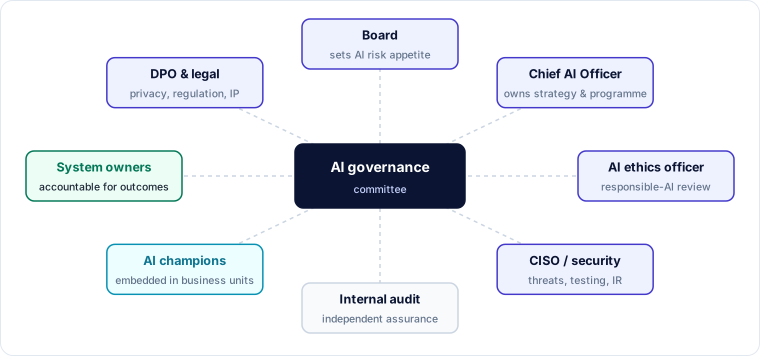
Key principle: accountability for an AI system's outcomes sits with the business owner who uses it, not with the data scientists who built it or the vendor who supplied it. The governance function supports and challenges; it does not own every risk.
3. The three lines model applied to AI
The familiar three lines model still works:
- First line — own and manage risk. Business owners, product teams, data scientists and engineers who build and run AI systems. They perform impact assessments, implement controls and monitor performance.
- Second line — oversee and challenge. Risk management, security, privacy, compliance and the responsible-AI function. They set policy, define risk tiers, review high-risk use cases and monitor the portfolio.
- Third line — independent assurance. Internal audit tests whether the framework is designed well and operating effectively, and reports to the audit committee.
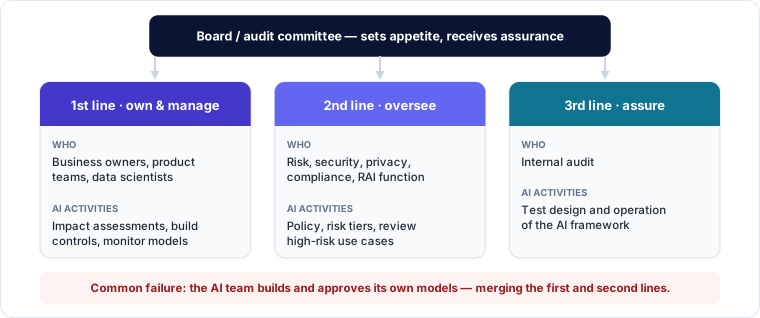
A common failure is letting the AI centre of excellence act as both builder and approver. That merges the first and second lines and removes challenge.
4. Operating models
| Model | How it works | Suits |
|---|---|---|
| Centralised | One central team builds, approves and runs AI | Early adopters, smaller firms, highly regulated pilots |
| Federated (hub and spoke) | Central hub sets policy, standards and tooling; business units build within guardrails | Most mid-to-large organisations |
| Decentralised | Business units act independently with light central coordination | Rarely appropriate for material AI risk |
Most organisations settle on hub and spoke: a small central governance team, a cross-functional committee for high-risk decisions, and AI champions in each business unit.
Worked example — fixing a governance set-up at a mid-sized insurer
An insurer's data-science team has built eight models in two years. The same team selects use cases, builds models, tests them and signs them off. There is no inventory, and the CISO learned about a claims-triage chatbot from a customer complaint.
| Problem | Fix |
|---|---|
| Builders approve their own work | Create an AI governance committee (risk, security, privacy, legal, business) to approve high-risk use cases |
| No one knows what AI is in use | Stand up a use-case inventory; make registration a condition of production access and budget |
| Security finds AI by accident | Add AI to the architecture-review and change gates, triggered by a simple intake questionnaire |
| Business units feel governance is a blocker | Train one AI champion per business unit; publish a fast lane for low-risk use cases |
Result: the data-science team stays the first line, risk and security become a genuine second line, and internal audit can test the framework a year later.
🔐 Security lens
Security teams often assume AI is "just another application". Insist on three additions to your normal gates: a record in the AI use-case inventory, a risk tier that determines the depth of review, and a defined trigger for reassessment after go-live.
Key takeaways
- AI governance must handle probabilistic behaviour, silent change, data dependency and impact on people — gaps in traditional IT governance.
- Business owners are accountable for AI outcomes; the governance function sets rules and challenges.
- Apply the three lines model and keep builders separate from approvers.
- Hub-and-spoke is the most common operating model: central policy, distributed delivery, a committee for high-risk decisions.
Self-check
- Give two reasons why a one-time pre-release approval is insufficient for an AI system.
- Why should the team that builds a high-risk model not be the team that approves it?
- What does an AI champion contribute that a central governance team cannot?