Ready reckoner
Why AI governance is different
AI is probabilistic, changes silently (data, prompts, models, providers), is tested statistically, fails as confident wrong answers, bias or unsafe actions, and spreads accountability across data, model, provider and deployer. → Approval is never one-time: monitor and reassess.
Roles
| Role | Remember |
|---|---|
| Board | Sets AI risk appetite |
| Chief AI Officer | Owns strategy and programme |
| AI governance committee | Approves high-risk use cases, policies, exceptions |
| AI ethics officer | Responsible-AI review |
| System / business owner | Accountable for outcomes |
| AI champions | Embedded advocates; surface shadow AI |
| Internal audit | Independent assurance (3rd line) |
Three lines: own (builders, owners) · oversee (risk, security, privacy, RAI) · assure (audit). Never let builders approve themselves. Most firms run hub and spoke.
Laws and frameworks
| Instrument | Key points |
|---|---|
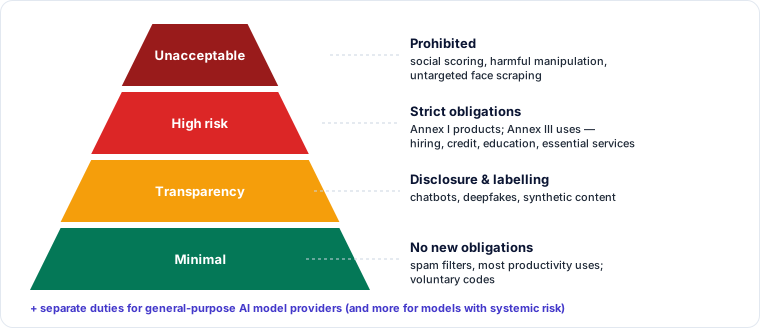
| EU AI Act | Tiers: prohibited · high · transparency · minimal. Provider vs deployer. GPAI duties. Fines €35m/7% · €15m/3% · €7.5m/1% |
| EU dates | Feb 2025 prohibitions · Aug 2025 GPAI · Aug 2026 transparency · Dec 2027 Annex III high-risk · Aug 2028 Annex I |
| NIST AI RMF | Govern (cross-cutting) · Map · Measure · Manage; GenAI Profile (AI 600-1) |
| ISO/IEC 42001 | Certifiable AI management system; PDCA; Annex A controls; pairs with ISO 27001 |
| GDPR | Lawful basis, DPIA, rights, Art. 22 automated decisions |
| DPDP Act + Rules 2025 | Consent / legitimate use, notice, safeguards, breach notification, erasure; SDFs do DPIAs and audits; up to ₹250 crore |
| India AI Governance Guidelines | Principles-based, largely voluntary; 7 sutras incl. trust, people first, accountability |
Modifying or rebranding a high-risk system can turn a deployer into a provider.
Policy hierarchy
Policy (intent) → Standard (measurable, mandatory) → Procedure (steps) → Guideline (advice).
Inventory and intake
- Inventory fields: identity · purpose & impact · technical make-up · data · risk · status. It is your AI asset register.
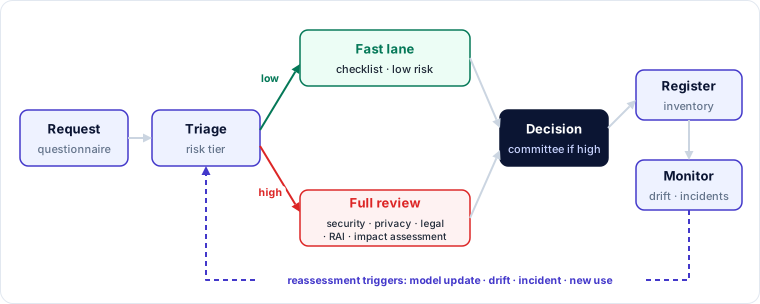
- Intake: request → triage (risk tier) → fast lane or full review → decision → register → monitor → reassess.
- Tie registration to credentials, API keys or budget. Slow-for-everything governance creates shadow AI.
Responsible AI
- Principles: fairness · reliability & safety · privacy & security · inclusiveness · transparency · accountability.
- Bias sources: historical · sampling · measurement · label · proxy · feedback loops. Removing the attribute ≠ fair.
- Disparate impact = lowest rate ÷ highest rate; < 0.8 flags concern.
- Equal opportunity = similar TPR for qualified people. Metrics can conflict → business + legal decision, documented.
- Transparency (openness) ≠ explainability (why this output) ≠ interpretability (how it works inside).
- Local explanations and counterfactuals for individuals; global importance for auditors.
Oversight, shadow AI, audit, training
- Authorities: intervene · override · suspend · sign-off — defined before go-live.
- Tiny override rate + fast reviews → automation bias.
- Shadow AI signals: network/CASB · endpoint · identity (OAuth) · SaaS · finance · code & cloud · people. Respond with an approved alternative, then restrict.
- Artefacts: impact & risk assessments, model cards, test reports, approvals, decision logs, overrides, exceptions (with expiry), disposal records.
- Labelling: disclose AI interaction; label synthetic content; C2PA + watermarks are layers, not proof.
- Training by role; measure behaviour, not completion.
Exam-day reflexes
- "Who is accountable?" → the business owner.
- "Builders approve their own model" → merged lines of defence.
- "Recruitment / credit scoring AI in the EU" → high risk.
- "Cross-cutting NIST function" → Govern.
- "First step for widespread unapproved chatbot use" → approved alternative, then restrict.
Visual summary